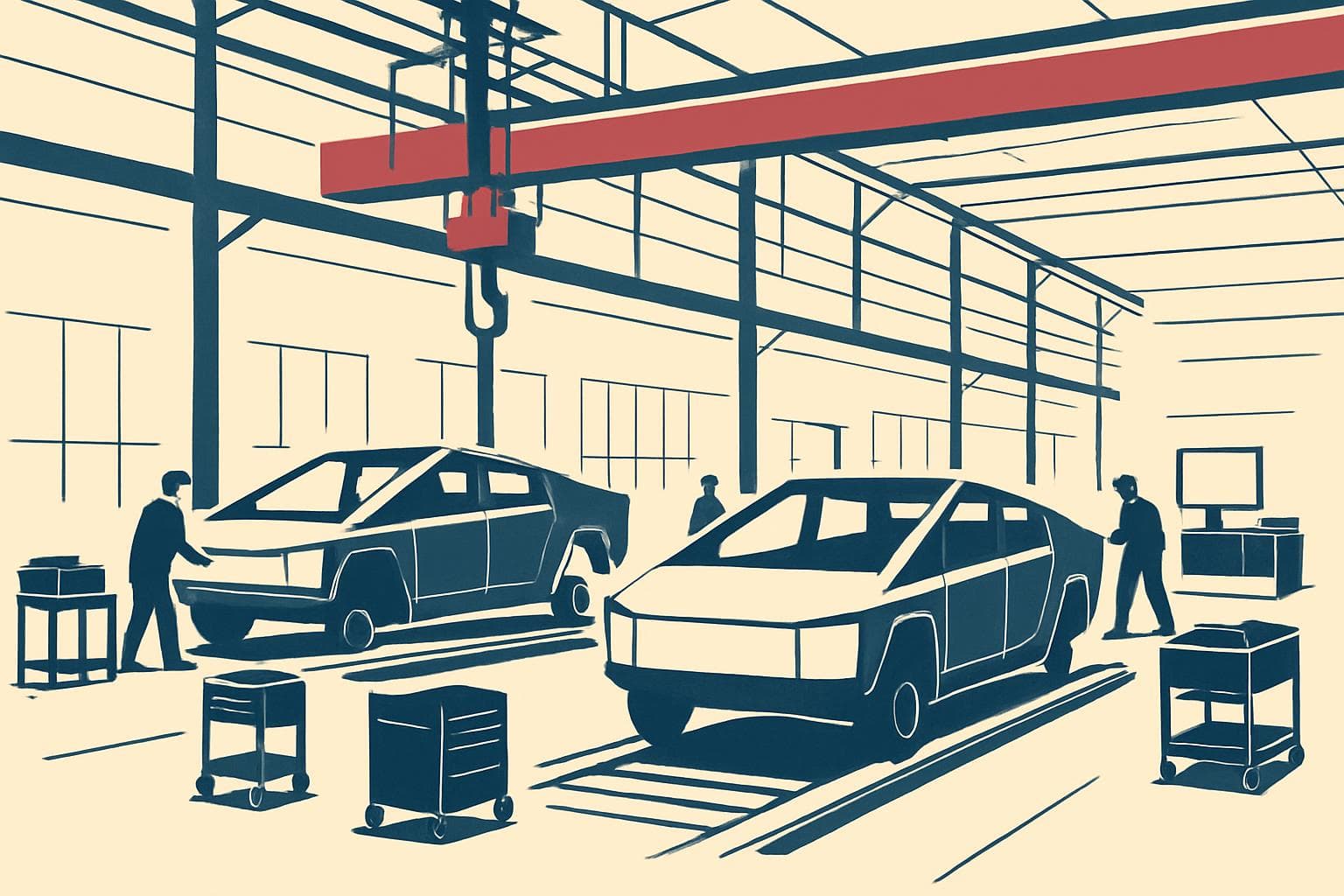
Elon Musk announced that Tesla will halt production of the Cybertruck at its Austin, Texas facility in mid-2027. The automaker plans to repurpose the freed manufacturing capacity to scale up production of its recently introduced autonomous-focused vehicle, the Cybercab.
Why the move?
According to Musk, demand for the Cybertruck has remained weak. Deliveries of the futuristic electric pickup began at the end of 2023, but sales have fallen far short of Tesla's earlier target of 250,000 units per year.
Kelley Blue Book data cited in reporting indicate Tesla sold 38,965 Cybertrucks in the United States in 2024, while "last year" the company reportedly sold 20,237 units — a decline the source characterizes as a 48 percent drop. (These are the figures provided by the cited data.)
Production constraints and relocation questions
In his post, Musk described the Cybertruck as an important model in Tesla's history and called the production halt the end of an era. He did not specify whether the model will be discontinued permanently or if assembly might later move to another plant; currently, the Austin facility is the only known site capable of producing the Cybertruck's specialized components.
International expansion was also limited by the vehicle's heavy, angular stainless-steel body, which prevented it from meeting pedestrian protection requirements and obtaining type approval in key markets such as Europe.
The Cybercab and Tesla's strategic shift
Tesla says it will use the freed capacity to accelerate production of the Cybercab. The Cybercab is central to Tesla's plan to shift from a traditional automaker toward a company focused on artificial intelligence and robotics. The vehicle is designed without a steering wheel, pedals or side mirrors, features butterfly doors, and is intended for use in a global robotaxi network.
Tesla has incorporated some technologies developed for the Cybertruck into the Cybercab. After years of delays, the company launched paid Cybercab rides with a small fleet in Austin in September of this year, but the U.S. National Highway Traffic Safety Administration (NHTSA) is currently reviewing whether Tesla has adequately demonstrated compliance with federal safety rules.
Industry reaction and context
The Cybertruck has been a polarizing model since its 2019 unveiling, which became infamous for a cracked demonstration window. Musk positioned the Cybertruck as a competitor to conventional pickups from manufacturers such as Ford and General Motors, but electric pickup trucks have generally failed to gain broad popularity among U.S. buyers, and rival models have also struggled.
Andy Palmer, former CEO of Aston Martin, told the reporting outlet that pausing production is a reasonable step if a model does not meet expectations.
What comes next?
Tesla intends to redeploy Austin's production capacity toward larger-scale Cybercab manufacturing, while ongoing regulatory review by the NHTSA and the lack of type approvals in markets like Europe will continue to affect the company's international prospects. Whether the Cybertruck will be discontinued permanently or reintroduced from another factory will depend on future decisions by Tesla.