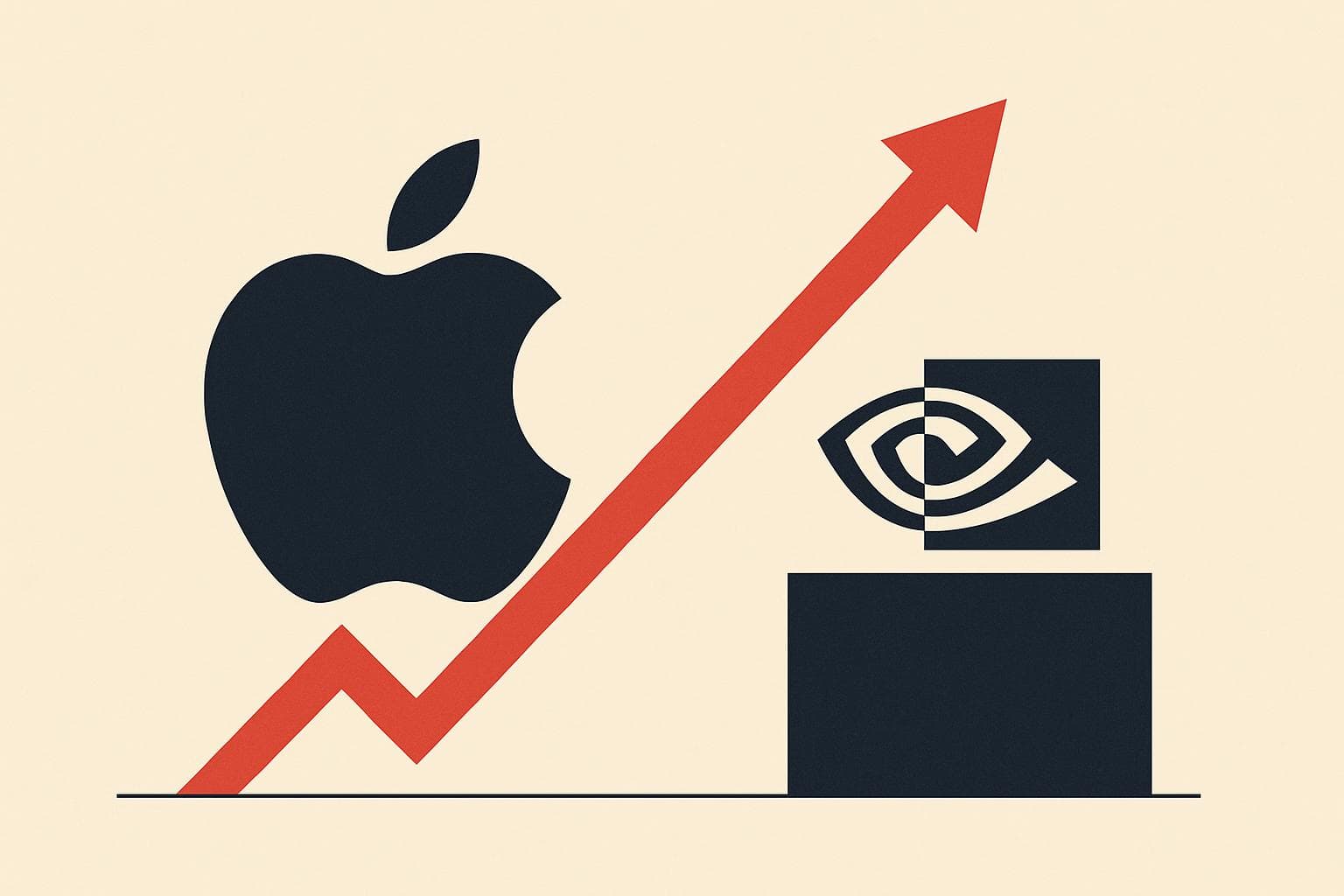
Apple Inc. regained the position of the world’s most valuable company from Nvidia Corporation on Monday, after Apple’s market capitalization at the close of trading exceeded Nvidia’s for the first time since April 2025, according to CNBC.
Market moves and valuations
- Nvidia shares fell about 5% on Monday, reducing the chipmaker’s market capitalization to roughly $4.77 trillion.
- Apple shares rose about 1%, lifting Apple’s market capitalization at the close to approximately $4.95 trillion.
Context and trends
Nvidia had led the rankings since June 2025, when it took the top spot from Microsoft, and briefly surpassed the $5 trillion mark in October 2025. So far in 2026, Nvidia’s stock has gained about 4% year-to-date, while Apple’s share price has risen roughly 24%.
Investors have rewarded Apple’s cautious approach to capital-intensive artificial intelligence projects: the company has favored leasing capacity over building large amounts of its own infrastructure, which has been viewed positively by the market.
At the same time, Nvidia’s revenues have been sharply rising for a third consecutive year thanks to explosive demand for AI. However, investor attention has increasingly shifted from graphics processing units (GPUs) toward memory chips and other data-center infrastructure — areas where companies such as Micron Technology, SK Hynix and SanDisk are also realizing substantial profits from the AI upswing.
Memory-chip shortage and cost effects
Apple is releasing its quarterly results on Thursday, and the report is expected to provide the first quantified assessment of the financial impact of the global memory-chip shortage driven by AI demand. That shortage already prompted Apple to raise prices on Mac and iPad devices in June.
Conclusion
Monday’s shift illustrates how changes in market sentiment and sectoral focus can quickly alter the relative rankings of the largest technology companies. Both Apple and Nvidia remain central players in the AI and chip markets, but future investor preferences and the cost of building infrastructure will be key factors shaping market capitalizations going forward.
This article does not constitute investment advice or a recommendation.