Debate about data centers has mainly focused on their large electricity and water use, but recent analyses highlight another environmental issue: the heat they release. Field measurements and satellite studies indicate that data centers can cause measurable local increases in air and surface temperatures.
Field measurements around Phoenix
This spring David Sailor and researchers at Arizona State University deployed car-mounted sensors with 0.1 °C accuracy at four data centers near Phoenix. Comparing upwind and downwind air temperatures, they reported in May that downwind areas were on average 0.7–0.9 °C warmer, with the largest observed difference reaching 2.2 °C. In some instances the excess heat could be detected up to 500 meters beyond the data center boundary.
At the CyrusOne complex in Chandler, for example, measurements on 18 June 2025 recorded 42.7 °C on the windward side and 43.5 °C in the residential area behind it, a 0.8 °C difference that persisted for roughly half a kilometre.
How much energy becomes heat?
The NTT PH1 data center’s IT equipment can draw up to 36 megawatts (MW). With a PUE (power usage effectiveness) around 1.3 — meaning each 1 MW of IT power requires an additional 0.3 MW for cooling and infrastructure — the total electrical demand is roughly 47 MW. Almost all of that consumed electricity eventually ends up as heat the cooling systems must expel to the environment.
The Chandler CyrusOne campus, with 169 MW of IT capacity, might require some 220 MW of total power — energetically comparable to more than 180,000 typical U.S. households — and releases that heat from a 34-hectare site.
Per-square-metre figures are striking: the average summer anthropogenic heat flux across Phoenix is about 13 W/m², with industrial areas peaking near 50 W/m². By contrast, a 36 MW data center can emit roughly 2,800–6,200 W/m² at roof or ground level, several times larger than peak midday solar input.
Cooling methods and direct air impacts
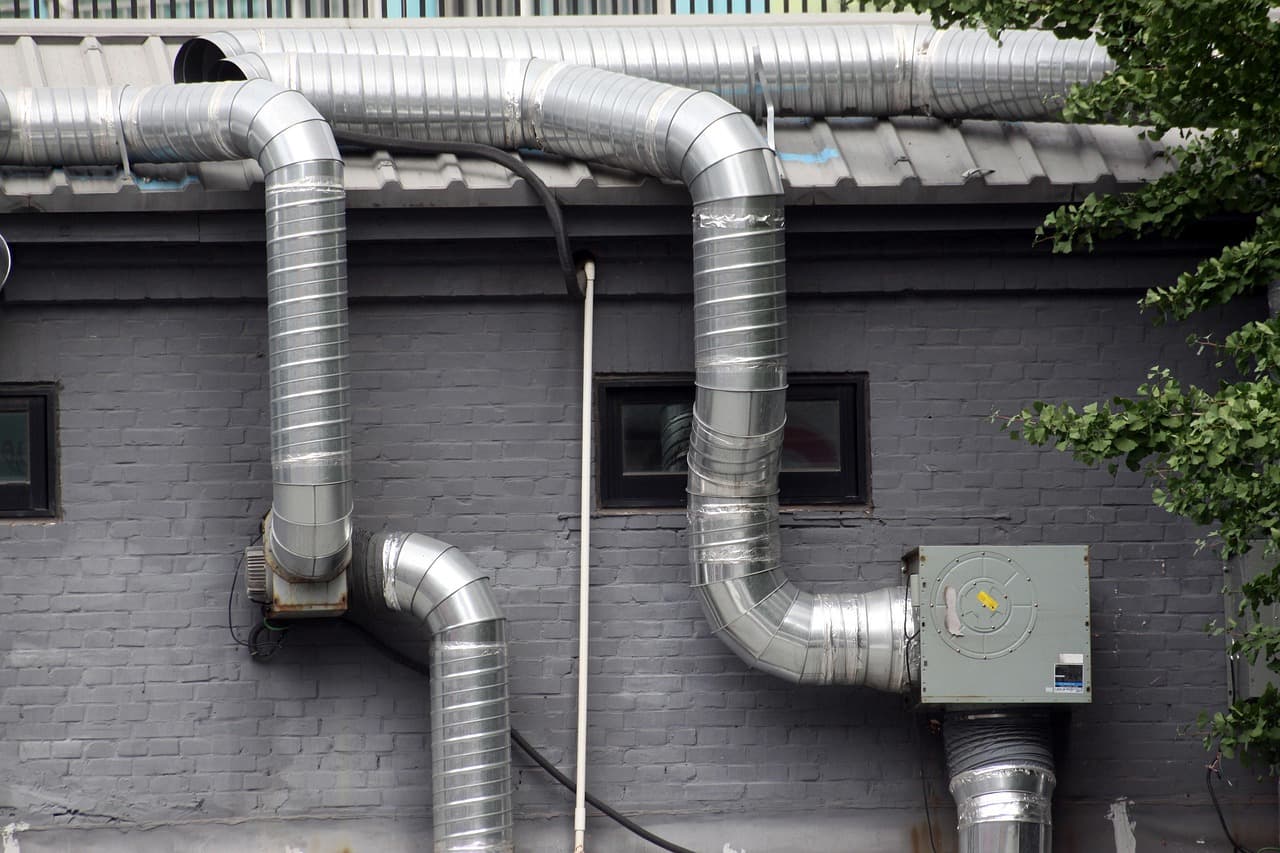
Some Phoenix facilities use air-cooled systems, which dump server heat directly into ambient air. Exhaust from condensers can be 8–14 °C warmer than surrounding air and, in extreme summer conditions, can exceed 50 °C. The wind-direction-consistent pattern of elevated temperatures observed in the field underlines the direct atmospheric effect of such waste heat.
Satellite analysis and the "data heat island" effect
A 2004–2024 satellite surface-temperature analysis by Andrea Marinoni (University of Cambridge) and an international team found that land surface temperatures around data centers rose on average by about 2 °C following facility commissioning. The researchers dubbed this pattern the "data heat island effect" and estimated that over 340 million people worldwide may live in regions where data centers contribute detectably to surface warming.
Surface temperature increases from satellites are influenced by pavement, roofs and vegetation loss, so they do not equate directly to air-temperature rises; the Phoenix fieldwork therefore provides important complementary evidence of atmospheric warming aligned with wind direction.
They don't create atmospheric heat domes, but can worsen conditions
A meteorological heat dome is a large, persistent high-pressure system covering hundreds or thousands of kilometres. There is no scientific evidence that individual data centers can generate or sustain such heat domes. However, models and local studies show that when winds are weak and the boundary layer is shallow, locally released heat disperses poorly and can produce larger local temperature anomalies.
A May modelling study in Geophysical Research Letters and a June study from Dhaka both indicate stronger night-time interactions: the Dhaka researchers found a daytime synergy of only 0.07 °C but a night-time excess of 1.28 °C, as urban surfaces release stored energy back to the atmosphere. Thus, data-center heat can be particularly consequential during hot, calm nights.
Energy, water and emissions risks
The International Energy Agency (IEA) estimated that data centers worldwide consumed roughly 485 TWh in 2025 and that consumption could rise to about 950 TWh by 2030 — around 3% of global electricity use. Between 2024 and 2030 overall data-center consumption could grow about 15% per year, while AI-accelerated server demand might increase about 30% annually. Approximately half of the growth could come from AI servers, and about one-fifth from cooling and other infrastructure.
This additional electricity must be generated somewhere, often with fossil fuels. The IEA projects that related CO2 emissions for data-center power could reach about 320 million tonnes by 2030. While roughly half of the incremental demand might be met by renewables, gas and coal together could still supply over 40%.
The European Commission aims to at least triple EU data-center capacity within five to seven years. A June energy-system modelling exercise suggested AI data centers could increase Europe’s annual electricity demand by 73–723 TWh by 2050, with some scenarios requiring up to 226 GW of new generation capacity; the study estimated 67–181 million tonnes of cumulative extra gas emissions between 2030 and 2050.
Water demand is another constraint. Zohar Barnett-Itzhaki (Ruppin Academic Center) estimated in Water Research that AI’s global water footprint could reach 4.2–6.6 billion m³ per year by 2027, noting that roughly two-thirds of data centers built after 2022 are sited in water-stressed regions.
Heat recovery potential and limitations
Waste heat can be reused: a May study examining 4,775 data centers and 57,547 wastewater treatment plants across 98 countries concluded that linking such infrastructures could annually save about 1.3 billion m³ of freshwater, avoid 84 million tonnes of CO2-equivalent emissions, and yield up to $95 billion in savings. In winter, data-center heat could supply district heating; in summer the same heat may be difficult to use beneficially, especially during urban heatwaves when demand for cooling is highest.
Why this matters for cities and planners
The key issue is not only whether data centers warm the planet at large, but where and when the enormous amounts of energy they consume are converted to heat, and who lives nearby. Locally concentrated waste heat is most problematic during hot, calm periods when cities already struggle to cool at night. Combined with rising electricity and water demands and remaining dependence on fossil generation in many regions, data-center expansion poses concrete urban and environmental planning challenges.
The research to date suggests policymakers, urban planners and data-center operators should account for local heat impacts, cooling technology choices, opportunities for heat reuse and energy-source emissions when siting and operating large-scale computing facilities.