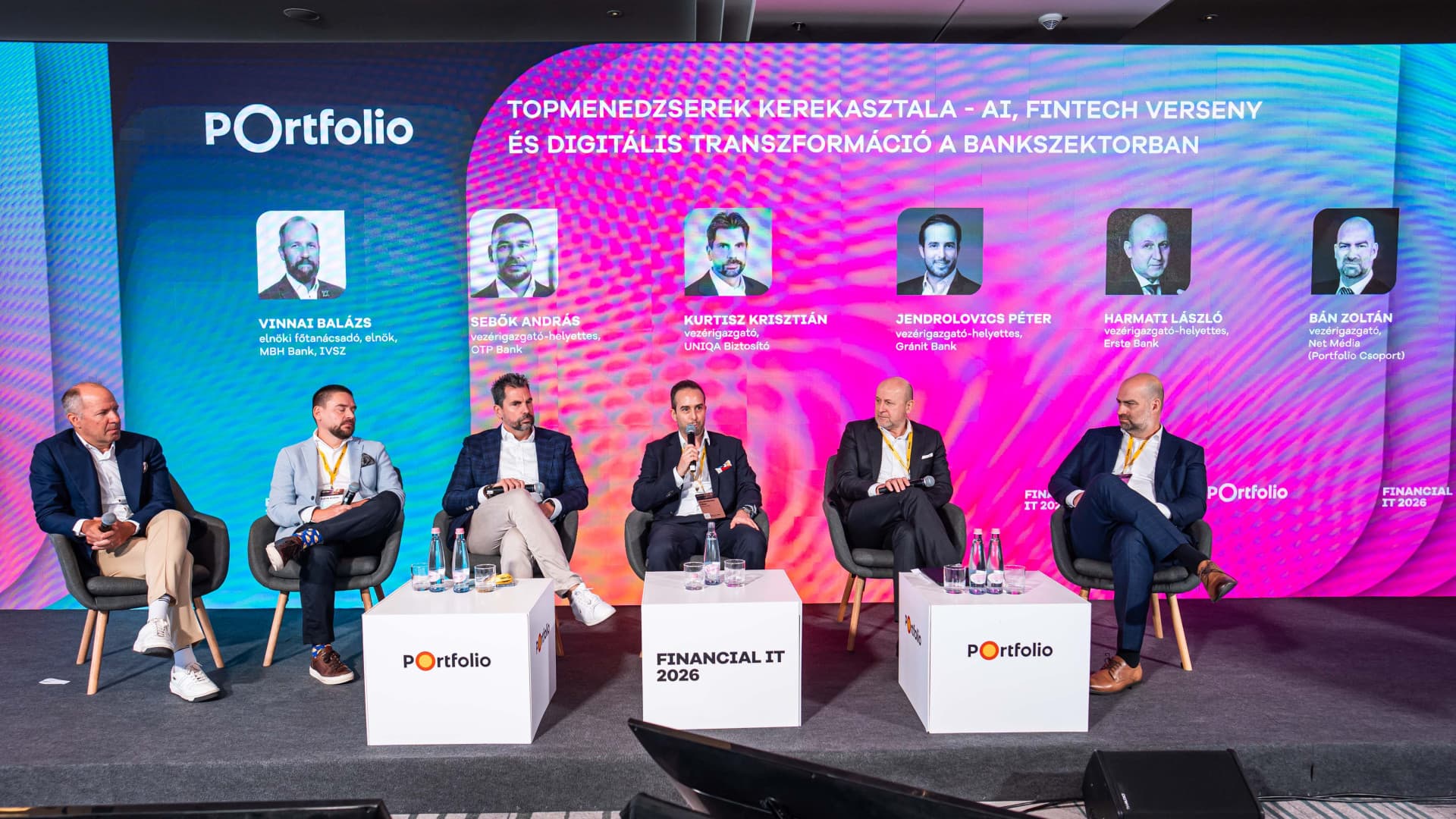
The spread of artificial intelligence (AI) in banking is irreversible, and while a dramatic sector‑wide efficiency breakthrough has not yet arrived, banking leaders said at Portfolio's Thursday Financial IT conference that AI is increasingly converting personnel expenses into IT capital and operating spending. The panel discussed where savings and efficiency gains are already visible and where challenges remain.
Competitive impact and rising transformational IT costs
Harmati László, Deputy CEO of Erste Bank, said AI use will be a major competitive factor in finance: as with earlier digital waves, the market will sort into leaders, followers and laggards. Transformational "change the bank" IT investments are growing far above inflation and are expected to continue doing so. At Erste, the balance of recent years has shifted 85–15 in favor of bank‑initiated developments over vendor‑initiated ones, and AI strengthens that trend. Harmati also noted that AI agents are spreading as an alternative to platform‑style agreements.
He pointed to competitor innovations such as OTP's P2P NFC payment as examples that could become sector‑level standards.
Resource shifts: concrete numbers and effects
Jendrolovics Péter, Deputy CEO of Gránit Bank, emphasized that a digital banking model already offers cost advantages over traditional models, and AI can be a differentiator. Gránit Bank's agentic chatbot can take over about 40% of human tasks. They have achieved a 70% reduction in document processing turnaround times and a 50% efficiency increase in lending back‑office processes through AI. Improving customer experience remains an ongoing objective.
Kurtisz Krisztián, CEO of Uniqa's insurance arm, said personnel costs currently account for roughly 50–60% of total expenditures, and AI is converting these into IT costs — though it is unclear how these line items will be labeled in the future. Uniqa's NiQa platform has already highly automated claims handling. Kurtisz argued that, over time, every service provider will resemble an IT company with an industry‑specific flavor, and suppliers with strong human business expertise will win.
Challenges: human expertise and regulation
Sebők András, Deputy CEO of OTP Bank, said they are aiming to hold IT spend steady for now, because their expenditures are at a peak as many systems are being replaced. Still, AI spending is steadily increasing. He warned that while the market has many self‑proclaimed experts, fewer firms can deliver solutions that meet the EU regulatory environment.
Vinnai Balázs, presidential chief advisor at MBH Bank and at IVSZ, said that to date it is not possible to demonstrate the level of efficiency gains from AI in proportional spend terms that banks expect. He quoted Jamie Dimon to stress that markets expect institutions to give prominence to AI in their reporting. Vinnai believes the key issue is whether there will be enough people who understand the business opportunities behind novel processes and developments.
Conclusions
The panel's consensus was that AI is shifting banks' cost structures away from personnel and toward IT. Which institutions become leaders will depend on both technological investment and business commitment, while human expertise and regulatory compliance will remain central to a successful AI transition.
Tags: banks, artificial intelligence, automation, Gránit Bank, OTP Bank, Erste Bank, MBH Bank, Uniqa, Harmati László, Jendrolovics Péter, Kurtisz Krisztián, Sebők András, Vinnai Balázs