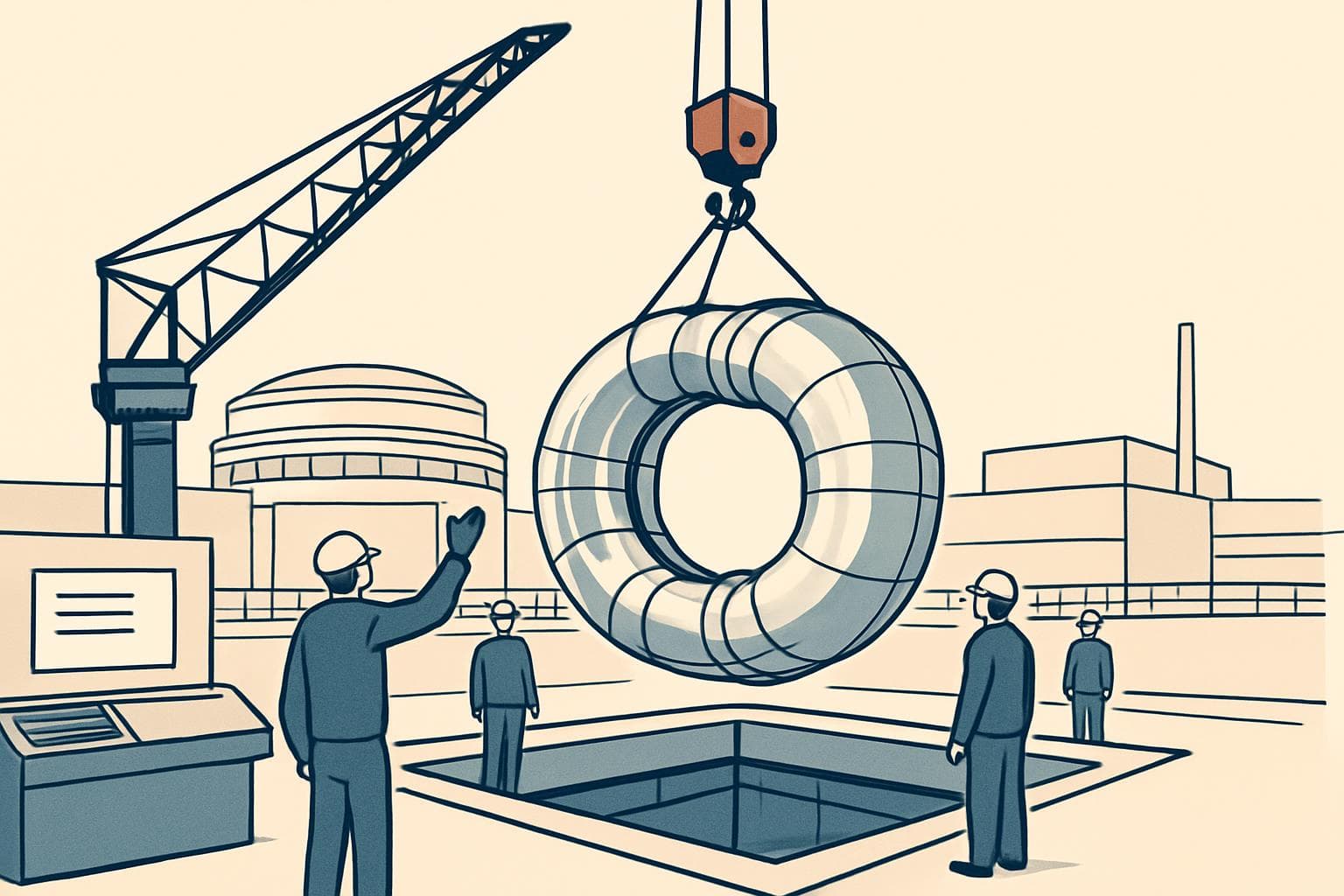
In recent years a series of scientific and engineering milestones have accelerated fusion power development. Key achievements — the net energy gain announced in December 2022, the Joint European Torus (JET) producing 69 megajoules in February 2024, South Korea’s KSTAR sustaining 100 million °C plasma for 100 seconds, and 2026 private- and lab-scale breakthroughs — have moved fusion closer to commercial use. Current expectations put pilot grid connections in the late 2020s–early 2030s, with broader industrial deployment in the 2040s and cost parity potentially between 2040 and 2045; mature, mass-produced technology could emerge around 2045–2050.
What happened and when
- December 2022: researchers overseas achieved a fusion reaction that produced more energy than was required to start it — a milestone demonstrating the physical feasibility of controlled fusion.
- February 2024: the Joint European Torus (JET) in the United Kingdom generated 69 megajoules from 0.2 milligrams of fuel, the largest fusion energy output achieved in a tokamak to date.
- 2024: South Korea’s KSTAR reactor maintained plasma at 100 million °C for 100 seconds, an important step for sustained, stable power operation.
- 2026: Helion Energy (United States) reached 150 million °C plasma temperature and produced measurable deuterium–tritium fusion — the first time a fully private-funded device achieved this level.
- October 2026: several additional milestones were announced, including a Princeton Plasma Physics Laboratory model that first heats then compresses plasma (reducing the energy needed to initiate fusion), and a Canadian–British mechanical compression experiment that exceeded the ~1 keV (~12 million °C) electron temperature threshold without high-cost lasers or superconducting magnets.
Why AI matters
Fusion plasmas are hotter and more turbulent than the solar core and can become unstable in milliseconds. Human operators and conventional control systems cannot reliably react on those timescales. Artificial intelligence can predict dangerous instabilities shortly before they occur — often less than one second in advance — and then adjust magnetic and heating systems in fractions of a second to prevent plasma collapse. AI is also used to map reactor blind spots, build digital twins and design new materials, all accelerating development cycles.
Government and industry strategies
- The U.S. Department of Energy (DOE) finalized a national Fusion Science and Technology Roadmap and launched the Genesis Mission, a government initiative using AI to improve plasma modelling and speed commercialization.
- Germany has launched government financing programmes to support fusion startups.
- Major tech companies and leaders, including Sam Altman (OpenAI) and Nvidia, are investing in fusion startups such as Helion Energy and Commonwealth Fusion Systems, in part because future AI and large-model computing demand could become a major customer for large-scale clean power.
The Helion Energy example
Helion Energy, supported by Sam Altman, has secured regulatory approvals for its Orion plant in Washington state and has a power purchase agreement with Microsoft. However, in September 2026 the company quietly postponed the commercial start it had earlier targeted for 2028, and now plans phased grid feeding and capacity increases in 2029–2030.
Commercialization timeline and costs
- Pilot grid connections: optimistic projections expect first experimental, grid-connected, commercially purposed reactors in the late 2020s–early 2030s.
- Pilot viability: the DOE targets pilot plant viability by the mid-2030s; the UK and Germany also plan initial grid reactors toward the late 2030s.
- Industrial scale-up and widespread deployment: global supply chains (for example, mining of rare earths for superconducting magnets and tritium production) are expected to mature around 2040–2045, enabling industrial series production. Expert estimates put the economic competitiveness (LCOE) emerging in 2040–2045; mature, mass-produced plants could deliver LCOE in the range of roughly 25–60 USD/MWh by 2045–2050.
National targets
- China’s national plan sets mass commercial deployment by 2050.
- South Korea similarly targets 2050 for widespread adoption.
Risks and prerequisites
Despite important technical and AI-driven advances, fusion’s potential to reshape the global energy system depends on long lead times for manufacturing and scaling, raw-material supply expansion, and the world’s ability to manage concurrent geopolitical, climate and technological risks. While first grid-connected fusion electricity could appear by the late 2020s–early 2030s, cost-effective, ubiquitous fusion power in everyday life is unlikely before the 2040s.
Event note: Portfolio Investment Day 2026
The article mentions Portfolio Investment Day 2026 on 21 October 2026, where leading market experts will discuss investor-relevant topics including AI and energy-sector outlooks.
Conclusion
Recent experiments and engineering progress — supported increasingly by AI and coordinated government and private strategies — make fusion power a credible mid-term prospect. Nonetheless, achieving mass-market, low-cost fusion will require decades of industrial expansion and supply-chain development before its transformative societal and geopolitical effects can be widely realized.