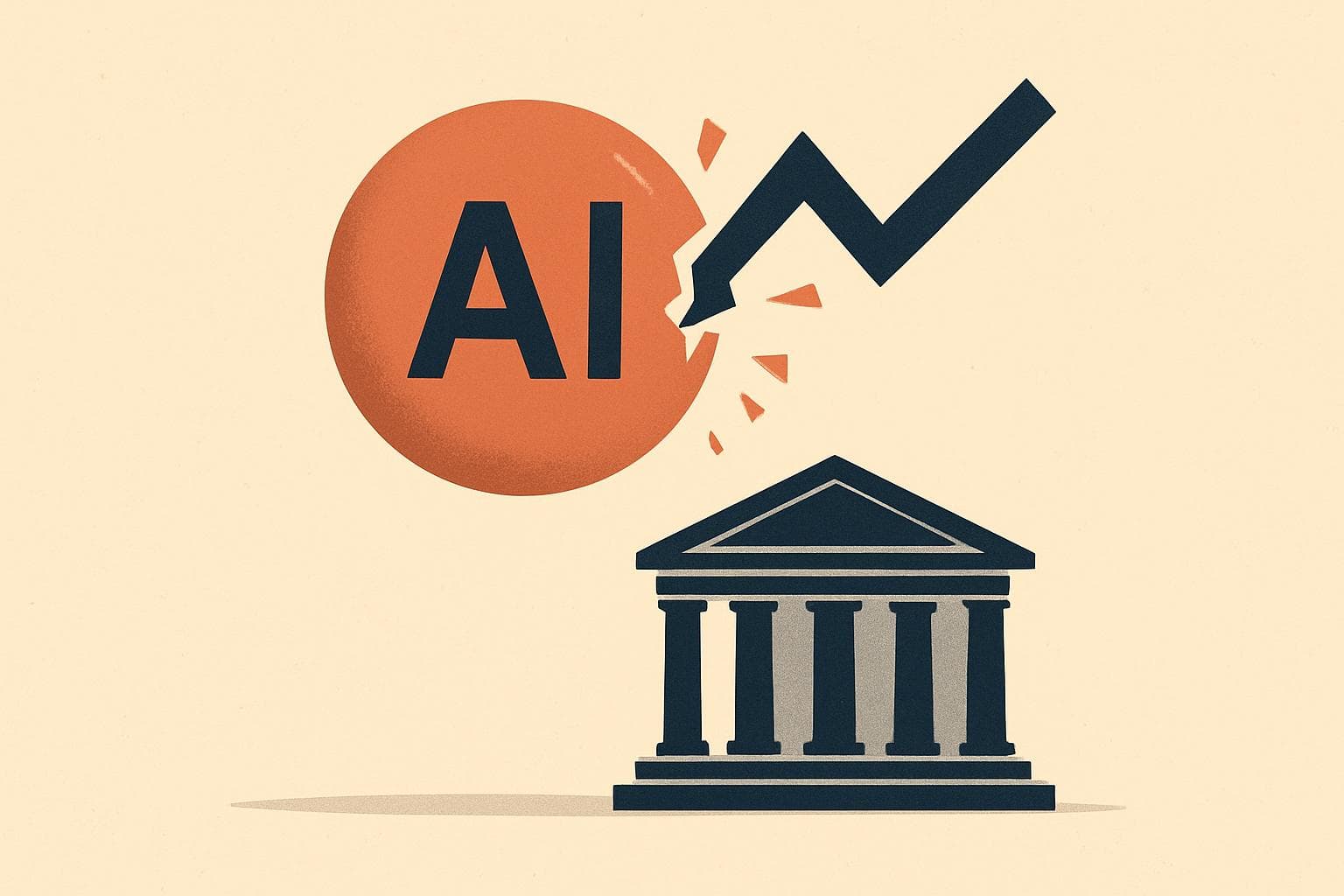
The Bank of England's latest financial stability report warns that the recent surge in investments tied to artificial intelligence (AI) may now pose a threat beyond the tech sector, with potential implications for the global financial system and real economy. According to the Bank's estimates, a major fall in AI-related equities could reduce UK GDP by about 2.2 percent.
A threefold threat and market vulnerability
Andrew Bailey, Governor of the Bank of England, said three related risks have accumulated in the AI market:
- investors have allocated very large sums to AI-linked equities;
- the practical deployment of AI may prove slower than many expect;
- it is uncertain which firms will ultimately be the long-term winners of the AI revolution.
The Bank notes that a sudden, significant equity market correction remains a realistic possibility. Bailey also said he does not see immediate justification for new regulations, arguing that authorities first need a deeper understanding of the financial-stability consequences of the AI sector's rapid expansion.
Retail exposure and new leveraged products
The Bank of England highlights that household investors have helped drive rapid price rises by directing more savings into equities. The fast growth of leveraged exchange-traded funds (leveraged ETFs) is a particular concern because such products can amplify market moves and volatility.
Global spillovers and cross-market impact
Although the UK equity market is less directly dependent on AI companies, the Bank warns that a collapse in US technology shares could quickly propagate to other markets, affecting global growth and the financial system. Its modelling suggests about 36 percent of the expected economic loss would stem from an equities slump, while nearly half would result from turbulence in bond markets.
Self-reinforcing capital loops and concentrated exposures
The report draws attention to so-called self-reinforcing capital loops in the AI ecosystem: large tech firms finance AI companies, which in turn spend that capital on products and services from the same large firms. While this cycle can boost growth, a negative market turn could simultaneously damage multiple companies' results.
Market expectations for AI firms' capital expenditures have also risen sharply: Bloomberg data indicate that since December last year, expected capex for AI giants in 2028 has risen from under $600 billion to over $1,000 billion.
Data centres, energy demand and debt funding
AI's growing energy requirements have triggered a wave of acquisitions in power utilities and record investment in data centres. The Bank flags concern that data centre financing is increasingly debt-funded: Morgan Stanley estimates that between 2026 and 2028 more than half of external financing needs for new data centres could be met with debt, with roughly $700 billion coming from private credit markets. Higher leverage in financing could increase the financial system's vulnerability.
Rising debt exposure among AI developers
The report notes that financing structures for major AI developers have become more complex. Companies such as OpenAI and Anthropic accounted for only about 3 percent of US investment-grade corporate debt at the end of last year; by May this share had risen to 15 percent. The Bank warns that the variety of funding channels makes it harder for financial institutions to assess their direct and indirect exposures to the AI sector.
Supply chains and infrastructure concentration
The Bank of England also stresses that the explosive demand for chips, data centres and electricity needed for AI poses risks: any supply disruption in these areas could significantly slow the AI industry's progress and reduce the revenues investors expect. The risk is amplified by concentration of key technologies and materials in a small number of countries and large firms.
Domestic commentary: communication and preparedness
In domestic discussions about the report, participants noted that public communication around AI is both exaggerated and incomplete. Mucsányi Marianna, lead organiser of AI Summit, said AI is no longer a distant technological promise but a business issue where Hungarian companies must act now. Regular podcast guest Aczél Petra, professor at Széchenyi István University, contributes to the professional debate.
Conclusion
The Bank of England's report underlines that AI-related investment has reached historic levels and that a sharp market correction could have effects beyond the technology sector. Regulators say they need more detailed analysis before moving to new rules, while market participants and policymakers face the task of mapping exposures and securing infrastructure to reduce systemic risk.