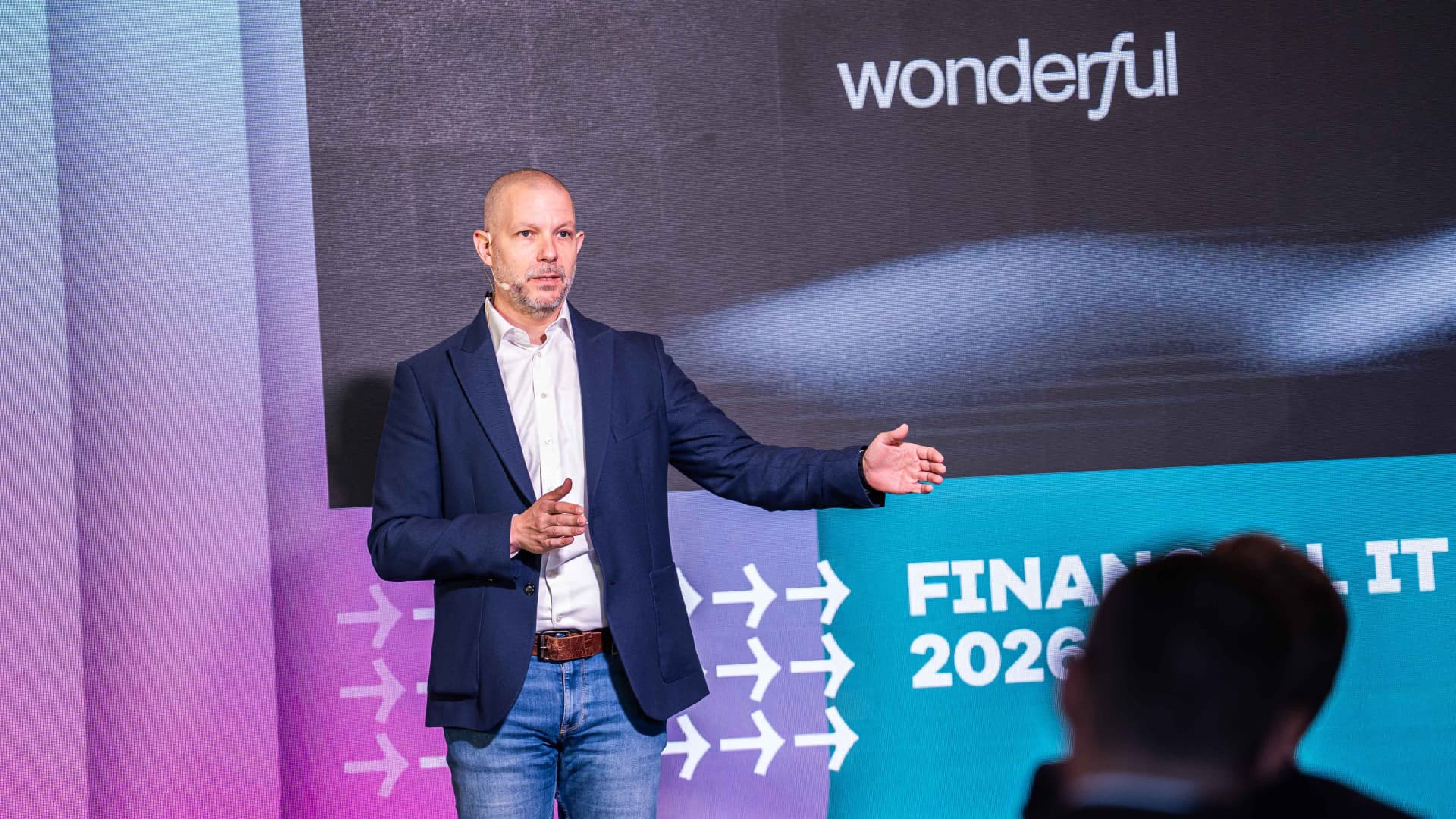
At the Portfolio Financial IT 2026 conference, Vedran Bajer, Managing Director for Hungary, the Baltics and the Adriatic at Wonderful, explained why many artificial intelligence (AI) initiatives in banking fail to move beyond pilots or trials. He identified three primary obstacles that hinder deployment of AI solutions into live banking environments.
Three main barriers
-
Core banking systems: According to Bajer, the IT infrastructure of most banks is 10–15 years old, and in some cases up to 30 years old. Those legacy systems were not designed for API access or real-time data transfer, creating significant integration challenges.
-
Regulation and compliance: Because of sector-specific rules and supervisory expectations — including GDPR, DORA and central bank requirements — ensuring compliance for a new AI system is time-consuming and costly.
-
Language requirements: Bajer stressed that most customers speak Hungarian and expect responses in fluent Hungarian. Solutions trained primarily in English, or poor localizations of English models, do not meet customer expectations on the Hungarian market.
Wonderful’s approach
Wonderful addresses these issues by deploying an integration layer above banks’ existing systems, including prebuilt certification elements to reduce compliance burdens, and by using AI agents trained on Hungarian financial terminology.
An illustrative example: handling a suspicious overnight transaction
Bajer gave a concrete example: when an unknown transaction appears at night, an AI agent can identify the issue within two minutes, block the card, open a compliance case, initiate a refund within 24 hours and send a replacement card within 48 hours — all without human intervention. Such end-to-end automated actions reduce customer anxiety and lower the risk that the client will switch to competitors.
Expected returns in the sector
Bajer cited a McKinsey AI report noting that 88 percent of companies using AI realize only a 5–6 percent advantage. He suggested that the banking sector’s results could be even lower. By comparison, conventional automated call systems resolve customer issues end-to-end without human involvement in roughly 3 percent of cases, while Wonderful reports a 60 percent rate. Bajer argued that this represents not merely a twofold improvement but a paradigm shift.
Why this matters
Widespread production deployment of AI in banking could improve customer experience, reduce fraud losses and increase operational efficiency. However, to realize these benefits in practice, banks must overcome legacy technology constraints, strict regulatory requirements and local language needs.
Cover image credit: Portfolio
Tags: banks, fintech, artificial intelligence, innovation, automation, digitization, chatbot, banking IT, Banking Technology 2025, AI agent