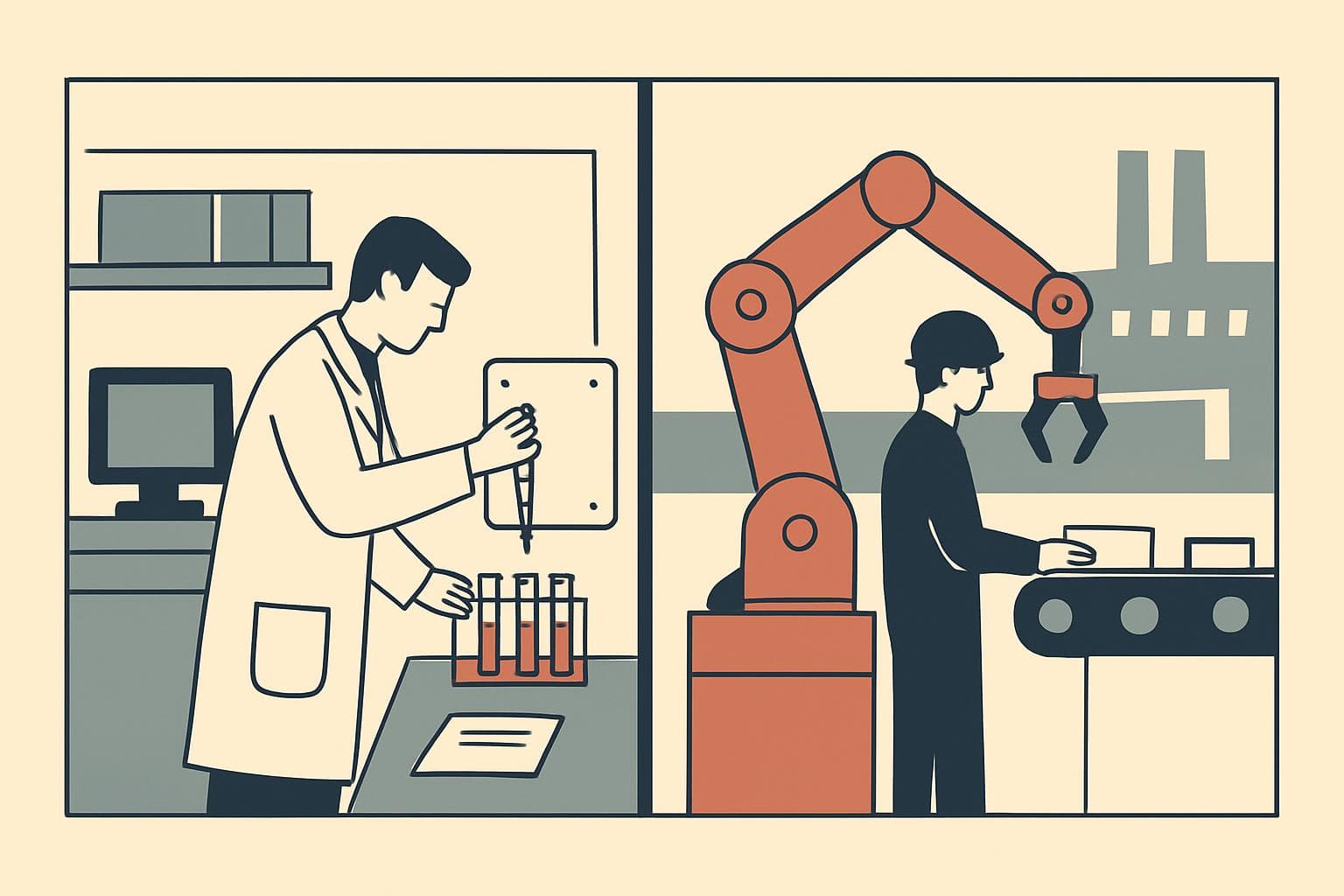
On August 27, 2026, Anthropic and HHMI Janelia Research Campus opened a research preview of the Model Hardware Standard (MHS), a shared specification designed to let AI agents safely operate programmable physical devices used in laboratories and manufacturing. MHS aims to make microscopes, liquid handlers, robotic arms and other instruments discoverable and controllable via a common interface so agents can coordinate multiple devices, run closed‑loop experiments, and in some cases recover from hardware faults without human intervention.
The standard is model‑agnostic and works with any device that exposes a programmable interface. Agent harnesses can access MHS using standard protocols such as the Model Context Protocol. Anthropic and partners are sharing an early version with labs and manufacturers to build safety evaluations and best practices before a wider open‑source release.
How MHS works
MHS introduces a standardized driver layer that translates simple primitives — for example, "read" (get temperature) and "write" (set temperature) — into device actions. Devices announce themselves in a uniform manifest so agents and other services can discover and communicate with them without bespoke translation code.
Crucially, MHS drivers include tags and natural‑language metadata describing device characteristics that are not always visible in APIs (for example, the weight of a robot arm). From these tags MHS auto‑generates a reference file that lists what the device can measure, adjust, and what safety limits apply; this gives an agent the context it needs to operate the hardware safely.
Agents control devices through three mechanisms supported by MHS: the MCP (Model Context Protocol), a command‑line interface, and code files (APIs). These mechanisms let a single orchestrator sequence steps across instruments and stream device state back to the agent. For long running or high‑speed operations, the agent can compile driver commands into deterministic scripts so devices execute autonomously without requiring the agent to reason at every step.
Early pilots and concrete results
Partners across biotech, robotics, quantum computing and academia have tested MHS in different pilots. Below are the main outcomes and key numbers reported by those collaborations.
Genentech — automating a BCA protein assay
Genentech implemented MHS to orchestrate a liquid handler, a robotic arm and a plate reader for the bicinchoninic acid (BCA) protein assay. The model (Claude) ran the baseline protocol, discovered flow‑rate issues that caused bubbles in viscous samples, and then autonomously optimized liquid transfer parameters.
Claude converged on roughly 140 µL/s for water (RMSE ≈ 0.016) and 10 µL/s for viscous bovine serum albumin (BSA) (RMSE ≈ 0.181), values Genentech automation experts judged reasonable. During runs Claude recovered from tip pickup and fluid detection errors on its own, though the team also noted the current limits of model reasoning about physical phenomena (e.g., bubble formation) and encoded corrective heuristics as reusable liquid‑handling skills.
University of Washington (Baker and Pinglay labs) — remote monitoring and instrument coordination
A PhD student used MHS to build a dashboard and agentic workflows: remote status monitoring, an agent‑supervised qPCR that watches amplification curves and stops at the right moment, and collision‑free handoffs between a robotic arm and a liquid handler. Connecting six instruments through MHS took under a week, including driver development, and allowed the researcher to move hours of monitoring time back into experimental planning.
Carnegie Mellon University — faster dose‑response experiments
Carnegie Mellon researchers used MHS to orchestrate a CyBio Felix liquid handler, a Varioskan LUX plate reader, a robotic arm and monitoring cameras across three incompatible control computers. They report being able to run serial dilution dose‑response experiments about three times faster than before. Developing drivers and the orchestration layer took roughly eight hours rather than the several weeks a traditional vendor setup typically requires.
In one test, the system rejected an initial run due to saturation at 200 µg/mL (R² < 0.9), automatically compressed the top concentration to 100 µg/mL and produced a second run with R² > 0.98 and 3.4% variation across repeats, without human input.
HHMI Janelia — synchronizing complex microscopy rigs and agentic imaging
Researchers at HHMI Janelia applied MHS to multi‑vendor two‑photon and light‑sheet rigs that previously required launching many vendor programs. By exposing every device state in a shared memory dictionary, they simplified integration: adding a new camera that feeds beam position back into mirrors took minutes instead of days. MHS enabled online analytics, unified viewers for different data types, and agentic loops that iteratively choose acquisition parameters and analyses — for example, to find oscillatory neuronal populations and then sample them at higher temporal resolution while preserving device safety limits.
QuEra Computing — laser relock automation and PID tuning
QuEra used MHS to give an agent control over a titanium‑sapphire laser used in their neutral‑atom quantum machines. An earlier hand‑crafted recovery script worked about 58% of the time and took ~150 seconds per attempt. An AI‑driven development loop ran multiple Claude instances in parallel roles (hypothesis, code writer, runner, and log analyst) through hundreds of nightly iterations and produced a decision‑tree style recovery script.
In a blind test of 700 induced disturbances the resulting script recovered the lock 695 times (99.3% success). Simple disturbances took 0.9–5.4 s to recover, the hardest 10–14 s — a substantial improvement on human recovery times (5–10 minutes). In further unattended tuning runs Claude reduced the RMS servo error from 15.7 mV to 1.55 mV across 363 experiments and 16 hours. Over a 19‑hour run the agent’s PID settings did not lose lock once, while a specialist tune unlocked ~1.6 times per hour.
Tetsuwan Scientific — qPCR automation and community science
Tetsuwan integrated MHS into ResearchOS and used Claude to orchestrate qPCR workflows for a citizen science study of San Pedro Creek pollution. Their automated tests covered 9,143 individual dispenses, 300 unique transfer types and 1,508 measured conditions across four liquid types. Using Claude and MHS to refine compiler heuristics improved multi‑dispense precision prediction by roughly 12% on held‑out tests (about 17% on the most replicated data). Preliminary qPCR data detected human‑associated Bacteroides markers (HF183, BacH) in the creek samples.
Industry engagement and technical support
Hardware and software vendors are adding MHS drivers and support: Amazon Web Services (Strands Robots), Automata (LINQ), Danaher, Doosan Robotics, MBF Bioscience (ScanImage driver), QIAGEN (QIAsymphony Connect), Tecan (Fluent), Universal Robots, Hugging Face (LeRobot) and Raspberry Pi have announced various levels of engagement or early access.
Limits, safety and the research preview aims
Anthropic and partners emphasize that models still have limitations in physical reasoning and require expert oversight. MHS currently needs a programmable interface on devices; the project is working with manufacturers to add drivers where devices lack them. The research preview will be used to develop safety evaluations, a physical safety roadmap and deployment guidance ahead of any open‑source release. Participants will share findings to help shape safe practices for AI agents operating physical equipment.
Acknowledgments and how to participate
MHS originated from collaboration between Alek Kemeny (Anthropic's Beneficial Deployments team) and Arco Bast (HHMI Janelia). Anthropic and partners thank numerous contributors across participating labs and companies. Stakeholders interested in the research preview can join the waitlist to request access and participate in further development and safety testing.