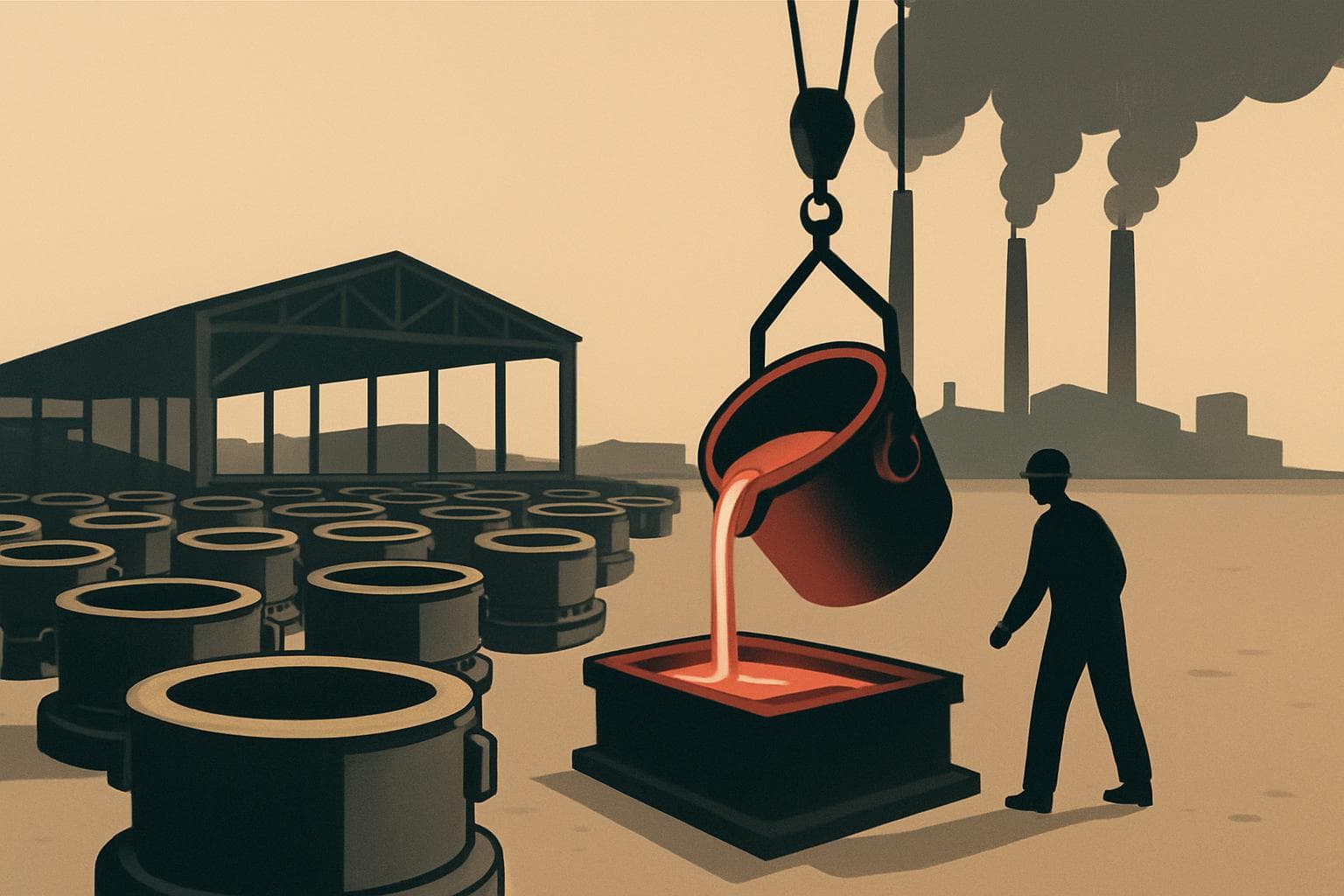
Elon Musk said on Saturday that SpaceX’s secret foundry under construction in Bastrop, Texas, will be used to cast the difficult‑to‑manufacture blades and vanes used in gas turbines. The confirmation followed reporting by The Information that cited job listings explicitly mentioning a “blades and vanes foundry” and findings from due diligence researcher Corey Trinetti that SpaceX purchased roughly 830 acres near its existing Starlink factory in Bastrop between March and June.
On X, Musk wrote that “SpaceX and Tesla are each building 100GW/year of solar production capacity as fast as possible, but natural gas will still be needed to supplement and bootstrap solar for several years. The limiting factor for nat gas turbine production is casting the blades & vanes. By doing in‑house casting at SpaceX, we can accelerate nat gas turbines coming online by up to 18 months, which is a profound game‑changer.”
The context: power bottlenecks for AI data centers
One of the major constraints on large‑scale AI deployment today is power. GPU shortages remain an issue — for example, Nvidia’s newest Blackwell chips still have several‑month lead times — but a parallel constraint has emerged in the physical power grid.
The International Energy Agency (IEA) projects global data‑center electricity use will roughly double by 2030. Gas turbine manufacturer GE Vernova says it is essentially sold out of production capacity through 2030, largely due to demand from AI infrastructure.
Because of those limits, hyperscalers including Amazon, Google, Meta, OpenAI, and Microsoft increasingly build private gas‑fired plants adjacent to data centers rather than waiting on the grid. After years of prioritizing wind and solar, many operators are turning to natural gas to bring data centers online faster.
Why turbine blades are a bottleneck
According to The Information, the blades in a gas turbine’s hottest section operate at around 3,000–3,600 °F — roughly 800 °F hotter than the melting point of the metal alloy from which they’re made. That operating regime is only possible because of internal cooling channels, thermal‑barrier coatings, and the specific way each blade is cast.
Only four companies worldwide have mastered casting these single‑crystal blades at industrial scale, and all are currently at capacity. The process requires each blade to be cast as a single, continuous crystal grown slowly in a vacuum furnace to avoid microscopic seams that would allow cracks under stress. The large size of power‑plant turbine blades makes producing them without defects especially challenging.
Potential advantages and the health and legal concerns
If SpaceX succeeds in producing these components in‑house, a Musk‑controlled entity would hold a manufacturing capability that other AI infrastructure builders currently rely on a tiny oligopoly to obtain. That could give SpaceXAI an edge difficult for other well‑funded but non‑manufacturing competitors to replicate quickly.
However, faster access to gas turbines also means more turbines being installed sooner, and turbines in the ground are already the subject of federal lawsuits and peer‑reviewed health research over their emissions. The article cites the case of Memphis, where SpaceXAI has run gas turbines to power its Colossus data centers since 2024. The National Association for the Advancement of Colored People (NAACP) has repeatedly accused the company of operating turbines without the permits or pollution controls required by federal law. The NAACP’s concerns focus on smog‑forming compounds and hazardous chemicals such as formaldehyde, pollutants linked to asthma, respiratory diseases, and certain cancers. University of Memphis researchers said in their own, limited analysis that air pollution became “slightly worse” because of the data center; the site sits near neighborhoods already facing heavy industrial pollution.
Similar disputes are playing out wherever gas turbines are used to address data‑center power shortages. A study commissioned by the Piedmont Environmental Council, using the EPA’s COBRA health‑impact model, found that emissions from a single facility’s eight full‑time gas turbines could affect more than 2.5 million people across multiple counties — with the greatest impacts on already marginalized communities — and could cause an estimated 3.4 to 6.5 additional premature deaths per year, translating to $53 million to $99 million in annual health‑related damages.
Conclusion
SpaceX’s Bastrop foundry, if it achieves reliable large‑scale casting of turbine blades and vanes, would aim to relieve a key manufacturing bottleneck and accelerate the deployment of natural‑gas turbines that many data centers rely on. That could ease short‑term power constraints for AI infrastructure but would also likely hasten the expansion of gas‑fired generation, raising significant environmental, health, and legal concerns for communities near those facilities.