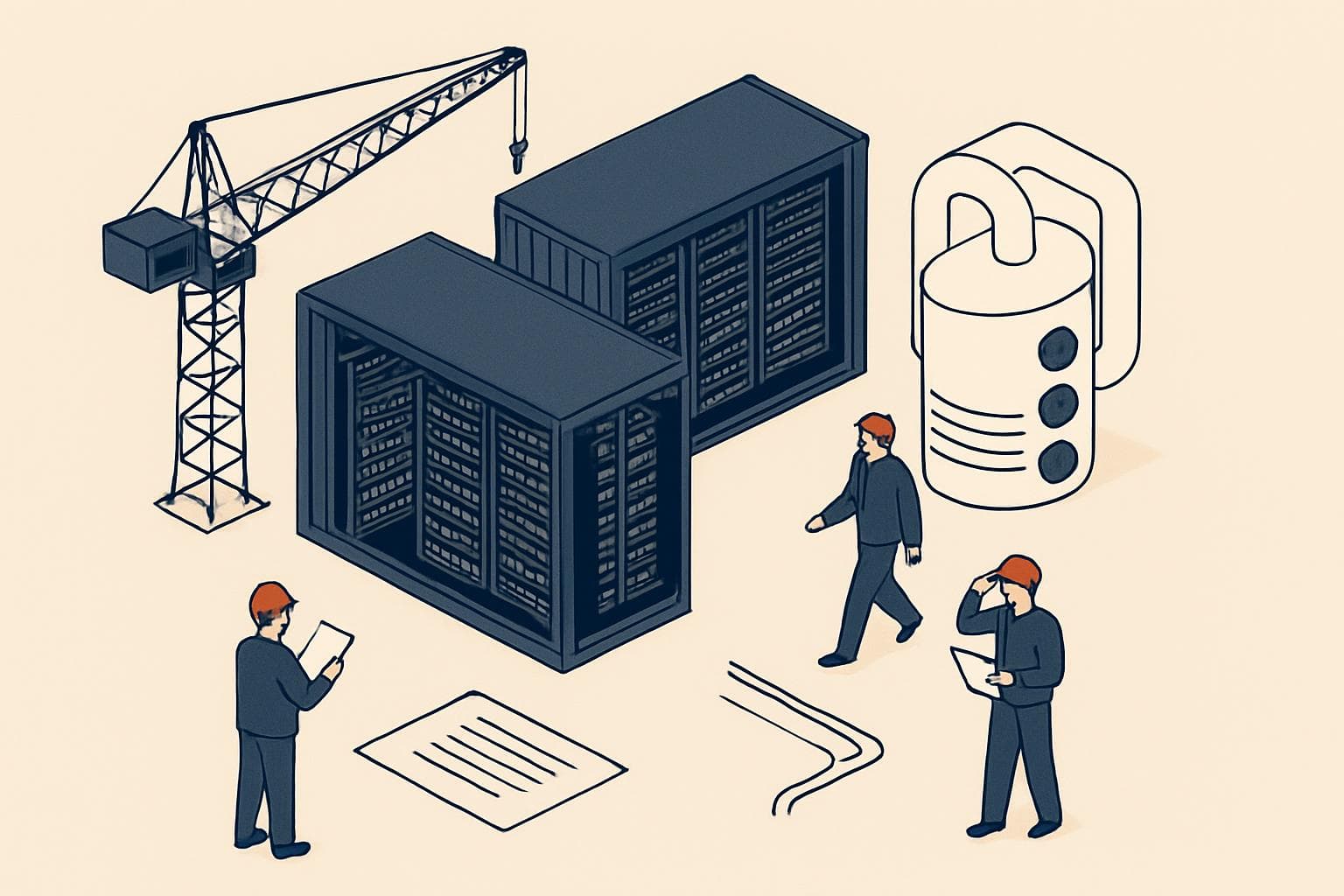
Bringing an AI workload online requires coordinated compute, networking, storage, power, cooling and software to operate as a single productive unit. In traditional data center builds teams must select a site, design power and cooling, lay out racks and cables, then incrementally validate the network and cluster — a sequence that depends on specialized labor and can delay the moment the infrastructure starts producing useful output.
NVIDIA DSX POD shifts much of that work into a controlled factory environment. As one implementation model supported by the NVIDIA DSX AI Factory Platform, DSX POD is a standardized, factory‑built reference design. It enables partners to construct standardized containers that pre‑integrate AI infrastructure, complete critical validation before shipment, and connect to prepared site infrastructure after delivery to reduce onsite complexity and reach productive AI capacity faster and with greater predictability.
Design foundations: more than a prefabricated data center
Modular and prefabricated data centers exist today, but AI factories pose additional engineering challenges. Rack‑scale AI systems pair high‑density compute with high‑speed scale‑up and scale‑out networking, liquid cooling, power delivery, telemetry and management software; these elements must perform as a single system and remain within mechanical, electrical, thermal and network specifications during factory integration, transport, installation and operation.
NVIDIA DSX POD provides a foundation for installing rack‑scale systems in factory containers, functionally testing the integrated unit, transporting it, and bringing it online through repeatable destination‑site processes. NVIDIA’s engineering scope includes rack layout, structural loading, power, cooling, cabling, service access, reliability and validation. The approach extends NVIDIA’s progression from chips and boards to complete rack‑scale systems and large reference architectures like NVIDIA DGX SuperPOD, applying that experience to factory‑built AI‑factory deployments.
The reference design is optional: conventional data center construction and onsite integration remain valid choices. DSX POD offers a standardized route for large deployments where schedule predictability, repeatability and reduced field work are priorities.
Architecture aligned with the NVIDIA Vera Rubin platform
NVIDIA DSX is a broad framework for co‑designed AI infrastructure that brings compute, networking, storage, power, cooling, facility controls and software together at the data center level. NVIDIA DSX POD is a concrete realization of that framework: a standardized AI factory architecture made of factory‑built container types and defined interfaces, designed around the NVIDIA Vera Rubin rack‑scale systems.
The reference design describes a complete AI factory rather than an isolated compute enclosure, accounting for compute, service and management functions, scale‑out networking, storage, power, cooling, cabling and supporting infrastructure.
Technical requirements for factory‑integrated deployment
The DSX POD reference design aims to make deployments repeatable. That requires coordinated requirements across compute integration, networking and storage, cabling and controls, power delivery, liquid cooling, and mechanical design and transportation.
-
Compute integration: the DSX POD compute container is designed for NVIDIA Vera Rubin rack‑scale infrastructure. The design defines how compute and supporting racks fit within the enclosure and how partners handle structural support, weight distribution, equipment restraint, service clearances, airflow, liquid‑cooling access, rack‑level power and network connectivity. Factory integration expands the validation boundary: containers are validated as deployment units (rack inventory, firmware and configuration baselines, power‑on checks, fabric connectivity, sensors, cooling integrity and system‑level functional tests) before leaving the factory.
-
Networking and storage: AI workloads require predictable data movement. The reference design treats networking and storage as integral system elements rather than site‑specific add‑ons. It defines connectivity within compute containers, between containers, and to the customer’s external network, covering scale‑out fabrics, management networks, fiber entry, trunk cabling, routing, labeling, bend radius, service access and factory‑installed link validation. Storage requirements specify capacity, performance, connectivity and management characteristics while allowing final equipment choices to reflect deployment scale and partner solutions.
-
Cabling and controls: DSX POD reduces onsite cabling by moving rack‑to‑rack network cabling, power wiring, control wiring and sensor integration into the factory where practical. The reference design defines cable paths, separation, termination points, labeling, test procedures and serviceability to reduce field terminations.
-
Power delivery: the design standardizes on an 800 VDC input at the container boundary and defines protection, distribution, grounding, rack connections, controls and telemetry. Upstream generation, conversion and regional electrical solutions are left to partners because utility conditions, codes and grid architectures vary by region. A common container interface enables repeatable core designs while preserving regional flexibility. NVIDIA software can complement the physical design with policy‑driven power control, workload orchestration and high‑fidelity telemetry to help convert a fixed power envelope into more productive computing.
-
Liquid cooling: Vera Rubin rack‑scale systems require coordinated liquid‑cooling infrastructure. Within the container the design covers plumbing that connects racks to the container cooling interface, including routing, manifolds, isolation, instrumentation, leak detection, pressure integrity and service access. Partners can assemble, flush, pressure‑test and validate the internal cooling loop at the factory, then connect the container to prepared site water and heat‑rejection infrastructure and commission the complete loop onsite.
-
Mechanical design and transportation: shipping pre‑installed, high‑value rack systems requires treating logistics as an engineering requirement. Container structure, equipment restraints, weight distribution, center of gravity, lifting and handling points, access paths and transport conditions must be engineered together. The reference design ties transport requirements to factory quality gates: inspect before shipment, document configuration and test status, secure for transport and repeat checks after arrival so the delivered system matches the validated factory unit.
Parallelizing factory integration and site preparation
The factory‑built model changes sequencing: site teams prepare land, foundations, power and external connectivity while partners manufacture and integrate containers in parallel. In the factory partners install rack‑scale systems, complete internal cabling and plumbing, integrate controls, load approved configuration baselines and run functional tests. On site construction teams prepare physical and utility interfaces. After delivery the focus is placement, inter‑container connections and hookups to external power, cooling and networking, followed by transport‑integrity checks and system commissioning.
This model does not eliminate onsite work but shifts complex, repeatable integration to an environment designed for consistent tooling, quality controls and parallel production.
Scaling with standardized deployment units
A standardized container architecture provides a repeatable unit for planning and expansion: after preparing supporting site infrastructure, operators can add compute and support capacity using the same interfaces and validation process. Standardization also supports consistent software optimization because known hardware, network, power, cooling and telemetry architectures allow tuning of software and operational practices. Partners can adapt implementations to local codes, site conditions, customer requirements and regional supply chains.
The DSX POD reference design delivers reusable NVIDIA engineering and validation while the ecosystem provides manufacturing capacity, site expertise, regional engineering, customization, deployment, service and support.
A partner‑led delivery model
NVIDIA supplies the validated AI infrastructure design and works with ecosystem partners to prove rack‑scale systems can be integrated, tested, transported and deployed as repeatable factory‑built units. OEMs and ODMs integrate compute systems; mechanical, electrical, plumbing and infrastructure specialists adapt power and cooling for sites; modular solution providers manufacture enclosures and integrate subsystems; site partners prepare locations and support commissioning. Together they turn the reference design into customer‑specific AI factories.
The model broadens the modular data center market rather than replacing existing offerings: partners can continue offering various integration levels from modular infrastructures populated onsite to fully factory‑integrated deployments. DSX POD provides a validated path for the latter while preserving room for implementation and service differentiation.
Practical impact
The value of an AI factory begins when the infrastructure produces tokens. By moving repeatable integration and validation into the factory, NVIDIA DSX POD is designed to reduce late‑stage schedule exposure, simplify onsite work and make deployments more predictable. The reference design brings NVIDIA Vera Rubin compute, networking, storage, power, cooling, cabling, controls and validation into a coordinated architecture: NVIDIA provides the engineering foundation, and partners build, customize, deliver and support the resulting solutions.
Learn how the NVIDIA DSX POD reference design can help convert available land, power and prepared site infrastructure into productive AI capacity more quickly and predictably.