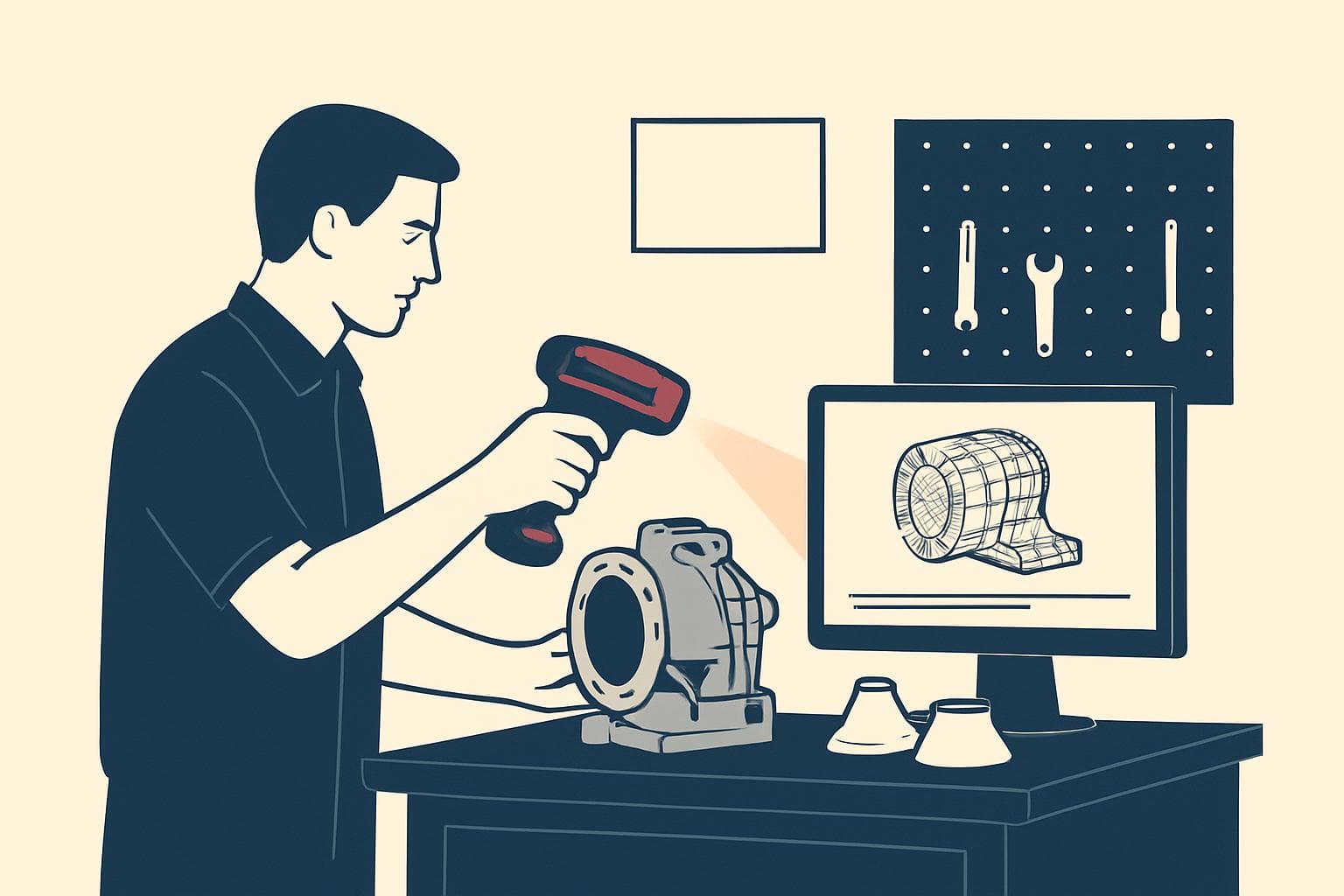
Quicksurface is introducing artificial-intelligence features to speed up the reverse-engineering process, aiming to reduce manual work when converting point clouds and polygon meshes into editable, production-ready CAD models.
Why this matters
Maintaining older but still operational industrial equipment is a common challenge, particularly when original documentation or spare parts are unavailable. Modern 3D scanners can rapidly digitize a part’s geometry, but the output is typically a point cloud or mesh that cannot be used directly for CNC machining or 3D printing. Turning that scanned data into an editable CAD model is currently the most time-consuming step in the workflow.
What the AI integration does
The planned AI enhancements in Quicksurface will not only offer modeling suggestions but also take over repetitive, routine steps in the conversion process, thereby reducing manual engineering effort. The development is intended to shorten turnaround times and free up measurable amounts of engineering hours per month, although the exact savings depend on how frequently reverse-engineering tasks are performed.
The integration does not replace engineering judgment: for example, when a part is worn or damaged, it remains the engineer’s responsibility to decide whether to preserve the measured condition, restore the original design intent, or produce a fully reconstructed version.
Usage modes and key features
Quicksurface is available as a standalone application and as a native plug-in, allowing engineers to import scanned data, extract geometric elements and curves, and generate surfaces within their familiar design environment. The system supports large file handling, both parametric and freeform modeling, and provides color-map deviation checking between the finalized CAD model and the scanned baseline.
This approach reduces the need to switch between different systems and avoids re-modeling parts from scratch.
Impact on engineering time
Targeted scan-to-CAD solutions help optimize engineering labor by automating repetitive manual tasks through software and AI. The monthly amount of reclaimed work hours is measurable but varies with the volume and complexity of reverse-engineering assignments.
Additional notes
The cover image for this article is illustrative and sourced from Getty Images. An AI assistant participated in preparing this piece; our journalist edited and verified the final text.
Tags: technology, software, 3D printing, artificial intelligence, automation, industrial production, engineer, machine building, AI, 3D