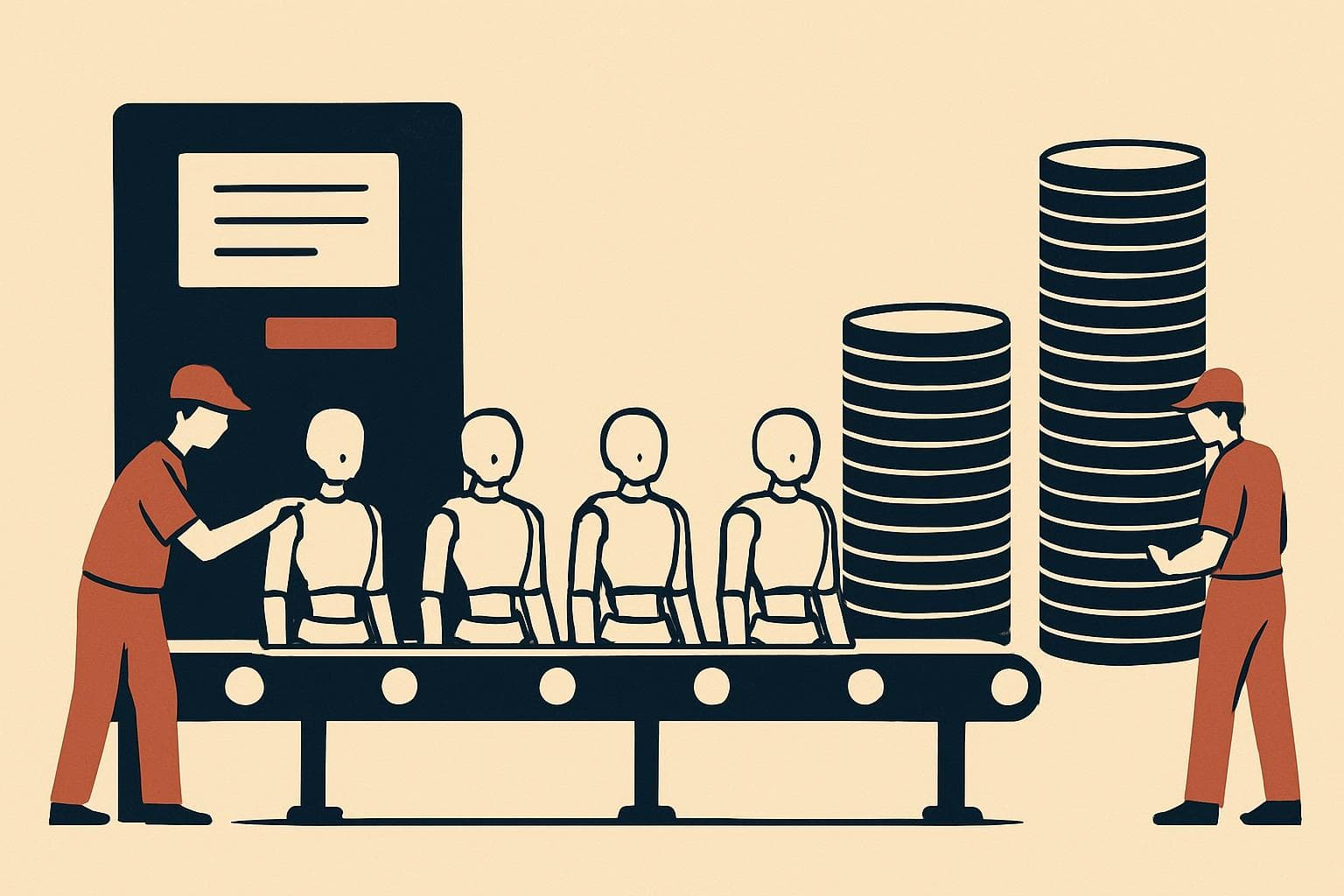
Tesla announced it has begun manufacturing production-quality Optimus humanoid robots at its factory in Fremont, California, using a manufacturing area that was previously dedicated to electric vehicle assembly. In its third-quarter letter to shareholders the company said, “the bots coming off this line are the first production-quality bots that we have manufactured,” and added that while hardware and manufacturing will continue to be iterated, the current process is suitable for a commercial product.
Tesla CEO Elon Musk described the rollout as “early production” on the company’s earnings call, warning that the ramp will be slow and “somewhat bumpy because it is such a radically new product.” Musk also claimed Tesla would be able to produce 20,000 Optimus units per week by the end of 2027.
“There’s still some things we need to tweak about the design, because you need to deliver a robot that is safe and reliable and has long duration, so it can’t, like, wear out after a month,” Musk said. He added that there is still significant work to be done on the AI and the robot for it to be useful for open-ended tasks.
Financial results: revenue broadly flat, profit down sharply
Despite the Optimus milestone, Tesla’s third-quarter financials showed the company in the middle of an expensive strategic push. Vehicle sales remained the primary revenue driver and were flat year-over-year at $20 billion. Tesla reported 486,532 vehicle deliveries in the third quarter, roughly 6,000 more than the previous quarter but fewer than in the same quarter last year.
Total third-quarter revenue was $28.04 billion, slightly below the $28.09 billion reported in the third quarter of 2025. That figure was also about $200 million lower than the $28.23 billion generated in the prior quarter.
Revenue from Tesla’s solar and energy storage business fell 16% year-over-year to $2.8 billion, which the company attributed to tariff-related customer refunds. By contrast, the services business — which includes customer subscriptions to Full Self-Driving (FSD) advanced driver-assistance software — grew 33% year-over-year, bringing in $4.6 billion and producing a record $734 million in gross profit for the quarter.
However, spending on artificial intelligence initiatives and the Optimus program weighed on profitability. Tesla reported net income of $787 million for the quarter, a 43% decline from $1.37 billion in the year-ago period. Lower sales of regulatory credits also pressured earnings.
Autonomy and robotaxi timing
Executives on the earnings call, including Elon Musk, Chief Financial Officer Vaibhav Taneja, and Ashok Elluswamy, Tesla’s vice president of AI software, expressed bullish views on the FSD product even as the timeline for an “unsupervised” consumer version slipped again. Today, Tesla owners can subscribe to a supervised version of FSD that requires the driver to remain attentive and able to take over at any time. The unsupervised version would correspond to roughly Level 4 autonomous driving, similar to systems intended for robotaxi services.
Ashok Elluswamy said on the call that he expects “somewhere around Q2 next year” Tesla can enable some customer vehicles to become part of a robotaxi fleet, referring to privately owned Tesla vehicles with Full Self-Driving (Supervised) receiving a software update to enable unsupervised driving. Elon Musk previously said in April that the unsupervised version would “probably” be released in the fourth quarter of this year.
Conclusion
Tesla has moved Optimus into production at Fremont but cautions the effort is at an early stage and the production ramp will take time. Heavy investment in AI, autonomy and the Optimus program dragged third-quarter profits downward even as overall revenue remained largely unchanged. The company reiterated ambitious targets for autonomous driving and robot production, while timing for a consumer-level unsupervised FSD and large-scale Optimus output remains uncertain.