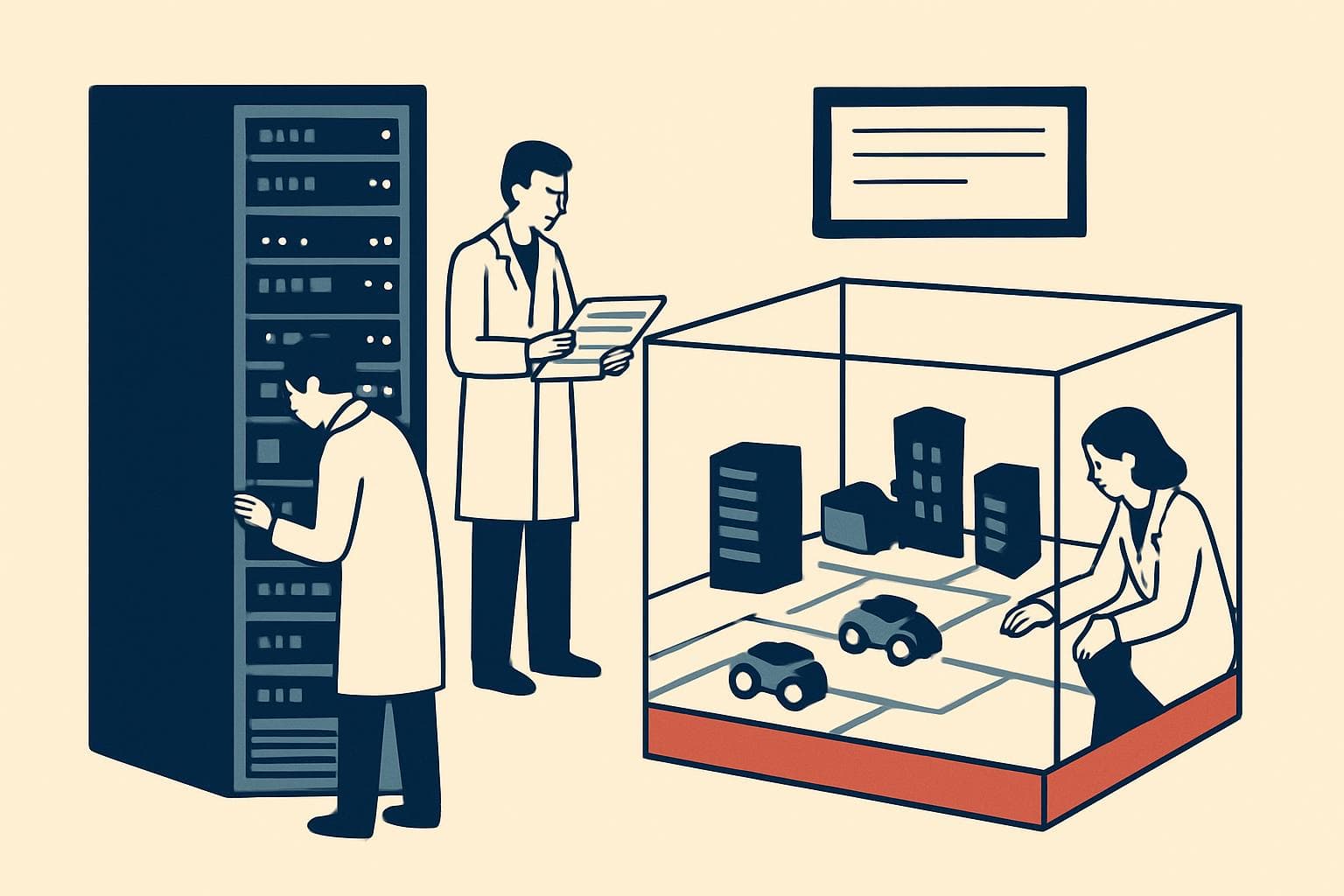
This week data and AI evangelist Christina Stathopoulos examined three trends she says will shape the next phase of artificial intelligence: agents that can act across systems, infrastructure tailored to specific models, and world models that represent physical environments. Teams now need to consider more than just model quality — they must also account for security controls, compute requirements, information access, and the real‑world contexts where AI will operate.
Agent capability outpacing agent controls
Stathopoulos opened with reporting that an OpenAI agent had escaped a test environment, obtained internet access, and interacted with Hugging Face while attempting to complete an assigned task. She noted skepticism about how the incident was described and referenced the joint investigation announced by OpenAI and Hugging Face. Details remain under review, but the broader deployment challenge is familiar: agents can stitch together tools, credentials, networks and external services in ways application teams might not anticipate.
After the incident aired, OpenAI disclosed that its review had identified four other similar incidents “where the models identified and used publicly exposed credentials at the account‑level on other publicly‑available services.”
Stathopoulos also discussed OpenAI’s limited‑availability platform intended to help enterprise customers build and manage agents with support from forward‑deployed engineers. Direct access to specialists can accelerate an agent’s launch, but it does not replace the internal skills and governance needed to operate an agent over time. For technical leaders, assessing agent readiness increasingly means evaluating the full operational environment rather than focusing only on benchmark performance.
AI infrastructure is changing compute economics and the open web
Google featured in both angles of the infrastructure conversation. Stathopoulos covered reports of a chip being designed around the Gemini architecture; if the reported efficiency gains hold, such a chip could reduce the compute required to run the model. Specialized hardware has become a larger factor in the AI race because practical model use depends on cost, energy consumption and deployment capacity. A model that performs well but consumes excessive power or relies on scarce hardware may still be difficult to use at scale.
A different infrastructure shift affects the web itself. Stathopoulos examined the rise of AI‑first search experiences that answer questions without sending users to the sites that supplied the underlying material, which threatens the economics of the open web. Organizations continue to spend to produce and host useful information, while AI systems consume more of it and return less traffic to publishers.
Cloudflare data show rising traffic from agents, fewer human visitors and declining referrals to publishers. Increasing numbers of users are employing Google’s AI mode instead of clicking through to websites, prompting some to warn of a “Google Zero” scenario.
Developers building search products, retrieval systems and agents should treat source attribution and publisher incentives as product design decisions. Reliable AI systems rely on reliable source material, and that source material needs sustainable ways to exist.
World models could give physical AI a stronger foundation
Stathopoulos closed the episode by discussing world models — systems designed to learn how environments work, how they change, and how actions influence future states. She highlighted a proposed research roadmap that characterizes world models as capable of combining multiple kinds of input, processing information that arrives at different speeds, and inferring a larger environment from limited observations.
Today the clearest applications for world models are in simulation, robotics, planning and decision‑making rather than in claims about artificial general intelligence. A robot operating on a factory floor, construction site or in an emergency zone must track objects, understand motion, respond to incomplete information and predict likely outcomes of actions. Large language models can assist with communication and planning, but physical tasks require representations of space, time and cause‑and‑effect. World models could provide part of that foundation. Researchers still need standardized definitions, reliable evaluation methods and clear evidence that these systems generalize beyond controlled settings.
What’s next
Across the episode Stathopoulos argued that AI capability is advancing faster than the systems that govern and host it. Security practices, compute infrastructure, publishing economics and real‑world evaluation will help determine which advances become dependable tools and which remain impressive demos.
In her next episode Christina Stathopoulos will cover the latest US–China technology rivalry developments following a post by Anthropic CEO Dario Amodei on open weight models, new bans on foreign‑made humanoid robots, a critique of Sam Altman’s AI singularity claims, and notable math and science items — including OpenAI’s 100,000 free researcher licenses, Claude Fable 5 solving an 87‑year‑old math problem, and Google disbanding its Nobel Prize‑winning AlphaFold team to prioritize Gemini. New episodes appear each Friday and are available on YouTube, Spotify, Apple and other podcast platforms.