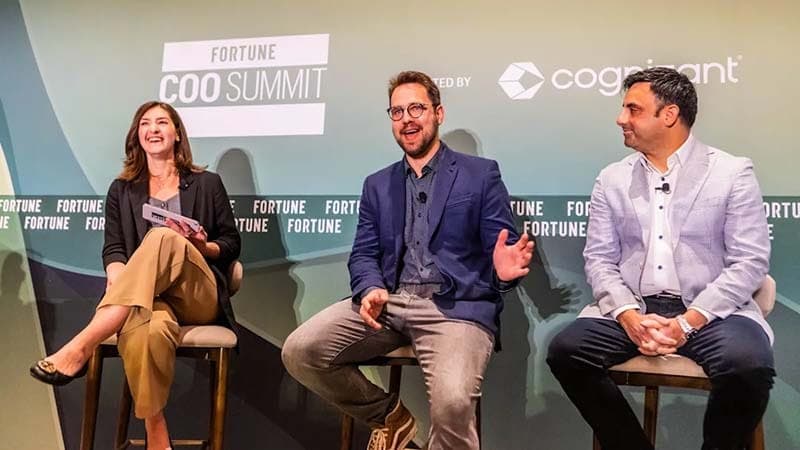
At Fortune’s COO Summit, executives publicly disagreed about whether AI agents should be regarded as colleagues or treated as tools. Okta President and COO Eric Kelleher named several AI agents — Leo, Sloan, Hank, and Walker — and said these agents have become "a colleague" rather than a tool, noting they sit alongside human staff in business reviews.
A few hours later, Francine Katsoudas, Chief People Officer at Cisco, pushed back, arguing that agents are "part of the workflow, but not a colleague."
Why the label debate matters less than organizational change
Observers say the argument over terminology distracts from a deeper problem. Research from Cognizant found that 93% of jobs have already been disrupted, a shift that occurred six years earlier than the company had forecast. Despite widespread disruption, promised productivity gains have not materialized — a shortfall Cognizant describes as an "activation gap." The gap, analysts argue, is not caused by the technology itself but by organizational inertia: org charts, budget cycles, and performance review systems were designed to ration human headcount and have not been reengineered for a workforce that increasingly includes AI agents.
Practical takeaway for leaders
Executives and analysts at the summit emphasized that whether an agent is labeled a colleague or a tool is secondary to the need for structural change. The urgent task for managers is to redesign organizational charts, budgeting processes, and performance-review cycles so the presence of AI agents can translate into actual productivity and strategic value, while managing the transition risks that the current frameworks expose.