The 4iG Csoport launched an internal initiative tied to last year’s Children’s Day activities, inviting children to submit drawings. The submitted artwork was later used to create a short animated film titled Kapcsolatmentők, with ChatGPT employed to help develop the narrative and script elements.
In Kapcsolatmentők, forest animals repair a communications network damaged in a storm. The film functions both as a children’s tale and a technological demonstration: the drawings incorporate contemporary communication symbols such as wifi signals, underlining how digitalization themes are entering children’s worlds.
The role of stories in the AI era
At the event, generation researcher Steigervald Krisztián argued that tales are never merely entertainment: they convey a generation’s central questions, fears and expectations. From Grimm’s tales to socialist-era moral stories, narratives have reflected the anxieties of their times; today’s stories increasingly incorporate digitalization and technological uncertainty, which is why modern communication motifs appear in the children’s drawings used for the animation.
Steigervald noted that because of developmental factors, children under roughly 10–12 years learn more from experiences than from abstract information: patterns, experiences and relational situations shape their development. In this context parental behavior — for example how often parents use their phones around children — becomes a model. If adults constantly carry their devices but do not spend attentive time with children, kids draw their own conclusions from that behavior.
The presentation also cited the National Széchényi Library’s (Országos Széchényi Könyvtár) 2020 self-report survey, which found that 53 percent of the Hungarian population did not read a single book in a year. Steigervald argued that if children do not see reading at home, sustained attention and imaginative practice are less likely to be part of daily life, potentially affecting later development of attention and decision-making.
Awareness and connection: a roundtable on parental roles
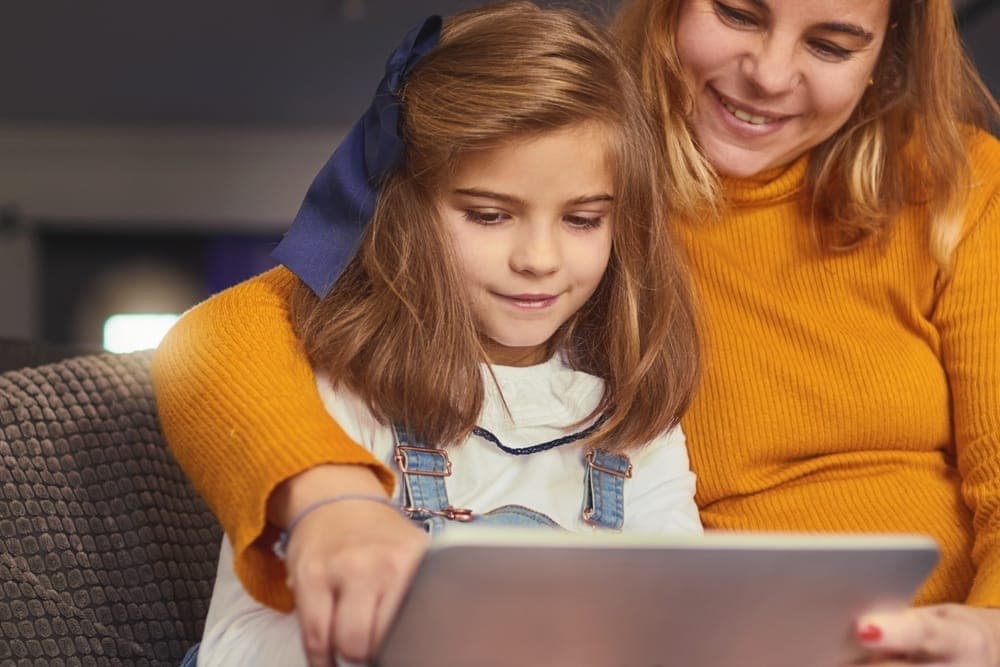
A roundtable titled “How should parents relate to AI?” discussed how families can balance printed and digital stories. Beszédes Henrietta, founder of the Boldog Gyerek blog, said this is primarily a question of family organization rather than technology: many parents welcome the 20–30 minutes when a child is occupied with a tablet because it allows time to cook, tidy or rest. Her point was that such device use is not inherently wrong, but it should coexist with intentional shared reading, conversation and connection.
Flakstad Emőke, head of corporate social responsibility at 4iG Csoport, agreed and added that modern families face different time pressures than previous generations, so guilt is not a useful approach; what matters is creating moments of shared interaction where families talk, laugh and respond to one another.
Psychologist Sipka Bence, an expert on human–technology relations, emphasized the interactive dimension of reading aloud: it’s not only the story but the parent–child interaction around it that matters. Through shared storytelling, children learn to ask questions, connect emotionally, and find words for inner experiences. These narratives build a repertoire that helps children later cope with fear, sadness, anger, loss or resilience.
When does AI help creation and when does it replace effort?
Panelists also debated when AI supports creative work and when it performs tasks in place of children. Flakstad cited a vocational school example where 16–17-year-old students, guided by Hungarian and IT teachers, used AI to process a literary work and then created a board game from it. The emphasis was on developing critical attitudes toward the tool, composing effective prompts, interpreting feedback and co-creating rather than outsourcing the task to AI.
Digital pedagogy specialist Fegyverneki Gergő argued that banning is not an effective strategy: AI is like an unbridled technological steed that needs taming, not prohibition. He said teachers and parents play a key role in teaching critical use, recognizing errors and checking sources. Often only those with the necessary knowledge spot AI mistakes, so sound school-based knowledge remains fundamental.
Sipka distinguished two AI-use archetypes: the "centaur" user separates work phases and consciously decides which parts to delegate to the machine, while the "cyborg" keeps continuous, uninterrupted interaction with AI. He suggested teaching children first how to break tasks into parts, set goals, and plan steps toward them.
Main takeaway: boundaries and presence
The event’s central message was that AI should not be feared but framed: placing boundaries around its use requires not only technical knowledge but family awareness, parental presence, pedagogical courage and generational self-understanding. The discussion was not about whether technology is inherently good or bad, but about how adults can sit beside children and help them learn to live in an AI-infused world.
The Kapcsolatmentők project and the accompanying discussions were produced on commission for the 4iG Csoport with the cooperation of HVG BrandLab; the editorial staff of HVG weekly and hvg.hu did not participate in the creation of the article.