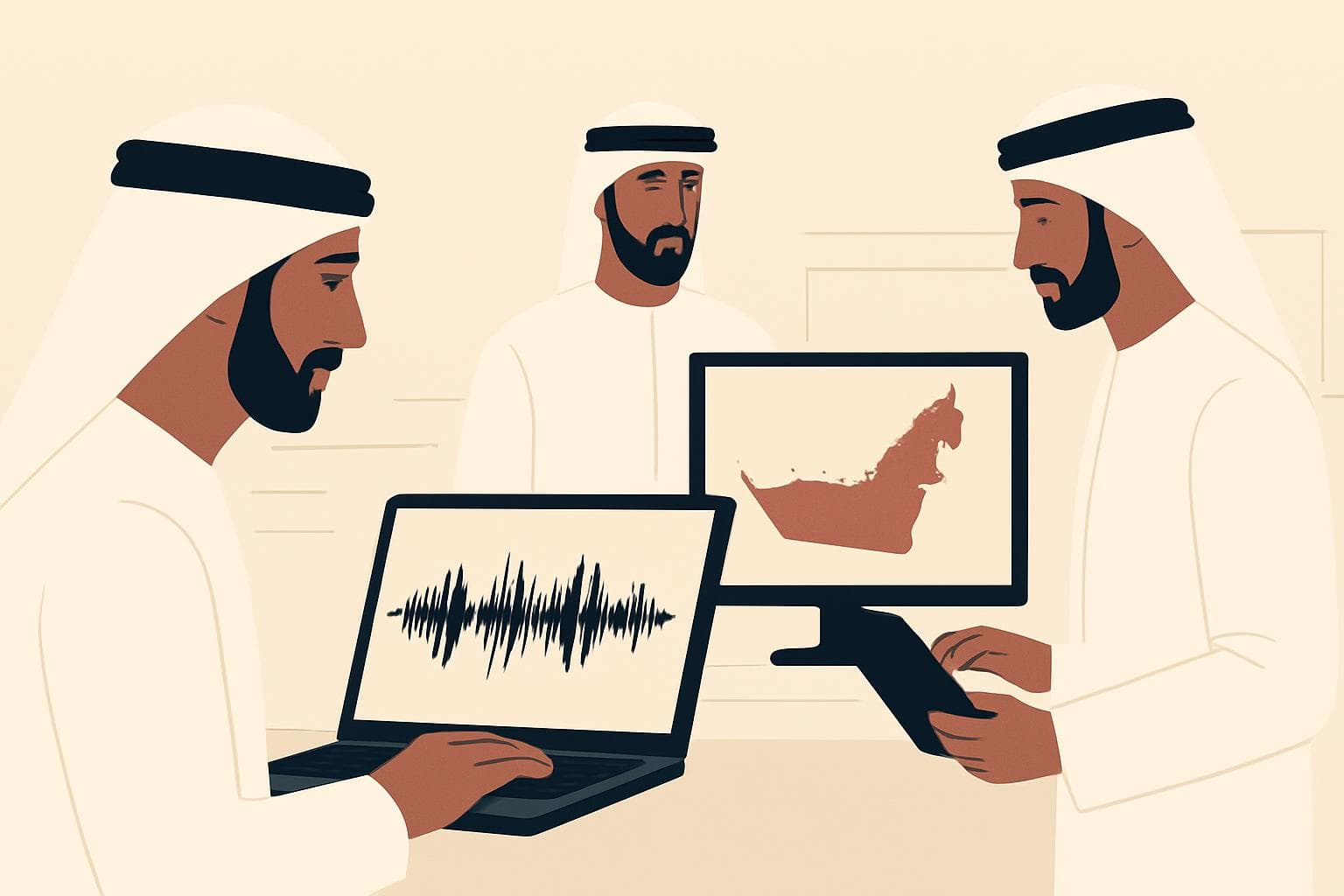
Abu Dhabi’s state-run research body, the Technology Innovation Institute (TII), has published a set of artificial-intelligence models trained specifically on the Emirati Arabic dialect. According to TII, the release aims to improve translation, transcription and voice-enabled services by incorporating local language usage and cultural references.
The released tools
TII says the package includes the Falcon-Emirati language model as well as models for speech recognition and for extracting Arabic text from images and documents. The institute highlights that these tools are relatively compact: in particular, the speech-recognition model contains 1.6 billion parameters and, according to TII, performs more accurately than a 30-billion-parameter model.
Why this matters
AI development for Arabic has lagged behind other languages in part because Arabic dialects vary widely. Many dialects can be hard to understand for people who only know Modern Standard Arabic—the variety used in news and textbooks. This dialectal diversity has led to notable machine-translation errors, sometimes producing culturally awkward or vulgar outputs in English.
TII’s approach is to reduce such mistakes by training models on local dialects, idioms and cultural references. The institute says this should make AI services more useful across the region and reduce misunderstandings caused by language mismatches.
Impact and outlook
TII’s work is part of broader efforts to close the gap in Arabic-language AI. Deploying compact, dialect-specific models could make local applications more practical for both private and public sector use, particularly where accurate speech recognition and appropriate contextual understanding are important.
Mohammed Sergie