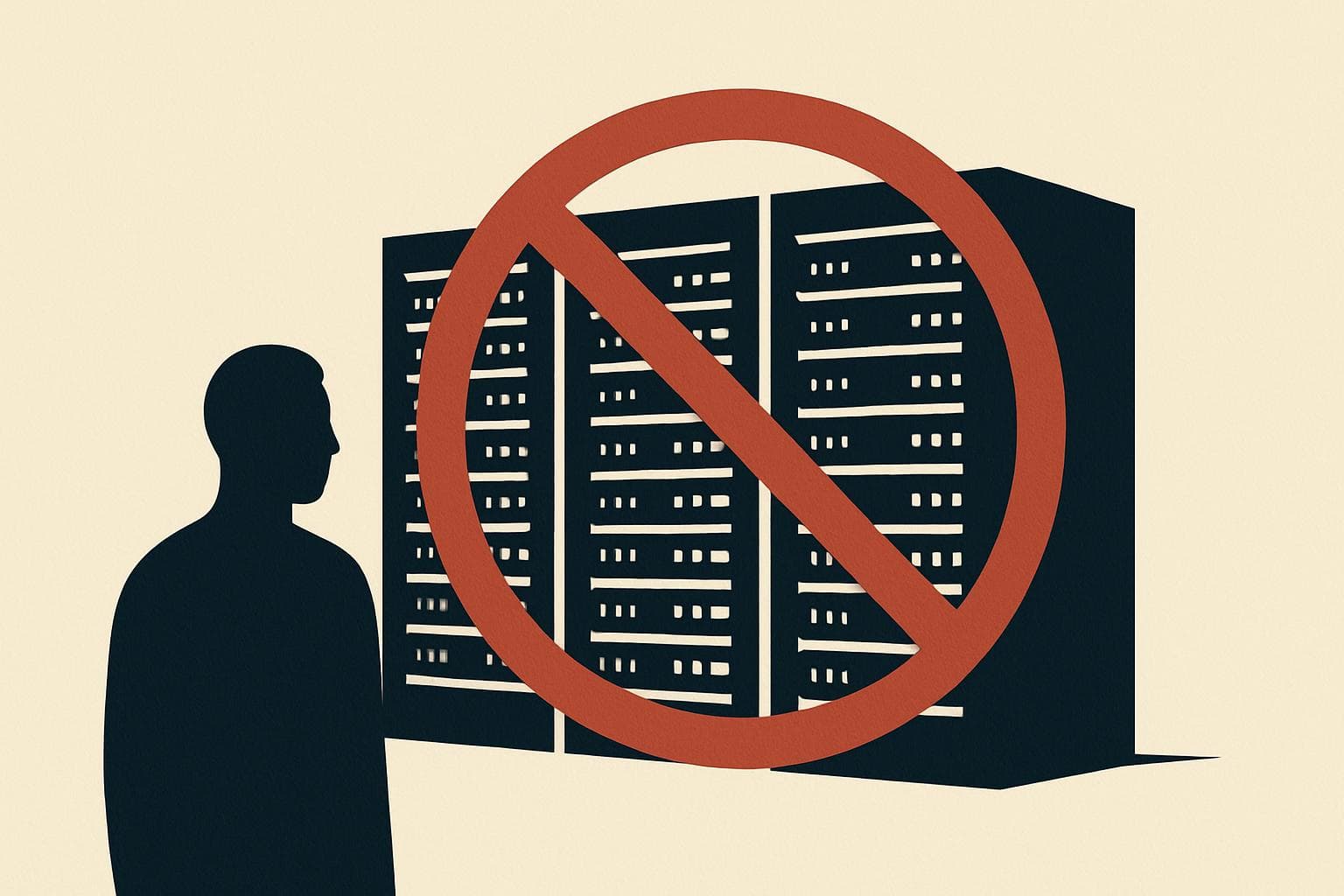
A recent poll suggests data centers have become a symbolic focus for broader public anger and fear about the future shaped by artificial intelligence — even though most opponents do not actually live near such facilities.
The survey was conducted by Milltown Partners and its results were shared first with Axios. Milltown Partners is a global public affairs and communications firm that advises leading AI labs and technology startups.
What the numbers show
- 38% of respondents said they would support a data center being built near their home, while 34% would oppose it.
- Support is stronger for a temporary construction moratorium: 49% back a pause on new data-center construction, while only 16% oppose a moratorium. Another 27% neither support nor oppose, and 8% said they don't know.
- Opposition to data centers does not mainly come from neighbors: among those who oppose data centers, only 8% reported knowing one or more data centers near their home.
Milltown Partners surveyed 6,872 registered voters between May 10 and May 20, recruited from online panels. The margin of error is +/- 3 percentage points. The poll oversampled voters in Texas, Georgia, Michigan, California, and North Carolina — states with ongoing data-center projects.
How to read the results
The split indicates many voters are not categorically anti-data center, but they are wary about the speed and terms of the buildout. A temporary moratorium could force companies and policymakers to provide clearer answers on costs, water usage and who benefits from the projects.
Tom Brookes, a researcher at Milltown Partners, said: "This isn't happening in a vacuum. The AI transformation is arriving at a time when Americans already feel angry, insecure and pessimistic." Warnings from various quarters that AI could cause mass job loss have also strengthened critics' arguments; figures across the political spectrum, including Steve Bannon and Bernie Sanders, have framed AI as a threat to working people.
Andy Hall, a professor at Stanford's Graduate School of Business and a senior fellow at the Hoover Institution, wrote on X that if unemployment rises by two percentage points and people attribute that to AI, the country could see a "real populist backlash."
Technology and workforce angles
The backlash and calls for pauses come as tech companies look for new ways to staff their data centers. Zhou Xian, co-founder and CEO of Genesis AI, told Axios: "People are building massive scale data centers everywhere and they're facing a severe labor shortage. That's the gap we want to fill." Genesis AI recently launched a new general-purpose robot designed to move in complex environments such as data centers.
Context from other research
Pew Research Center's April poll reached a similar conclusion: living near an existing or planned data center does not have a large effect on Americans' views of the facilities. Pew also found that two-thirds of planned data centers are in rural areas, while 87% of existing data centers are in urban locations.
Bottom line
The massive, windowless warehouses that house computing infrastructure have become a tangible symbol of wider anxiety about AI. Milltown Partners' polling shows public opinion is divided: outright local opposition is limited, but broader unease about economic and environmental impacts fuels substantial support for a temporary moratorium.