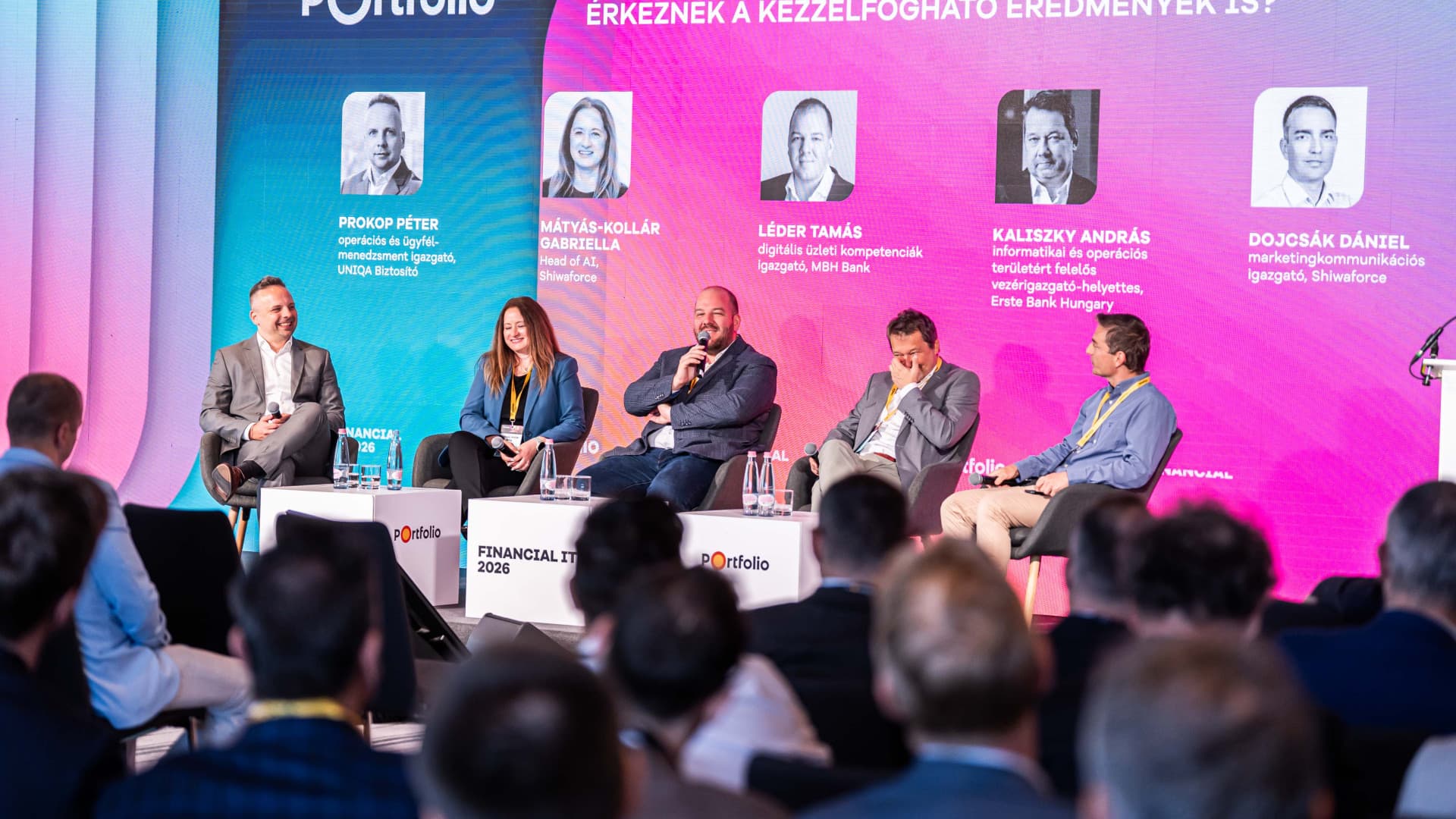
Artificial intelligence is increasingly present in the financial sector. At the morning panel of the Portfolio Financial IT 2026 conference, participants discussed how banks can achieve tangible results as quickly as possible. The session was moderated by Dojcsák Dániel, marketing and communications director at Shiwaforce.
Leadership and incremental change
Kaliszky András, deputy CEO of Erste Bank, emphasized that AI adoption within banks tends to spread through leadership. Rather than rewriting established processes wholesale, institutions are currently using AI to optimize and make incremental improvements. The learning phase inherently includes the possibility of mistakes, and outcomes depend heavily on data quality. Adopting AI is also a cultural challenge: organizations need to prepare for a longer-term transformation.
Agentic workforce and the role of experimentation
Mátyás-Kollár Gabriella, AI lead at Shiwaforce, said that introducing an agentic workforce currently holds the greatest transformational potential, and this focus informs her work. She argued for bold changes to processes and for removing as many constraints as possible: some processes will become automated, others will be augmented to better leverage human capabilities. Shiwaforce actively experiments with these approaches, and the panel encouraged attendees to do the same.
Practical challenges: customer preferences and internal resistance
Léder Tamás, director of digital business competencies at MBH Bank, pointed out that many organizations still do not know how to work with AI, and customers often prefer personal contact over demonstrably effective AI solutions. Nevertheless, he said AI can infiltrate operations even along indirect paths, and ideally a specialist team should be given the chance to prove its value. He also noted that banks often dislike when an experiment succeeds, despite the learning value of failures—especially in AI. Léder suggested that it might not always be appropriate to give customers a choice if an AI solution is more effective.
Integrating business and technology
Prokop Péter, operations and customer management director at Uniqa Biztosító, highlighted the importance of business teams understanding technology and vice versa. Uniqa has reworked its end-to-end claims-handling process to improve both efficiency and customer experience. Prokop said the biggest challenges are simplifying internal mindsets and managing and communicating the workforce implications of AI adoption.
Conclusion
Panelists agreed that AI transformation is a long-term endeavour requiring leadership commitment, high-quality data, a willingness to experiment, and close alignment between business and technology. Agentic workforces and augmentation are promising directions, but customer preferences and organizational culture will strongly influence how quickly tangible results appear.