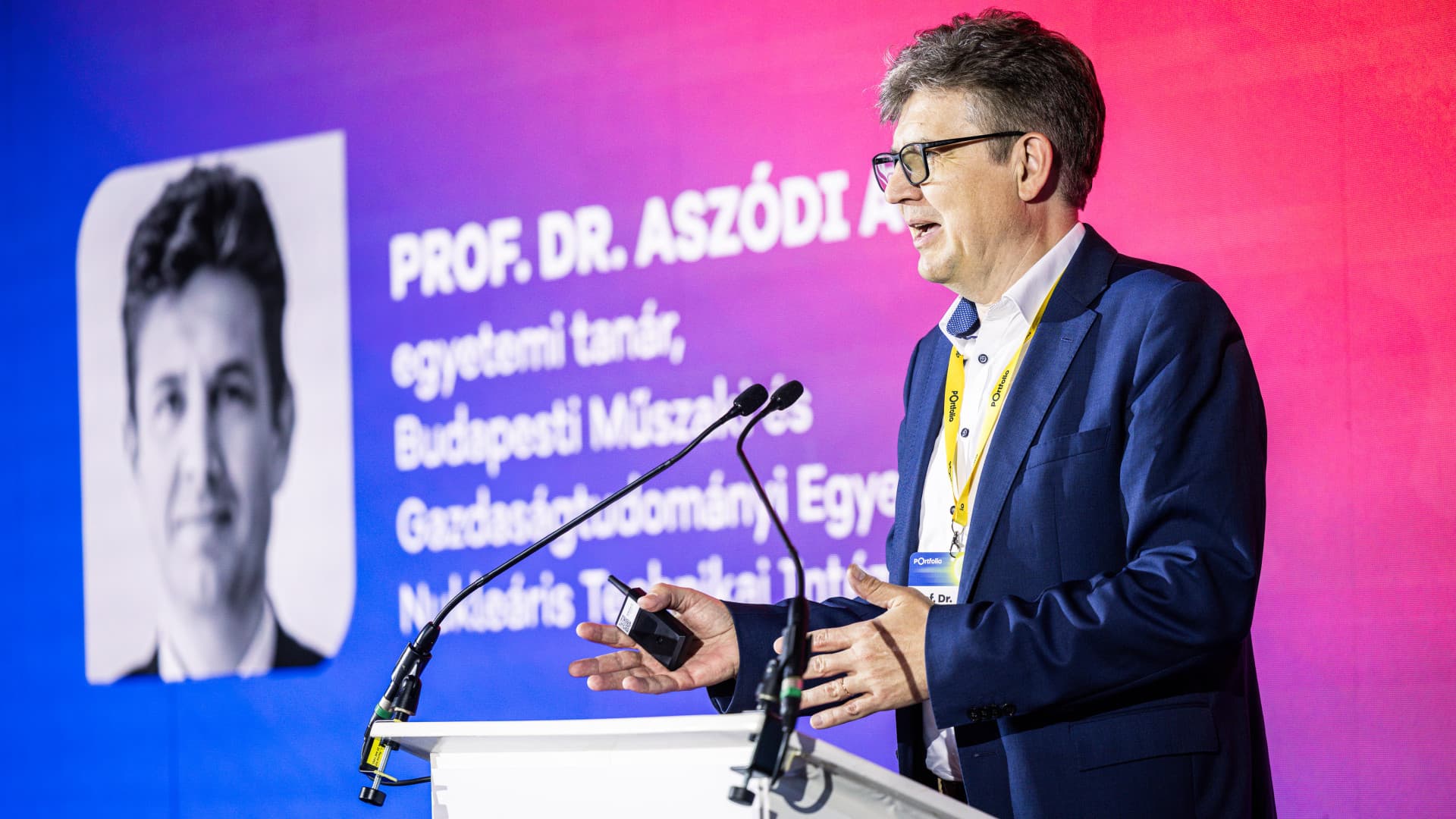
Data and artificial intelligence (AI) are playing an increasing role in operating and planning electricity systems, Professor Aszódi Attila of the Budapesti Műszaki és Gazdaságtudományi Egyetem (BME) Nuclear Technology Institute said at the Portfolio AI in Energy 2026 conference.
Aszódi pointed out that the transformation is driven not only by changes in energy sources but also by the growth of data: where a few large power plants once dominated, today there are hundreds of thousands of producers on the grid. As a result, system operation is becoming more stochastic—i.e., influenced by random processes—which traditional deterministic mathematical models describe less adequately. Machine learning and other AI-based methods can help address this shift.
Roles for algorithms in the energy sector
According to Aszódi, algorithms can be used for many tasks in energy, such as production planning, price forecasting, or maintenance scheduling. He emphasized, however, that the quality and quantity of data and the purpose for which algorithms are trained are critical. Large language models (LLMs) are part of today’s AI landscape, but for electricity-sector use cases machine learning techniques are particularly promising.
Rising power demand and investment responses
Aszódi also warned that new learning algorithms require substantially more computation and thus significantly more electricity—often 10–20–30 times the demand of previous methods. Citing an updated report by the International Energy Agency (IEA), he noted that the five largest tech companies invested more in AI over the past year than they did in gas and oil in overseas markets. Projections indicate that server-farm electricity demand could rise to around 1,000 TWh by 2030 and exceed 1,500 TWh by 2035.
Consequently, technology firms are making large investments to secure energy supply; Aszódi mentioned their involvement in developing small modular reactors as one example.
BME study: explainable AI for day-ahead price modelling
At the end of his talk, Aszódi presented BME’s latest research on AI-based modelling of European day-ahead electricity prices. The Budapesti Műszaki és Gazdaságtudományi Egyetem Faculty of Science (BME TTK) has been studying factors that affect European electricity markets for some time; in this project they tested the applicability of explainable AI algorithms.
The model was trained on ten years of data from 19 European countries. According to the researchers, the BME TTK development enables better and more accurate price forecasts for market participants, using freely available data and AI models that run quickly.
Aszódi reiterated that day-ahead market forecasting is one of the most complex tasks in the sector, but that explainable AI algorithms can be effectively applied—while stressing again that result reliability strongly depends on data quality and quantity.
Conclusions
The presentation’s main message was that the energy transition involves not only a change in fuel mix but also the emergence of a data-driven, learning-systems operating paradigm. This offers new opportunities for improved forecasting and optimization while posing significant challenges in data management, computation, and energy consumption.
Tags: data, energy, artificial intelligence, machine learning, research, BME, power sector, energy consumption, electricity market, algorithms