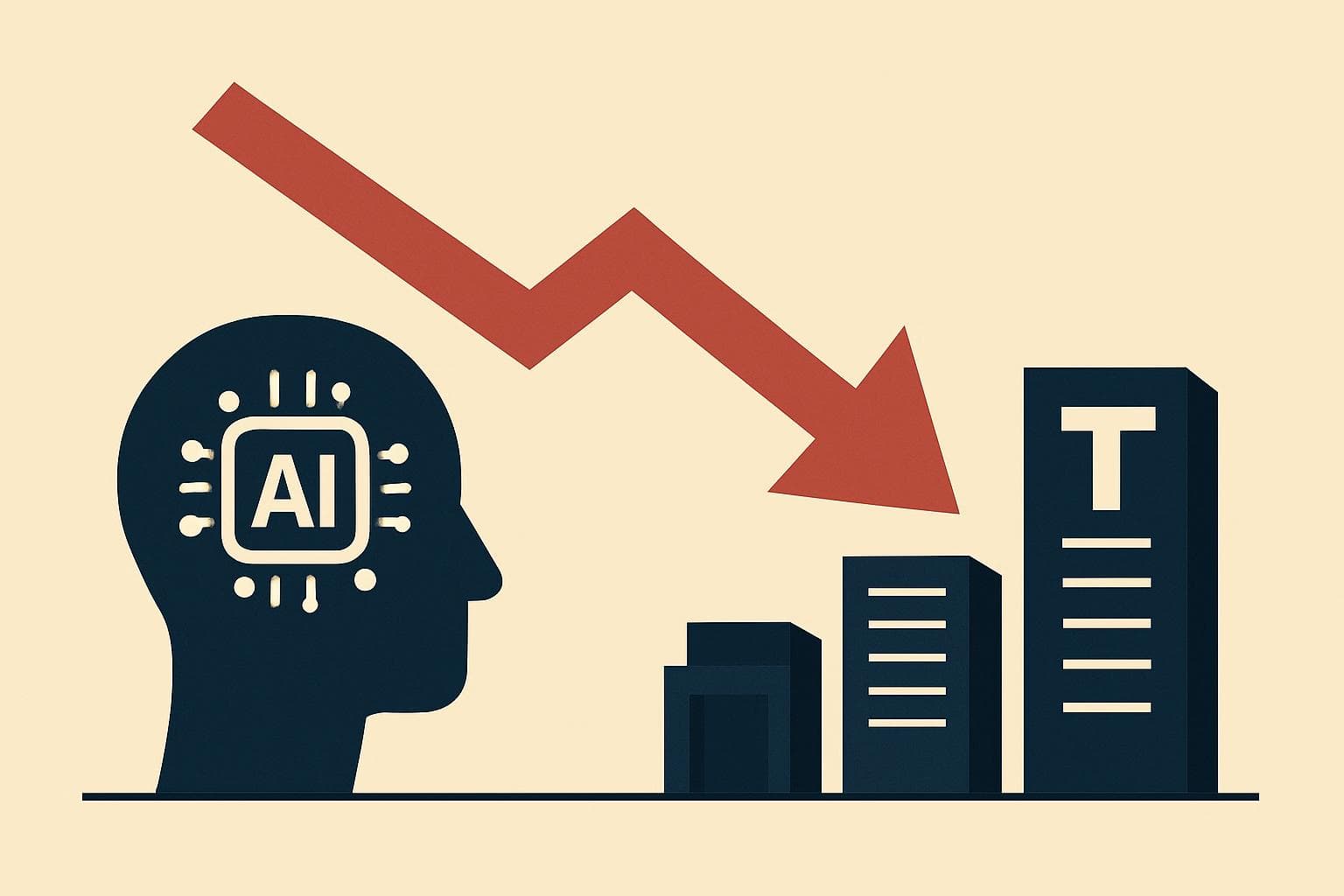
Investor confidence in the AI-led growth story that has driven Wall Street for more than three years suffered a notable setback on Thursday. The Bloomberg Magnificent Seven index, which tracks the seven largest US technology companies, fell about 4.8% intraday, erasing roughly $767 billion in combined market value — approximately HUF 244,800 billion.
Since its late‑May peak the group has already lost about 11%, equivalent to roughly $2 trillion (more than HUF 638,000 billion). Broader indexes also closed lower: the Nasdaq Composite down 2.15%, the S&P 500 down 1.21% and the Dow Jones down 0.97%.
What triggered the sell-off?
The initial downward move followed quarterly reports from Alphabet and Tesla, but investors were reacting to a larger question: when and with what returns will companies be able to monetise unprecedented spending on AI, data centres, chips, autonomous systems and robotics?
Alphabet reported an 82% increase in Google Cloud revenue, showing strong demand for AI-related compute. Yet the company lifted the top end of its capital‑spending guidance to $205 billion for the year — $15 billion higher than prior planning — and spent $45 billion on capex in Q2 alone. Its free cash flow turned negative by $5.9 billion for the quarter. Investors had previously valued Alphabet as a cash-generative business that could fund new initiatives internally; the shift toward much higher investment raised doubts about how quickly those investments will return cash.
Tesla’s adjusted earnings per share fell short of expectations — $0.31 versus $0.51 forecast — and the company spent $5.8 billion on investments in Q2, producing negative free cash flow of about $1.1 billion. Elon Musk told investors that 2026 will be a very heavy investment year and that Tesla needs to spend rapidly on projects such as a robotaxi service, the Optimus humanoid robot, proprietary AI systems and related manufacturing capacity. These projects do not yet produce revenue comparable to the traditional auto business. Tesla’s stock plunged 14.5% on the report.
SpaceX and earlier warning signs
SpaceX, which began trading in June, has also seen a sharp pullback: shares fell from a peak of $225.64 to near $115, reducing the company’s market value by more than $1 trillion — about HUF 319,000 billion, according to Bloomberg. Investors are reassessing whether very high valuations are justified by distant future growth and capital‑intensive development plans.
Wider risks beyond equities
The Bank of England‑quoted estimate cited in the market discussion suggests that AI‑related and supporting investments by major cloud and AI companies could exceed $700 billion this year (roughly HUF 223,000 billion). Up to $240 billion of that — nearly HUF 76,600 billion — might be financed by investment‑grade corporate bond issuance, exposing corporate credit markets, private credit funds and insurers to the risk.
Competition from Chinese AI developers, who are increasingly offering strong, often openly accessible and cheaper language models, could push down prices for AI services. If prices stay depressed, companies that have locked in large computing capacity but expect revenues later may face pressure. This dynamic could indirectly affect suppliers such as NVIDIA and data‑centre equipment vendors, because their revenue ultimately depends on customers’ ability to pay for and efficiently use the infrastructure.
Conclusion
Thursday’s market rotation does not necessarily mean the AI opportunity is collapsing: demand for infrastructure and some cloud revenues remain visible. But investors have begun to scrutinise the timing and profitability of AI investments more closely rather than assuming unlimited patience. The risks now reach beyond equity valuations to credit markets and insurers, while global competition — notably from Chinese developers — adds another layer of uncertainty.