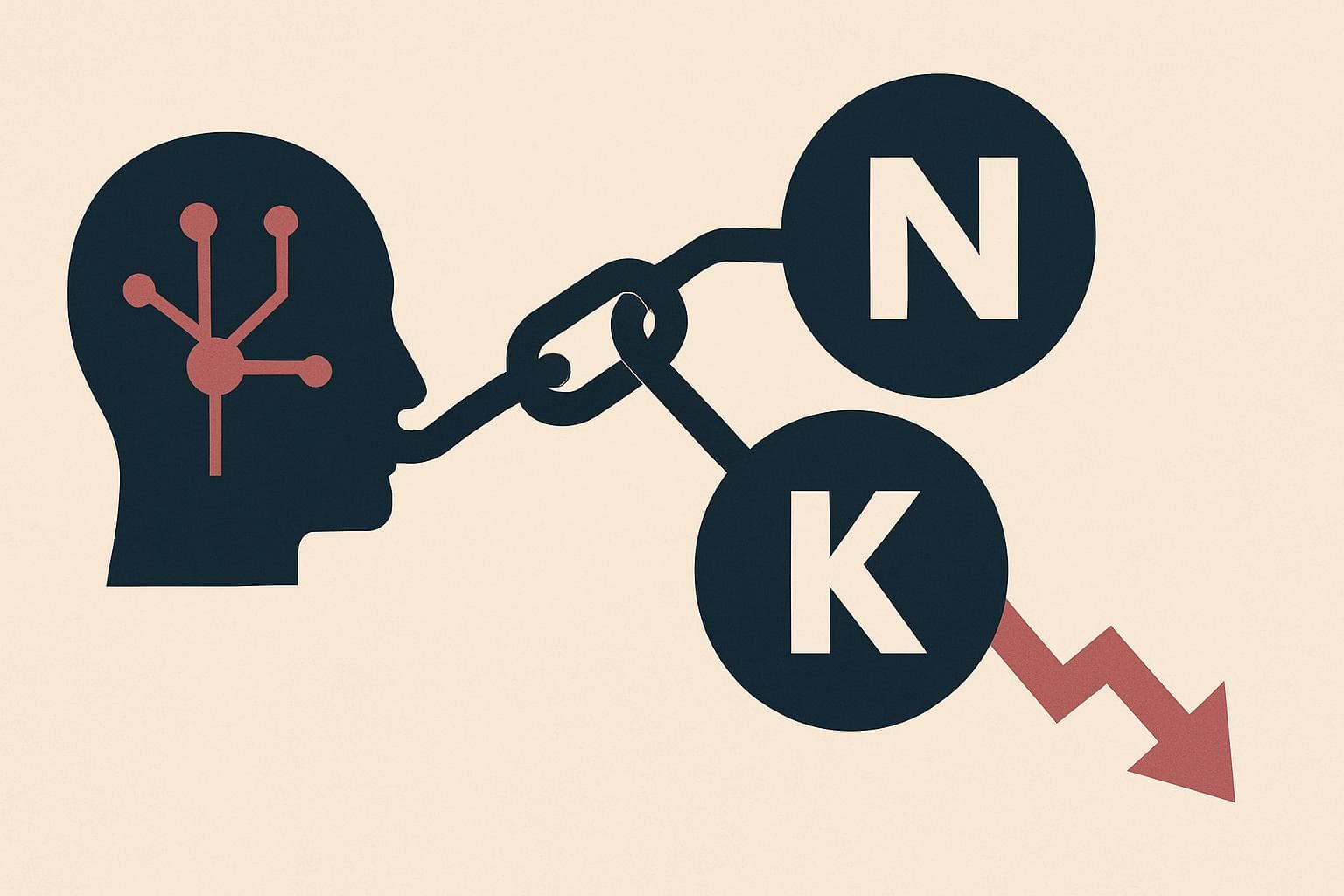
Investments directed at artificial intelligence hardware have increasingly linked the performance of Wall Street technology stocks with South Korea’s equity market. Data from Rayliant show the 60-day correlation between the KOSPI and the Nasdaq 100 recently rose to about 0.50 — the highest level since 2021.
What’s driving the link?
The closer connection reflects the growing weight of Samsung Electronics and SK Hynix within the KOSPI: together the two companies now account for more than half of the Korean index. Both firms are key nodes in the AI hardware supply chain because they manufacture memory chips used by large U.S. data centers operated by hyperscalers.
Rolf Bulk, an analyst at Futurum Group, said the KOSPI has effectively become a semiconductor-focused index. The dependence of Samsung and SK Hynix on the investment cycles of hyperscalers increasingly ties Korean and U.S. technology stocks together.
DRAM’s role and predictive value
DRAM (Dynamic Random-Access Memory) is a fundamental component of AI servers. Analysts estimate data centers accounted for about 40 percent of global DRAM demand last year and that share has exceeded 50 percent this year. That dynamic allows Asian markets to provide an early read on global AI demand before U.S. markets open.
Jung In Yun, founder of Fibonacci Asset Management, noted that shares of Samsung and SK Hynix often provide the first liquid-market reaction to overnight developments affecting global AI demand. SK Hynix in particular has become an important indicator because of its role in the high-bandwidth memory (HBM) market, a critical element in AI supply chains.
Recent market moves illustrate the pattern
A clear example occurred on July 13: the KOSPI fell by more than 8 percent, driven largely by a 15 percent, record decline in SK Hynix shares. On the same day the Nasdaq 100 closed down 1.88 percent. Major U.S. technology and chip names also fell: Micron Technology lost 4 percent, Sandisk fell 12 percent, and Intel declined 6 percent.
Diversification benefits are shrinking
Analysts warn that rising correlation reduces the geographic diversification benefits investors traditionally sought by holding both U.S. and Korean equities. Phillip Wool, head of research at Rayliant Global Advisors, said U.S. and South Korean tech stocks are increasingly moved by the same fundamental factor — investor sentiment about the AI hardware market. As a result, Korea no longer provides the same diversification shield versus U.S. tech stocks that it once did.
Bulk also pointed out that shares of Korean memory chipmakers are inherently more volatile than many U.S. chipmakers, and flows into leveraged ETFs can amplify price moves.
Potential divergence and new risks
While Micron, Samsung and SK Hynix are currently benefiting from rising DRAM prices, Peter Kim, head of global investment strategy at KB Financial Group, said differences in capital expenditure, product portfolios and state support for U.S. chip manufacturing could produce diverging performance over time.
A further emerging risk is the rise of China’s memory-chip industry. Although Chinese manufacturers remain behind global peers technologically, their progress often exceeds investor expectations: Changxin Technology Group (CXMT) saw its shares rise 466 percent on their debut day on the Shanghai STAR Market, making CXMT the most valuable company listed on that Chinese exchange on that day.
Conclusion
AI-driven investment flows have tightened the link between the Nasdaq and the KOSPI, improving short-term market signaling but eroding geographic diversification and increasing volatility. Investors should monitor developments in the memory market and China’s advancing capabilities, both of which could have further implications for global technology equities.