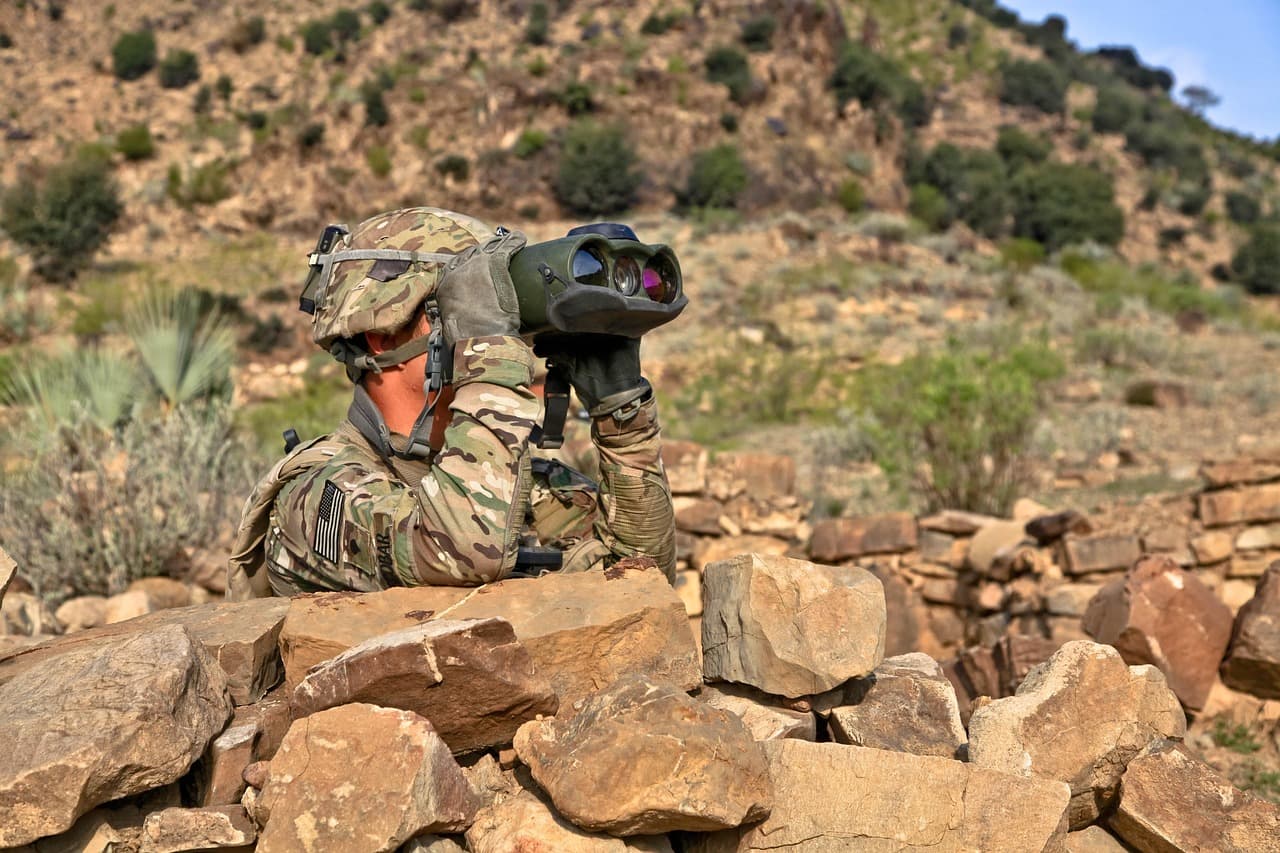
Artificial intelligence (AI) has moved beyond corporate and office use and is now part of modern warfare, especially where fast decisions and data processing directly affect human lives. In a recent episode of the podcast “The Big AI Story,” László Csicsmann, professor at Corvinus University and lead researcher at the Hungarian Institute of International Affairs, said many experts describe the Middle Eastern conflicts as the first significant AI-era wars. Regular podcast guest Petra Aczél, communication researcher and professor at Széchenyi István University, also participated in the discussion.
Systems and capabilities discussed
Csicsmann highlighted Maven, a Pentagon-linked system that functions as an integrated data-processing tool to assist target selection. Systems like Maven aggregate satellite imagery, mapping data and intelligence reports, then present commanders with recommendations on which assets could strike a given target. The Israeli Lavender system received attention in connection with the Gaza conflict; such systems use large datasets to help identify, track and designate individuals or structures as targets.
Main advantages of these technologies include:
- Rapid aggregation and processing of data, enabling the assessment of thousands of potential targets in a time frame impossible by manual means.
- Defensive applications — for example, AI-supported missile defense systems that calculate trajectories and decide interception timing.
Limits and risks
Csicsmann stressed that AI is not infallible: outputs are only as good as the input data. If the information fed into a system is erroneous, incomplete or misleading, the resulting target recommendations and tactical decisions can also be wrong. Another major problem is the radical shortening of decision time: commanders often receive recommendations that require very quick approval for strikes, increasing pressure on human decision-makers.
Asymmetric warfare presents a particular challenge for AI-driven forces. Csicsmann noted that in cases involving Iran and Hamas, one side may operate with advanced satellites, drones, software and integrated AI systems, while the other uses cheaper, simpler and harder-to-track tools. When there is insufficient digital data or the adversary leaves no identifiable trails, the effectiveness of AI-based systems declines.
Technological superiority is not static: while defensive systems such as missile defenses can achieve high protection rates, they are costly and sustainment becomes critical in prolonged conflicts. Adversaries can learn and adapt — for example, by exploiting a defense system’s vulnerability to large numbers of inexpensive simultaneous drone or rocket attacks.
Ethical and operational dilemmas
A central dilemma is how to separate combatants from civilians in environments where armed groups are embedded in society. Machines detect patterns and recommend targets, but social and environmental context is often not fully reflected in digital data. Thus, technological advantage alone does not guarantee accurate or ethical decisions.
Geopolitical and strategic implications
Csicsmann pointed out that AI warfare is linked to the global technology competition: it connects to the US–China rivalry, semiconductor manufacturing, supercomputer exports, university visa restrictions and technology orientation in the Global South. Therefore, the issue is not only whose algorithms are best but also who has access to chips, data centers, satellite information and military integration.
As a result, data centers, communication infrastructures and technological hubs may become primary strategic targets in future wars. Warfare will not become purely digital, but data and infrastructure will increasingly be strategic objectives comparable to bridges, airports or military bases.
Conclusion
The podcast discussion indicates that AI fundamentally changes military decision preparation and the functioning of defensive systems, but it does not eliminate core limits of warfare. AI speeds up information processing and can increase effectiveness, yet accuracy and ethical compliance heavily depend on data quality, the time available for commanders to decide, and the adversary’s capacity to adapt. In future conflicts, infrastructure and access to data will be crucial strategic factors.
Podcast timestamps (from the episode)
- How does AI appear in US military technology? (00:32)
- What data do military AI systems use? (02:11)
- How much does AI accelerate military decision-making? (06:11)
- Why is asymmetric warfare difficult? (07:09)
- You cannot win a war solely from the air and with AI-guided strikes (11:10)
- Dangers of autonomous weapon systems (13:35)
- Data centers and digital infrastructures as strategic targets (19:46)
- Where can AI succeed in missile defense systems? (23:19)
- How long might the Middle Eastern conflict continue? (32:16)
Previous podcast episodes are available in the editorial archive.