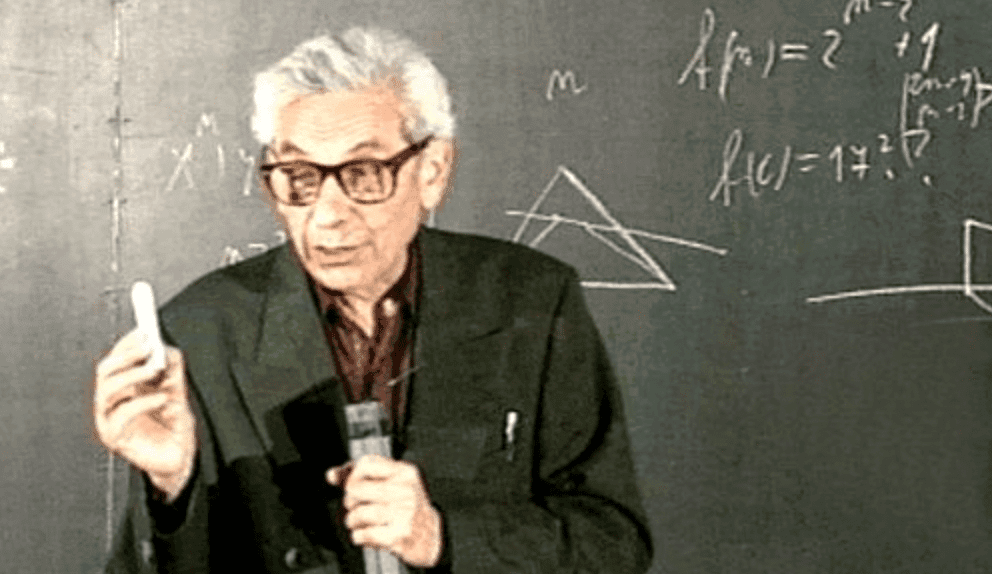
Pál Erdős was one of the most prolific and influential mathematicians of the twentieth century; many of his conjectures and questions, often deceptively simple in statement, continue to drive research. In 1946 Erdős proposed a conjecture about arrangements of points and unit-length segments in the plane: for a given number of points, the square lattice (the regular grid of points) provides the maximal number of unit-length connections (edges). In other words, the familiar square grid was conjectured to be optimal for maximizing unit distances among points.
The core assertion is that as the number of points grows, the count of unit-length edges grows roughly proportionally to the number of points, and that the lattice arrangement attains the largest possible density in the infinite limit.
According to recent reports, an artificial intelligence system has produced a configuration that contradicts Erdős's 1946 conjecture: the AI-found arrangement yields more unit-length connections for the same number of points than the standard square lattice. This construction therefore serves as a counterexample to the conjecture in its simple, general form.
Why this matters
- Historical and theoretical impact: Erdős’s conjecture guided decades of work in combinatorial and geometric graph theory. A counterexample forces a reassessment of conclusions that assumed the lattice’s optimality.
- Methodological significance: the event highlights that AI and computational search can do more than numerical experiments; they can find explicit, constructive counterexamples to abstract mathematical statements.
- Consequences for the field: strategies for proving extremal results about unit distances and graph arrangements must be revisited. Future work will likely focus on understanding and generalizing the constructions the AI produced.
The available notice does not provide technical details about the AI’s methods, the exact number of points involved, or the precise structure of the found configuration. Such specifics are essential for the mathematical community to verify the result, determine whether it generalizes, and decide if the counterexample overturns the conjecture in a broad sense or only in particular instances. Nevertheless, the episode is another example of computational tools and AI becoming active contributors to contemporary mathematics.
A brief historical note: Erdős’s 1946 formulation relied on an intuitive picture — reminiscent of graph paper — and for many years the lattice’s optimality was a common belief. The new AI-produced counterexample challenges that intuition and opens new directions for research on extremal arrangements and unit-distance graphs.
Next steps: mathematicians will need to formally check the AI’s construction, investigate possible generalizations, and determine whether stronger counterexamples exist or whether restricted versions of the original conjecture remain valid.