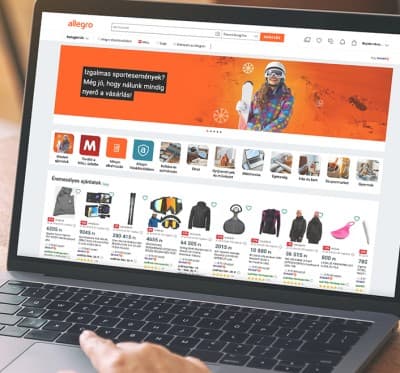
Allegro, the largest European-rooted online marketplace in Central and Eastern Europe, opened 2026 with group-level results that beat expectations. In the first quarter of the year the consolidated gross merchandise value (GMV) rose by 12.8%, revenue increased by 16.5%, and adjusted EBITDA grew by 23.6% compared with the same period a year earlier. The platform currently serves 20.4 million active buyers across the region.
Strong performance in international markets, including Hungary
The most rapid expansion came from Allegro’s international markets — Hungary, the Czech Republic and Slovakia — where GMV grew 67.5% year on year. Those three countries together account for 4.9 million active buyers, roughly 26% of the online shopper base in their markets.
Following these results, Allegro raised its annual guidance for the international division: it now expects GMV growth of 40–45% and revenue growth of 25–35% for the year. The company aims for its international marketplaces’ GMV to exceed the 2025 level by more than 1 billion złoty (84.3 billion forints) by the end of 2026, and it targets break-even for its international operations by 2029.
Increasing marketing and brand investments in Hungary
After a low-key launch in Hungary in October 2024, Allegro is significantly increasing investments in marketing and brand-building in 2026. The company is promoting its competitive pricing, wide product selection, reliable delivery, buyer-protection measures and its Europe-focused marketplace model built on local and regional sellers.
Hungarian consumers are characterized by price sensitivity and deliberate purchasing behaviour, and Allegro positions itself as a reliable, practical choice for cost-conscious everyday shopping. In Q1 2026 the largest shares of allegro.hu’s traffic came from electronics, supermarket goods and automotive products. Categories that support everyday quality of life — health & beauty, sport, and construction & industrial products — all recorded almost fivefold year-on-year growth.
Regional growth opportunities for Hungarian sellers
Allegro’s Europe-focused operating model aims to keep value generated on the platform within the region. The company’s ecosystem comprises tens of thousands of small and medium-sized enterprises, which increases resilience against international logistics challenges and rising cross-border costs.
The number of sellers with Hungarian tax numbers rose by 71% year on year, indicating that the platform is becoming an increasingly important growth channel for local businesses. Allegro’s “list once, sell everywhere” approach allows Hungarian merchants to appear on the Polish, Czech and Slovak marketplaces without separate listings.
To reduce the technical burden on local merchants, Allegro has entered a strategic partnership with Shoptet, one of the region’s leading e‑commerce platform providers. Shoptet users in Hungary can connect their webshops to allegro.hu, reaching new customers without bespoke development or building new international infrastructure.
Allegro is also offering incentives for new partners: sellers can list with a 0% commission for the first 180 days, and Hungarian merchants can benefit from 0% commission on exports to the Czech, Slovak and Polish markets.
AI development at the core of Allegro’s strategy
AI-based solutions are a central part of Allegro’s group strategy, aimed at improving both seller and buyer experiences. An AI assistant for merchants, following positive early feedback, is now available to all Allegro partners. The tool helps create offers, manage sales and logistics processes, and optimise day-to-day operations.
Artificial intelligence is also making marketing more efficient and accelerating product development. Allegro has started a collaboration with OpenAI, the developer of ChatGPT. The partnership provides access to advanced AI technologies, implementation and optimisation support, and access to OpenAI’s latest models and features to design, test and deploy new e-commerce solutions.
Conclusion
In 2026 Allegro is pursuing a dual strategy of expanding its regional marketplaces and investing in AI-powered tools. The company is increasing its marketing presence in Hungary and strengthening support for local merchants through technical partnerships and commercial incentives, while its cooperation with OpenAI may unlock additional product and service innovations across Central and Eastern Europe.