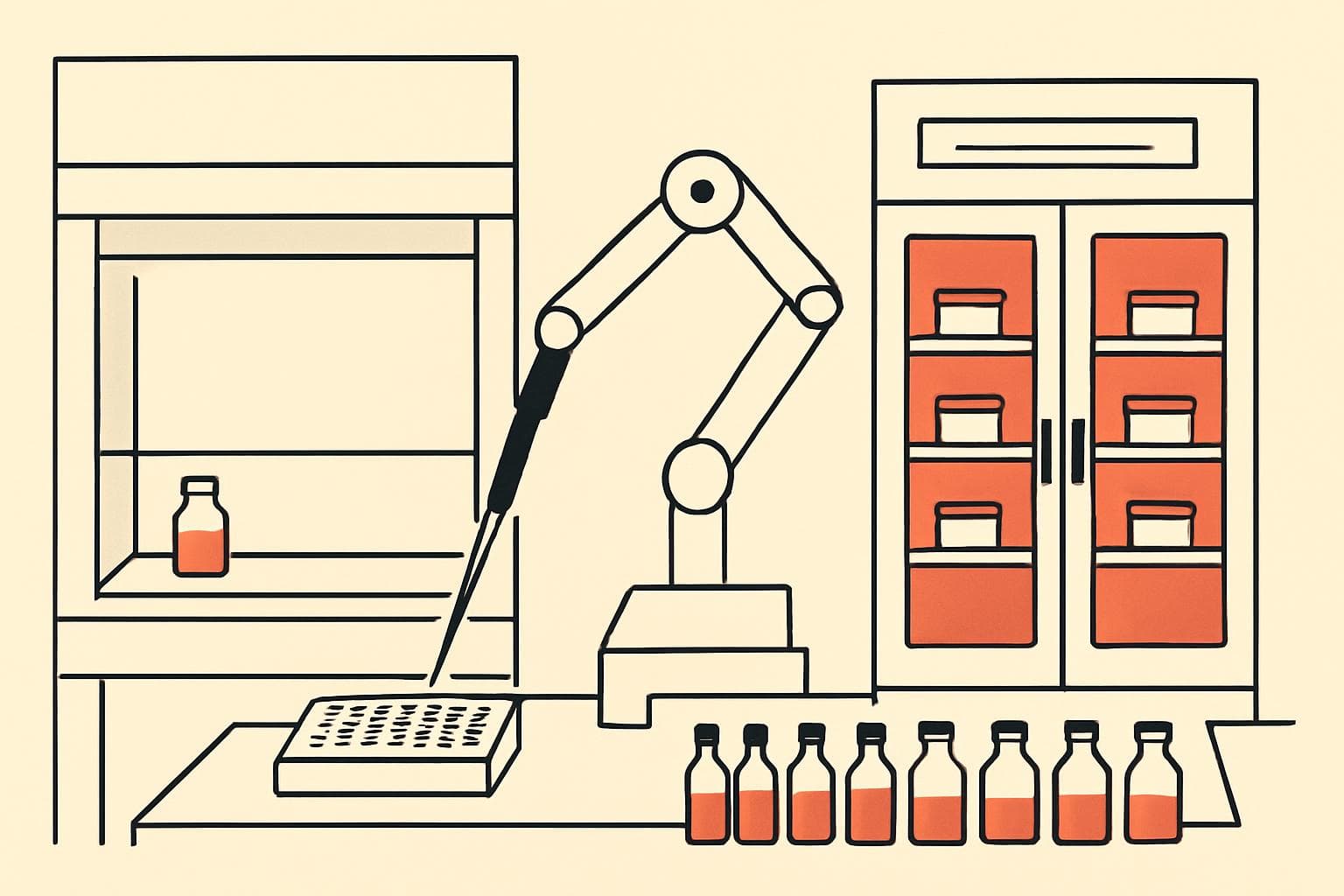
Anthropic, the AI startup known for its Claude models, has established its own experimental biology laboratory in the San Francisco Bay region and is conducting physical laboratory experiments in addition to computational simulations, Reuters reports.
Eric Kauderer-Abrams, the company’s scientific lead, said that while digital modeling plays a major role, real laboratory work remains the decisive test in biology. For that reason Anthropic is running experiments both in its own lab and in the facilities of other companies. A company spokesperson clarified that the in-house lab is not dedicated specifically to drug discovery.
Aiming for Claude to control lab robots
Anthropic is working toward enabling Claude to directly control robotic units that carry out laboratory procedures with minimal human intervention. Kauderer-Abrams emphasized that automation of lab work is still at an early stage but holds substantial potential to accelerate experimental workflows.
In August the company published the Model Hardware Standard, a specification intended to allow AI systems to directly interface with and control laboratory equipment.
Investments and life-sciences initiatives
In June Anthropic announced plans to initiate preclinical drug programs focused on areas that traditional pharmaceutical companies find financially unattractive. Since then the company has launched Claude Science software, added Vas Narasimhan, chief executive of Novartis, to its board of directors, and acquired the startup Coefficient Bio in a stock deal worth about $400 million.
Life sciences work has become one of Anthropic’s largest investment areas in terms of staff and resources. Kauderer-Abrams said AI could speed up discovery in modalities such as bispecific and trispecific antibodies—complex molecules that can target multiple biological sites simultaneously.
No clinical trials yet; not competing directly with pharma
Anthropic says it is not conducting clinical trials and does not intend to compete directly with established drugmakers. Even if a drug candidate were identified, bringing it to market would still take years. By comparison, Alphabet’s drug-research arm Isomorphic Labs has long sought to advance candidates to clinical phases and previously pushed its own target into late 2026.
Trust and data concerns from pharmaceutical partners
The company’s move into lab work raises trust issues for some pharmaceutical clients, including Genentech, Bristol Myers Squibb and Novo Nordisk, which may fear Anthropic gaining access to competing program data. Kauderer-Abrams said Anthropic has drawn clear boundaries: it will not bring drugs to market and will focus on areas that the pharmaceutical industry currently overlooks.
Why this matters
Anthropic’s steps illustrate the growing convergence of AI and biotechnology: AI is moving beyond purely computational roles into direct experimental involvement. Successful automation and AI-driven lab work could accelerate research in neglected therapeutic areas, but also introduce new ethical, privacy and competition challenges.
The article’s lead image was generated by artificial intelligence. An AI assistant contributed to preparing this piece; the final content was edited and verified by the journalist.