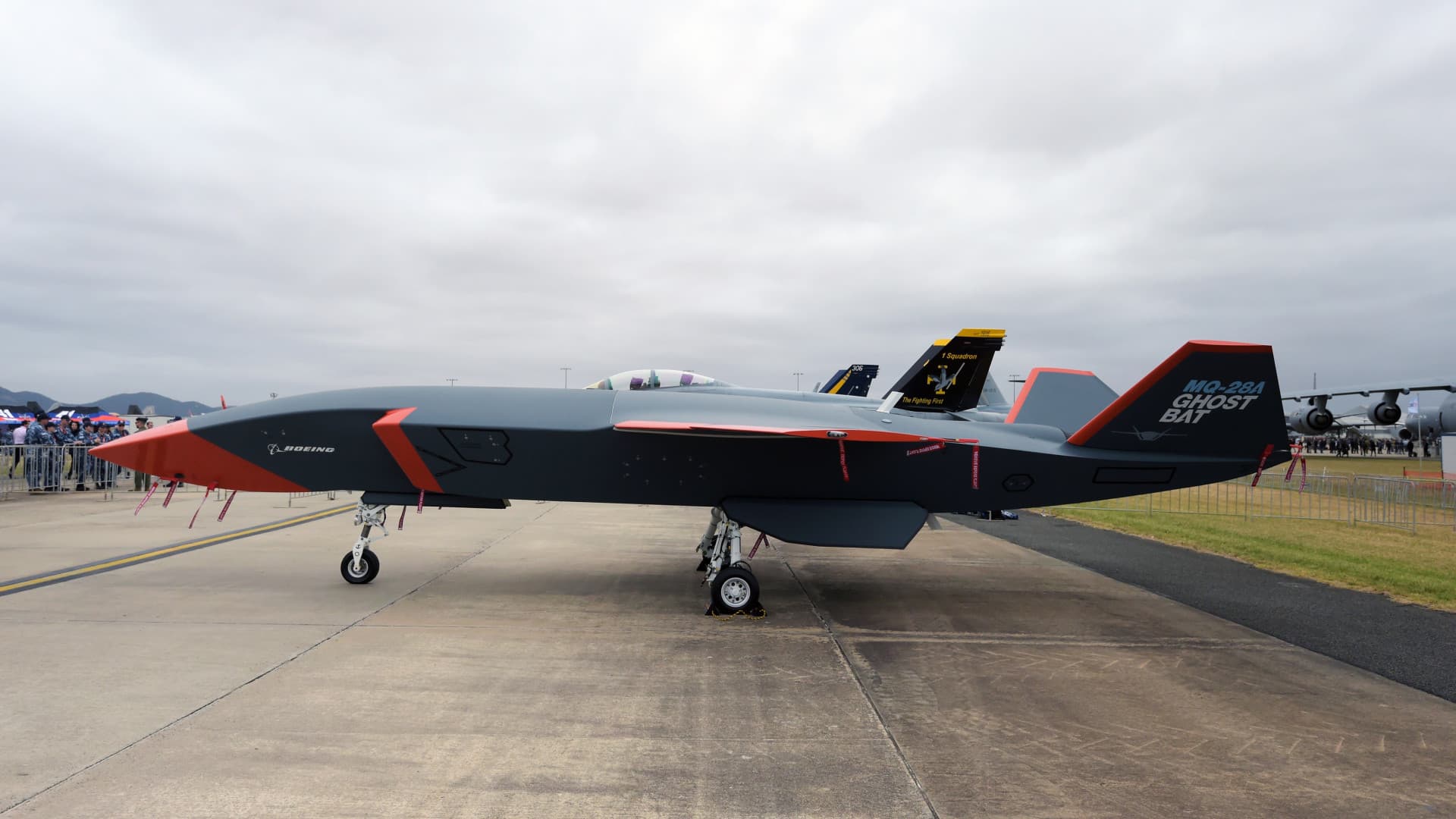
Boeing Australia has started test flights of the MQ-28 Ghost Bat unmanned aerial vehicle (UAV) from the U.S. Navy’s Point Mugu base off the coast of Southern California. According to reporting by The War Zone (TWZ) and a Boeing statement, the Ghost Bat completed at least three missions on the Point Mugu maritime range.
Boeing described the base as an ideal test site for unmanned aircraft because it sits directly on the ocean and is surrounded by agricultural land, reducing risks to civilians. The company called the activity the MQ-28’s “first international operation conducted in allied airspace,” although it did not disclose the exact start date of the tests.
Footage released by Boeing shows the Ghost Bat in a two-tone grey paint scheme and fitted with an infrared search and track (IRST) sensor integrated into the nose. That aircraft differs from an earlier orange-marked example that appeared in the background during a Point Mugu visit by Secretary of Defense Pete Hegseth in December of last year.
Design, blocks and capabilities
The MQ-28 uses a modular design with a quickly replaceable nose section, allowing different sensors and payloads to be carried. The type has flown in Australia since 2021, and the Royal Australian Air Force (RAAF) has taken delivery of eight pre‑production Block 1 examples to date.
Boeing is currently working on the first aircraft of a nine‑aircraft Block 2 series, which is intended as an intermediate step toward a combat‑capable Block 3 variant. The Block 3 is planned to be substantially larger, with increased range and an internal weapons bay. According to the reporting, the internal bay will be able to carry either one AIM-120 AMRAAM medium‑range air‑to‑air missile or two GBU-39/B small diameter bombs.
Block 1 aircraft have already conducted a live AIM-120 missile launch and successfully demonstrated cooperative operations with E-7A Wedgetail airborne early warning and control aircraft and with F/A-18F Super Hornet fighters.
Export ambitions and international talks
Boeing has been public about its export ambitions for the Ghost Bat. The company has explicitly named Japan as a potential buyer. In March, Boeing and Rheinmetall offered the Ghost Bat to Germany. Earlier, Boeing proposed a carrier‑capable, arresting‑hook version to the United Kingdom. The company is also in talks with several, as‑yet‑unnamed Indo‑Pacific countries.
Why Point Mugu matters: the U.S. Navy’s carrier‑borne CCA effort
The Point Mugu tests have significance for the U.S. Navy’s carrier‑based Collaborative Combat Aircraft (CCA) program. In September 2025 the Navy awarded contracts to Boeing, Anduril, General Atomics and Northrop Grumman to develop concepts for carrier‑based, collaborative combat drones.
The fleet has previously expressed strong interest in the MQ-28’s AI-driven autonomy and modular architecture. At the same time, the Navy itself acknowledges it is behind the Air Force and Marine Corps on similar drone developments, and its carrier drone program remains in formation.