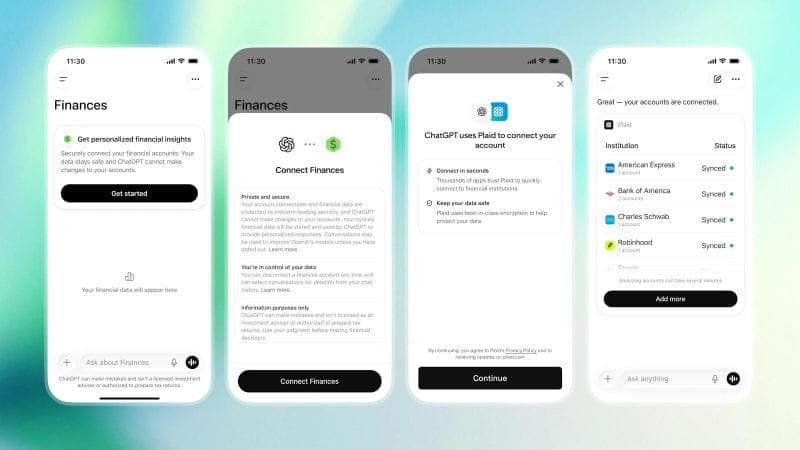
Paid ChatGPT customers in the United States can now link their actual bank accounts, credit cards and brokerage accounts to the chatbot and ask questions that use live account data — for example, “have I been spending more lately?” or “help me plan to buy a house in five years.”
Which institutions are supported
The rollout covers more than 12,000 financial institutions, and the announcement lists names including Chase, Schwab, Fidelity, Robinhood and American Express. The company says tax software integrations are planned as a next step.
Why this matters for user behavior
OpenAI reports that roughly 200 million people ask ChatGPT money-related questions each month; until now users typically had to type their numbers or summaries manually. With this feature, the chatbot can access a user’s real account information and generate answers or recommendations based on those records, potentially providing responses before a user opens their bank or broker app.
Practical implications
Users can use the connection to compare spending trends, monitor savings, or request planning help for larger financial goals such as purchasing a home, with suggestions grounded in their actual account balances and transactions. Because the chatbot can see live data, the answers can be more specific than when users input figures by hand.
Points to note
The announcement emphasizes broad institutional compatibility and strong user interest, but the public summary does not detail aspects such as exact access mechanisms, data‑protection guarantees or the security measures of the integrations. Also, the capability currently applies to paid ChatGPT users in the United States.
Summary
By enabling direct access to real account data, ChatGPT positions itself closer to users’ financial decision points: it can now analyze live financial information and provide tailored responses, which may shift where people go first when they have money questions.