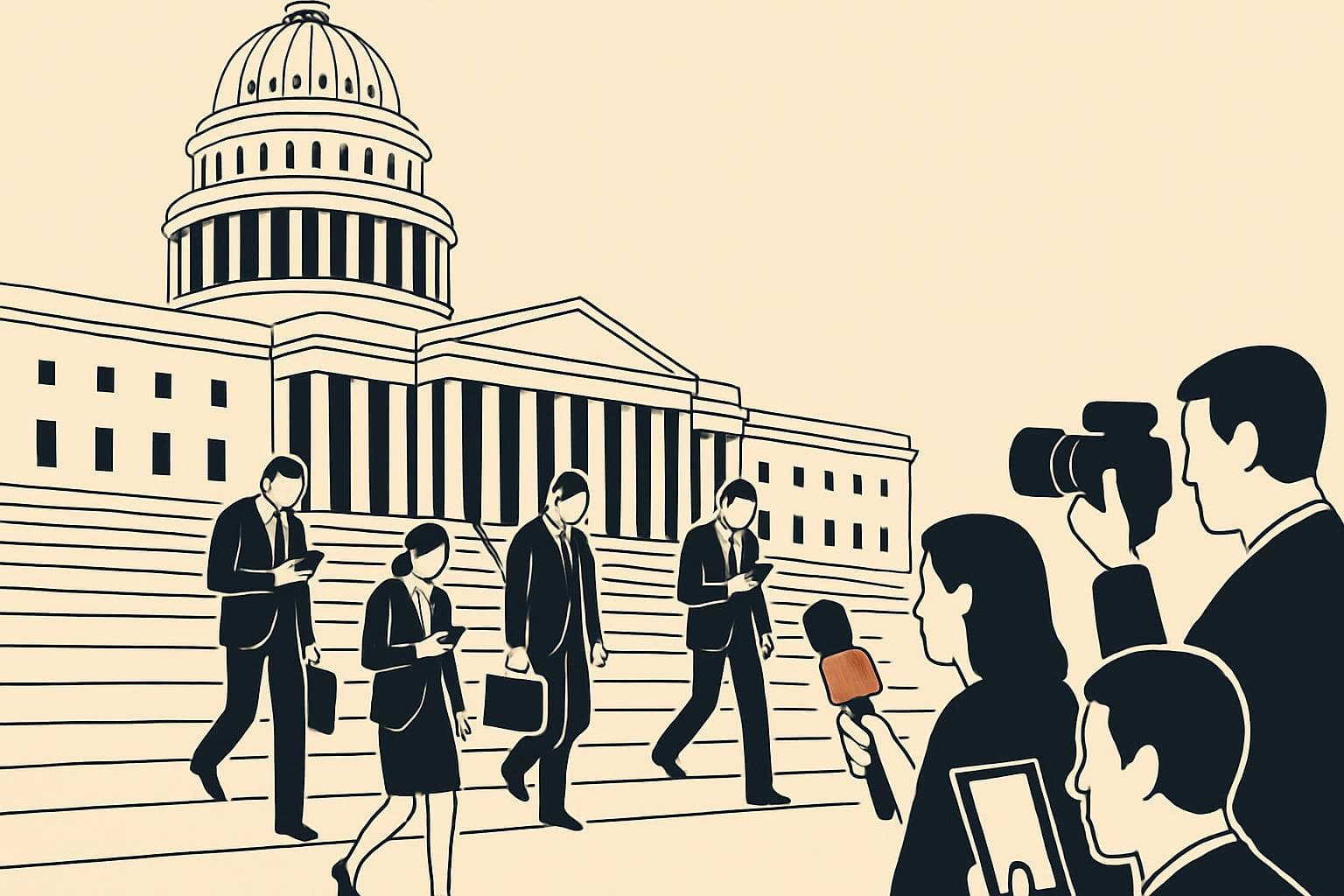
Three accelerating developments are reshaping the AI landscape and forcing real-time strategy shifts across governments, companies and investors: the rapid growth of large models and agentic capabilities, a U.S. administration moving toward more prescriptive oversight, and discussions in both Washington and Beijing about restricting foreign access to the most advanced AI systems. These dynamics are converging and changing how stakeholders plan.
1. Models are getting bigger and more capable
Media coverage often frames capability gains as incremental, but the last few months have shown transformational jumps. Anthropic’s Fable and Mythos models — which the company restricted for nearly three weeks in June due to security concerns — have raised expectations for frontier AI. Engineers report entrusting multimillion-line codebases to these models and relying on them for rebuilding outdated systems, fixing bugs and testing their work with surprisingly little oversight.
After a "voluntary" delay while consulting with the government, OpenAI returned with Sol, which early testers describe as a quantum leap in agentic power. Sol reportedly coordinates swarms of sub-agents that collaborate, hunt for security vulnerabilities, and rewrite software at speeds that make earlier models feel very slow.
Elon Musk’s SpaceXAI, following a record-breaking IPO and its $60 billion acquisition of Cursor, re-entered the race with Grok 4.5, a model three times the size of its predecessor. Musk says another model nearly twice as large is coming next month, signalling a bet that raw scale — not only smarter training — remains decisive.
At the same time, China is making strides in open-source. GLM-5.2 from Chinese startup Z.ai is freely downloadable and, according to reports, now performs in the same tier as America’s costliest models. Z.ai founder Jie Tang projected that China will achieve a "Fable-class" model before Q1 of 2027.
2. The administration is activating
President Donald Trump initially adopted a laissez-faire stance on AI to help preserve U.S. lead over China. Sources say, however, that senior officials are now actively debating a more systematic and prescriptive regulatory approach, including protocols AI labs should follow before releasing their most powerful models.
"The possibilities are wide open," said an outside adviser closely involved in the conversations. Although Trump is generally reluctant to regulate, the power of Claude Mythos 5 and Fable 5 has prompted many officials to favour a more robust, less ad‑hoc strategy.
Restrictions on those models signalled the administration’s willingness to act: when national security concerns arise, compliance can become mandatory, as reflected in Commerce Secretary Howard Lutnick’s letters to Anthropic. A U.S. official told reporters that "the export controls were effective [in] ensuring Anthropic worked with the administration." Multiple sources described Mythos as a wake-up call that additional guardrails are necessary. Officials are reportedly considering a new governing body to vet AI, potentially with participation from other countries.
3. U.S. and China are contemplating export controls
Reuters reported that Chinese authorities met with top tech firms in recent weeks to discuss restricting overseas access to China’s most advanced models. When asked about that reporting, U.S. interlocutors said Washington is also exploring ways to limit Chinese access to U.S. models, possibly via export controls. Those discussions remain preliminary and lack agreement on which measures would be effective.
The debate is not solely about commercial competition; national security is central. A source who communicates with competing factions in the administration observed: "AI is already deeply integrated into both countries' intelligence and military, which will change the geopolitical competition and the nature of warfare."
Bottom line
We have entered what some describe as a "Big Phase": big governments contemplating new rules, big AI models in a neck-and-neck race for frontier supremacy, and a major geopolitical face-off between China and the United States that increasingly frames AI as a national-security issue. The situation is evolving quickly and will require rapid responses from both the private sector and policymakers.
(Reporting contributions from Zachary Basu and Andrew Kay.)