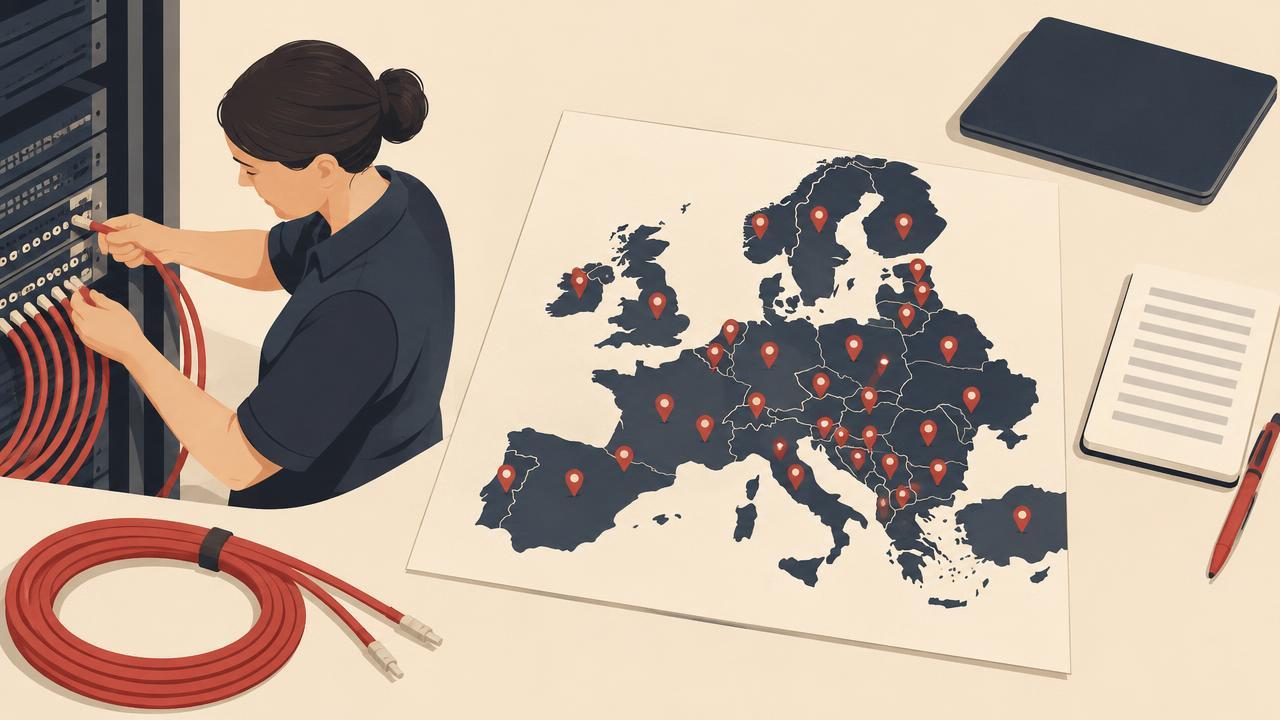
Hungarian company E-Group has unveiled COIOS, an artificial intelligence platform designed to operate within an IT environment controlled by the organisation using it. Developed as part of the European IPCEI-CIS cooperation, the platform is set to become available in more than 20 European countries through an international technology distributor’s network.
The platform is intended for institutions and companies that handle sensitive information or operate critical processes. Held in Budapest alongside the launch, the CISERO conference examined how European technology developments can become competitive industrial solutions that can be used in practice.
AI within an organisation’s own environment
Adopting AI in regulated sectors can be difficult because access to the most useful data must also be tightly protected. External cloud services can raise data-handling and security concerns, including when questions submitted to an AI system contain confidential information.
COIOS is designed to integrate AI with existing organisational systems rather than send data to external providers. It can run on an organisation’s own infrastructure or in another environment under its control, including without an internet connection when necessary. Its AI agents can connect to systems using permissions defined by the organisation; their activities can be logged, and critical operations can require human approval.
Under E-Group’s approach, organisations can select and replace AI models and decide where data is processed and which tasks are automated. Founder and chief executive officer Kuthy Antal said the use of external providers can also be governed by an organisation’s own rules, while licensing allows more predictable cost planning. Representatives of the IPCEI-CIS industrial steering board attended the Budapest launch.
Hospital demonstration and other uses
The demonstration illustrated administrative work following a patient’s discharge. Once a doctor decides that a patient can leave, collecting test results and other documents from several systems and completing related coordination can take days. In the demonstration, COIOS completed the task spanning multiple systems in minutes. The medical decision remained with the treating doctor; AI supported the subsequent administrative and coordination work.
The platform has other potential uses. Banks could use it to process internal policies and risk documents, while industrial companies could use it to review technical documentation and prepare issue tickets. In public administration, it could assist with large volumes of records and the handling of confidential government and citizen data.
Goals of the European cooperation
Important Projects of Common European Interest, or IPCEI, is the European Union’s framework for major industrial and technological projects of common European interest. Its strategic areas include battery technology, hydrogen, semiconductors and biochemistry, as well as next-generation cloud infrastructure and related services.
As an IPCEI-CIS participant, E-Group was also the main organiser of the Budapest stop of the CISERO conference series. The cooperation aims to strengthen independent technological capabilities for European digital services and encourage collaboration among different developments, infrastructures and providers.
Andrea Polereczki, the state secretary for digitalisation, said at the event that Hungary should participate in Europe’s technological transformation through development expertise and competitive companies as well as through the use of technology. She said this requires connecting research results, business expertise and user needs, while creating conditions for responsible deployment.
The conference also considered opportunities for companies in Central and Eastern Europe, including the development of technical expertise, international services and strategic partnerships alongside the adoption of new tools. The programme covered projects involving TIM, Villanova, Bosch and SAP, as well as barriers to industrial adoption, business needs and sustainable business models.
Matthias Kuom, coordinator of the CISERO project, said European digital competitiveness depends not only on research but also on infrastructure and software that businesses and public institutions can rely on. Mauro Boldi, a TIM expert and head of the IPCEI-CIS Facilitation Group, stressed interoperability and the ability to change providers without having to rebuild everything from scratch.
The 8ra initiative associated with IPCEI-CIS is working on the technological framework for cooperation among providers. CISERO, meanwhile, supports the practical application of developments, outreach to potential users and the creation of new industrial partnerships.
European distribution and Hungarian plans
COIOS was developed under E-Group’s FedEU.ai project. The company is the only direct Hungarian corporate participant in IPCEI-CIS, a co-leader of the work area focused on advanced data processing and a member of the industrial steering board. E-Group is also among the Hungarian candidates for the first European IPCEI specifically focused on artificial intelligence.
The platform will reach companies and institutions through an international technology distributor’s network, using local systems integrators and resellers. According to E-Group, customers will retain control over operating and data-handling conditions. Alongside its international expansion, the company wants to encourage sovereign AI projects in Hungary that support government and critical industries.