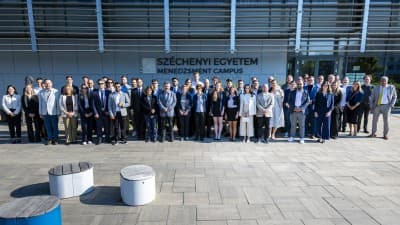
Recipients of the Egyetemi Kutatói Ösztöndíjprogram (EKÖP) and the Kooperatív Doktori Program (EKÖP KDP) presented their recent research at a scientific conference organized by Széchenyi István University in Győr. The event featured 62 presentations across eight sections, covering topics from automotive and health-technology development to artificial intelligence research and innovative methods for producing healthy food.
Purpose of the event and funding
Széchenyi István University annually provides a forum for EKÖP and EKÖP KDP scholarship holders to present their work. At the conference opening, Dr. Varga László, chair of the university’s Doctoral Council (Egyetemi Doktori Tanács), recalled the launch of the Új Nemzeti Kiválóság Program ten years ago and explained that EKÖP and EKÖP KDP have operated as its continuation since last year. He described EKÖP’s aim as supporting domestic research and artistic talent among undergraduate, master’s and doctoral students, as well as encouraging young lecturers and researchers. EKÖP KDP specifically supports doctoral candidates working on industry–university collaborative R&D projects with practical exploitation potential.
For the 2024/2025 academic year, the university reported that it secured more than 90 million forints for EKÖP and nearly 150 million forints for EKÖP KDP from the Nemzeti Kutatási, Fejlesztési és Innovációs Alap.
Highlighted presentations and research areas
The opening scientific talk was delivered by doctoral student Moldvai László Attila, titled “Application of machine vision and artificial intelligence in precision crop production.” He described a technology capable of automated, accurate identification of crops and weeds, enabling herbicide to be applied only to weeds, which improves sustainability and cost-efficiency. The system also allows continuous monitoring of crop health for early reaction to disease outbreaks.
Artificial intelligence appeared prominently in other presentations as well. Doctoral student Dr. Verebélyi Viktória examined the use of AI in lawmaking and its constitutional implications. Her research investigated how AI might affect traditional legislative responsibility and constitutional frameworks, noting that AI can effectively support parliamentary decision-making or administrative offices—for example, by organizing large numbers of amendment proposals or by using chatbots for rapid citizen responses—but that its use must be accompanied by proper regulation and human oversight to be safe and effective.
The diversity of research at the university was further illustrated by Macher Gergely Zoltán’s presentation. As a lecturer at the Department of Applied Sustainability (Alkalmazott Fenntarthatóság Tanszék), he presented a model addressing asbestos contamination in western Hungarian settlements under the title “A systems-level study of municipal asbestos-removal transition dynamics by adapting the Isenberg ecosystem framework.” His model examines the roles of policy, financing, human resources, infrastructure, culture and market forces in asbestos remediation. He emphasized that asbestos poses intertwined health, environmental, economic and legal challenges, requiring comprehensive programs and strong public awareness to achieve long-term results.
Significance and outlook
The Győr conference showcased the practical relevance of the university’s and funded programs’ research, particularly in areas where studies offer direct applications—such as precision agriculture, supporting legislative processes, or reducing environmental risks. Presenters underlined that technological advances like machine vision and AI require responsible deployment backed by regulation and human control.
The presentations and the allocated funding demonstrate EKÖP’s and EKÖP KDP’s objectives: strengthening the pipeline of researchers and promoting university–industry collaborations that lead to practically valuable research.