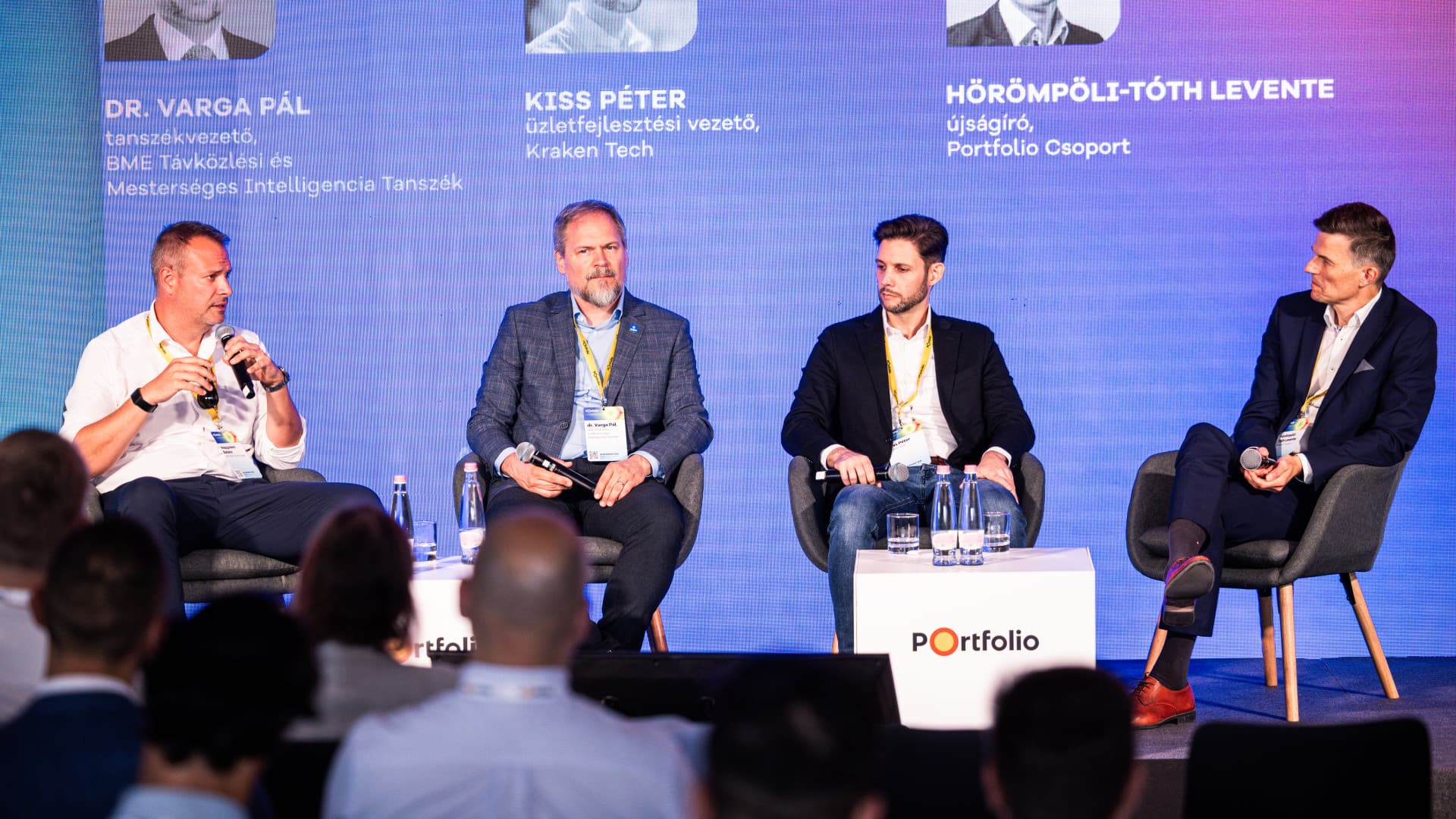
At the closing panel of the Portfolio AI in Energy 2026 conference, experts said that new tooling and practices let energy companies validate AI-driven solutions already during the prototyping phase, shortening development cycles and reducing risk. Digital tooling enables teams to test whether a proposed solution works before full-scale integration with legacy systems.
The discussion was opened by Hörömpöli-Tóth Levente, a journalist at Portfolio Group, who asked how quickly AI advances allow teams to reach a prototype in day-to-day work. Varga Pál, head of the Department of Telecommunications and Artificial Intelligence at the Budapest University of Technology and Economics (BME), answered that speed depends on the prototype’s scope and the desired output quality, but that reaching a functioning prototype can now be very fast. He illustrated this with student assignments, noting that sometimes surprisingly good — and sometimes surprisingly poor — results appear even after a single night, so critical scrutiny remains essential.
Balázs Veszprémi, CEO of ARTEMIS Technologies, observed that although the energy sector must integrate with many older and diverse systems, prototyping can now include early testing against those systems. That prevents waiting until everything is fully developed and then testing in live environments — often involving 10–15 year old systems — and gives a significant speed advantage.
Péter Kiss, head of business development at Kraken Tech, said his company channels AI capabilities to customers as quickly as possible, including by using AI in build-and-test processes. To do this they need CI/CD pipelines and operational setups that allow for high-frequency rollouts — he cited the ability to deploy new software versions up to 200 times per day — which requires AI-driven building and testing. This approach raises cybersecurity issues: Kraken operates a cloud-based service and partners with cloud providers that can meet high cybersecurity standards. As panelists noted, many utilities still run fragmented and outdated systems that are relatively vulnerable, so protections offered by leading cloud providers are often orders of magnitude better.
On how to make developments measurable in practice, Varga stressed the need for metrics and test cases that are designed into the technology from the start. At the highest level organizations must also ask whether a project complies with the AI Act and whether it will be financially viable for the company. Kiss added that past projects provide reference values that help set early, customer-aligned targets; these targets are typically financial metrics or metrics that can be readily converted into financial terms.
Panelists identified three main areas where the supplied solutions create value:
- customer-facing benefits, such as financial savings or environmental improvements;
- operational efficiency gains for the utility itself (for example, customer retention or saved work hours, which are measurable);
- optimization and portfolio management, enabling energy assets to be operated and marketed as virtual power plants on energy markets.
Veszprémi argued that the major shift is replacing earlier guesswork with modelling and early testing — in other words, having models that predict whether the models will work. That opens many opportunities but also new risks that must be modelled. For large companies the challenge is to manage and adapt to very rapid technological change. He said this means making risks transparent, creating environments such as sandboxes or domains where end users can carry out daily work with AI tools, and building the right culture: if the environment and culture exist, people will use the tools even as they continue to evolve.
The panel concluded that early-stage testing and metric-driven rollouts can accelerate digitalization and deliver financial savings for the energy sector, but long-term adoption requires appropriate infrastructure, cybersecurity, and organizational culture.
Related event
The article also notes the Debrecen Economic Forum, scheduled for 9 June 2026, which aims to provide high-level professional dialogue and business networking to support regional growth.
Tags: technology, development, artificial intelligence, innovation, machine learning, automation, digitalization, energy, banking systems, ai