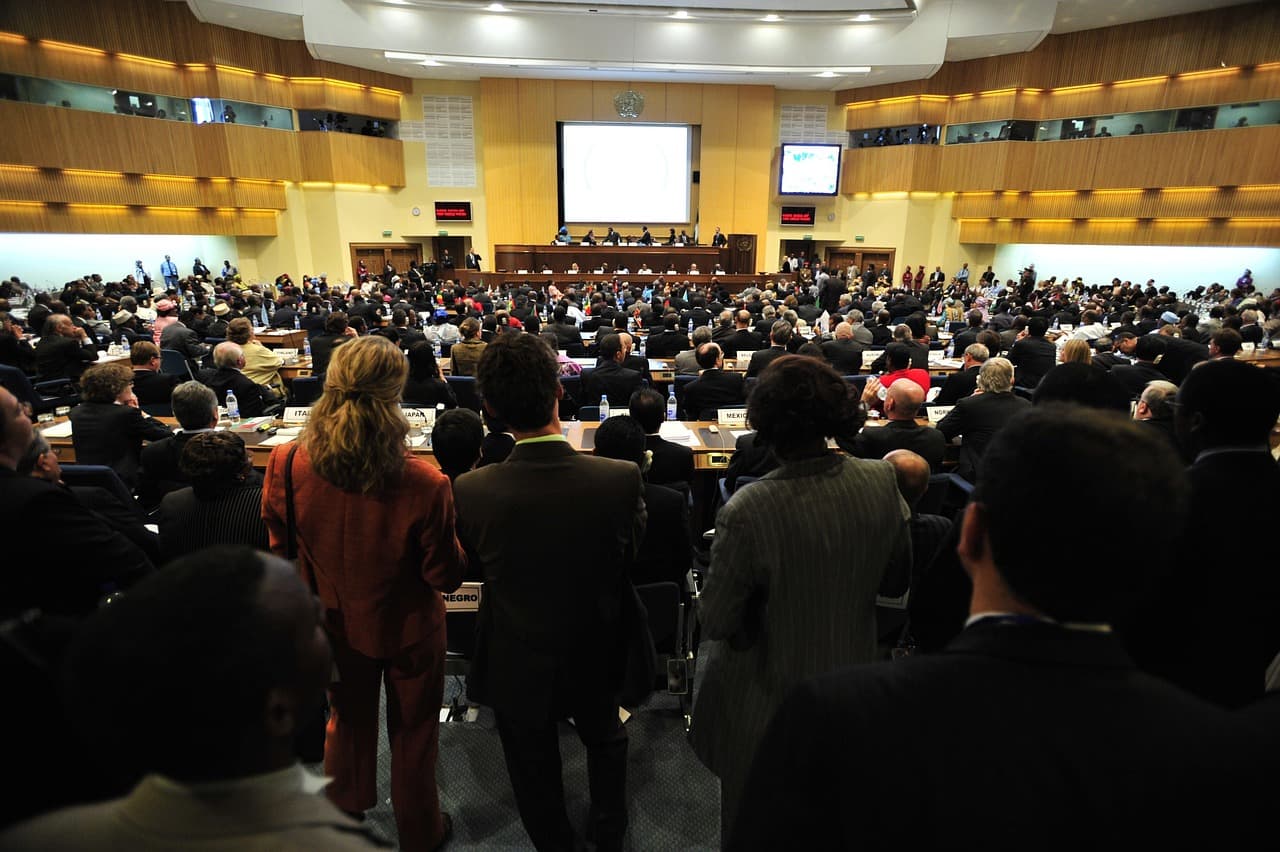
The White House and its allies have taken a clear position: artificial intelligence development in the United States should accelerate, and governments should not impose international ground rules. That stance was communicated at the United Nations General Assembly in New York and during meetings in Washington this week with Chinese leader Xi Jinping.
President Donald Trump has urged leaving AI “exactly where it is,” arguing US companies should remain leaders in the field. That contrasts with Xi and other Chinese officials, who say responsible AI development is necessary and have expressed support for a global governance framework.
Difficulty of reaching agreements without US support
Without official US backing, any international agreement will be hard to implement. Michael Kratsios, the White House science and technology adviser, rejected global efforts in a speech at the UN, calling them an “intervention.” As a result, countries may end up producing nonbinding guidance and best practices without the formal buy-in of the home country of the largest companies.
At the same time, leading labs and companies are pressing ahead with self-regulatory plans that aim to agree on testing standards — a challenge in an environment of intense competition.
Industry alignment with international safety efforts
Even many AI CEOs align more with the UN’s approach than with the White House position. Companies are advocating coordinated “AI pacing,” supporting global efforts to harmonize safety and warning that they cannot set responsible-use standards alone.
Jean-Noël Barrot, the French official who chaired a UN national security meeting on AI attended by the CEOs of OpenAI, Anthropic and Hugging Face, said: “The international community will need to establish a common framework to manage the risks associated with frontier AI models.”
Public opinion and political tensions
Polling shows Americans are generally skeptical of claims that the US must beat China in AI development, and people across party lines express concerns that the technology is changing jobs and livelihoods too quickly. The White House’s international isolation on AI also places congressional Republicans in a difficult position: some members push for safety measures and slowdowns and sponsor bipartisan regulation, even as the party leader calls for accelerating development.
Senator Todd Young (R-Ind.) has asked Secretary of State Marco Rubio to convene National Security Council meetings with cyber experts and AI developers to discuss potential national security threats, including AI-enabled attacks on critical infrastructure. In his letter Young wrote that the United States should continue to lead in AI development and deployment, and that maintaining that leadership requires the government to keep pace with emerging capabilities and understand their risks.
Debates over motives and the path forward
Allies of President Trump often view calls for stricter AI safety rules with suspicion. Some argue that large companies such as OpenAI, Google DeepMind, and Anthropic seek “regulatory capture” by shaping legislation that only they can effectively comply with, thereby gaining a competitive advantage.
Others dismiss so-called “doomerism” — the belief that AI could doom humanity or eliminate large numbers of jobs — as alarmist and speculative. The White House has also criticized the effective altruism community, to which several AI safety groups have connections.
The core message from the administration is straightforward: avoid actions that might give China, with its cheaper open-source models, an advantage in the AI race.
Industry coordination emerges
There are signs of industry coordination: The Information reports that Google, Anthropic and OpenAI are forming an AI safety coordination group. Such self-regulatory efforts could be important for creating shared testing standards and safety practices, especially if international political consensus remains elusive.
Overall, the debate centers on whether the United States should accelerate development without new international rules to preserve technological leadership, or whether coordinated global frameworks are needed to manage risks — a disagreement that divides governments, companies and parts of the US political establishment.