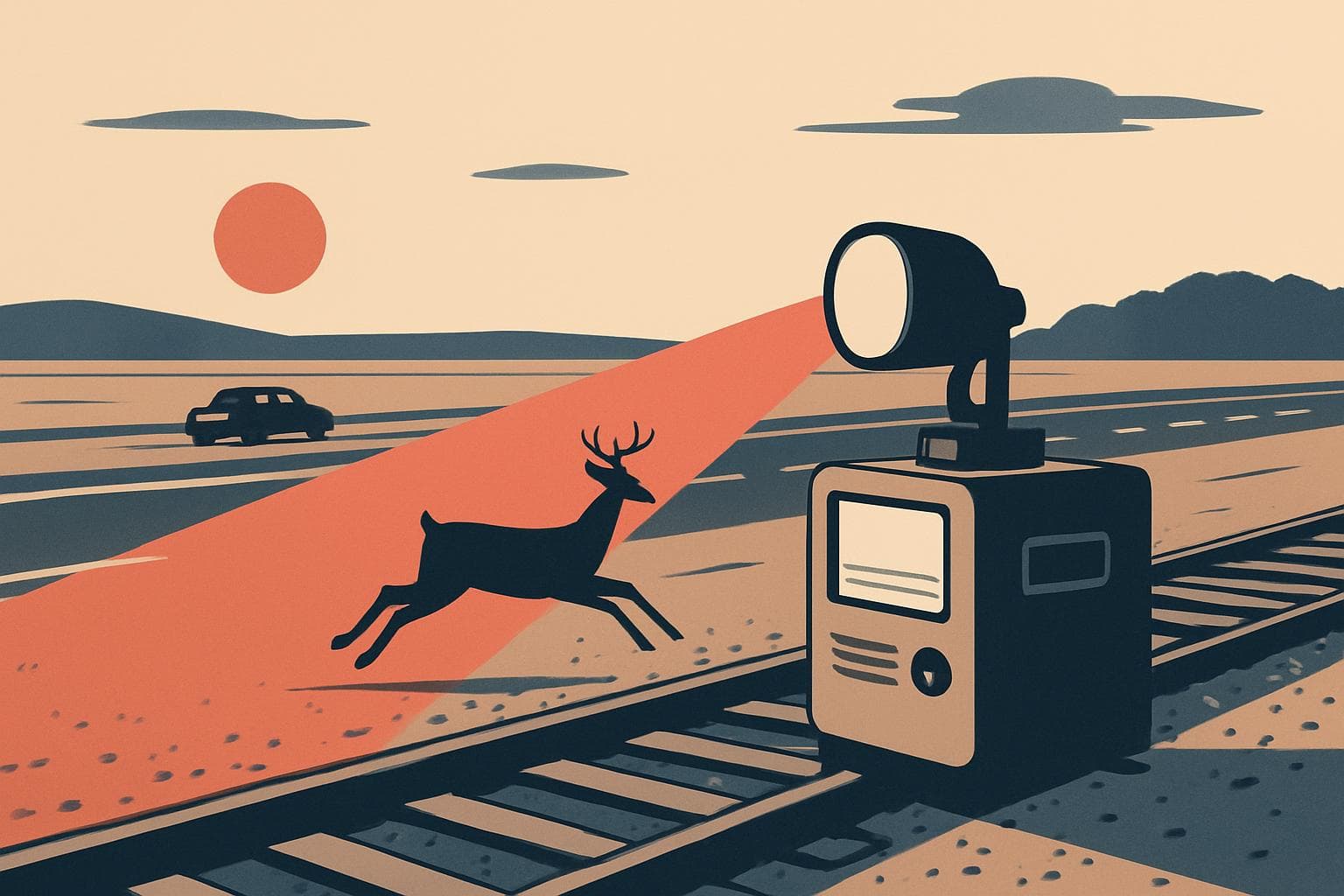
Flox Intelligence, a spinout from KTH Royal Institute of Technology in Stockholm, builds edge devices that identify wild animals and emit species-appropriate sounds to deter them from roads, railways, airports and other infrastructure.
Why the issue matters
Collisions between wildlife and infrastructure cause significant economic and safety impacts worldwide. The U.S. Federal Aviation Administration estimates that wildlife strikes cost U.S. civil aviation an average of about $272 million per year between 1990 and 2025. In France, the national rail operator SNCF reports that wandering animals affect more than 8,000 trains a year and rank among the top five causes of delays. In Brittany alone, 120 trains hit animals in 2023, disrupting 660 services and causing over 15,000 minutes of delays.
The article’s author also recalls a childhood incident in India where a train struck a wild bison, underlining that these problems occur across different geographies.
Flox’s approach
Sara Nozkova, Flox’s founder, who previously spent 13 years working in transportation and autonomous vehicles, concluded that louder deterrents are not the answer. At KTH’s AI lab she began developing a system that adapts its deterrent responses based on what a nearby animal is doing and on the species involved.
Flox’s devices process data on-site rather than in the cloud. A motion sensor wakes the unit, a camera runs on-device models to identify the animal, and the device emits a sound tailored to that species to encourage the animal to move away safely. The system also learns from experience and varies responses to prevent animals from becoming habituated to repeated signals, Nozkova says.
Product, customers and revenue model
The company currently sells battery-powered units that can be mounted on poles, trees or other structures, plus a software platform that shows device deployments and on-the-ground activity. The platform can produce reports for regulatory compliance and biodiversity monitoring. Longer-term goals include making the software portable enough to run on machines that operate outdoors, such as trains, cars and drones.
About 150 Flox devices are live across North America, Europe and Australia at airfields and airport perimeters, road and rail corridors (particularly fence ends and crossings along wildlife corridors), national parks, agricultural land, urban areas, mining sites, and critical infrastructure such as electrical substations.
Flox’s business model charges upfront for the edge units and then an annual software and AI subscription after the first year. The company also has OEM partnerships in which partners pay an annual fee to deploy Flox software on vehicles; train manufacturer Alstom is named as one such partner.
Nozkova said the company expects to finish 2026 with about $1.5 million in revenue. Flox has raised roughly $5 million across pre-seed and seed rounds so far, with the seed round led by Unconventional Ventures and Tilia Impact Ventures; co-investors include GENIUS NY, Norrsken, Satgana and angel investors.
Competition and differentiation
Competitors include Robin Radar’s Scarecrow, which uses species-specific distress calls and records activity, and iCHASE, which detects birds with computer vision and targets them with a moving laser, adjusting responses as needed. Nozkova argues that Flox’s moat is the breadth of its system and the field data it has collected — what she calls “ground truth” on what actually makes large animals like moose or grizzly bears move safely.
“No physical AI is walking out of the factory and into the messy, alive outdoors,” Nozkova says. “Every machine that operates outside — trains, trucks, drones, tractors, robots — will need to understand nature, and nature intelligence is the next layer of the perception stack.”
Funding and growth plans
The company has opened a $10 million Series A round intended primarily to scale deployments from roughly 150 devices to several thousand units and to extend the system beyond its current wildlife use cases.
Flox has so far raised about $5 million in pre-seed and seed funding, and plans to use Series A proceeds to grow deployment and broaden applications.
Public demonstration
Flox Intelligence is a finalist in the Startup Battlefield 200 pitch competition at TechCrunch Disrupt, taking place October 13–15, 2024, at Moscone West in San Francisco.
Overall, Flox aims to reduce infrastructure collisions with wildlife by combining on-device AI, species-specific deterrents, and field-collected behavioral data to produce adaptive, non-lethal responses that lower both economic damage and harm to animals.