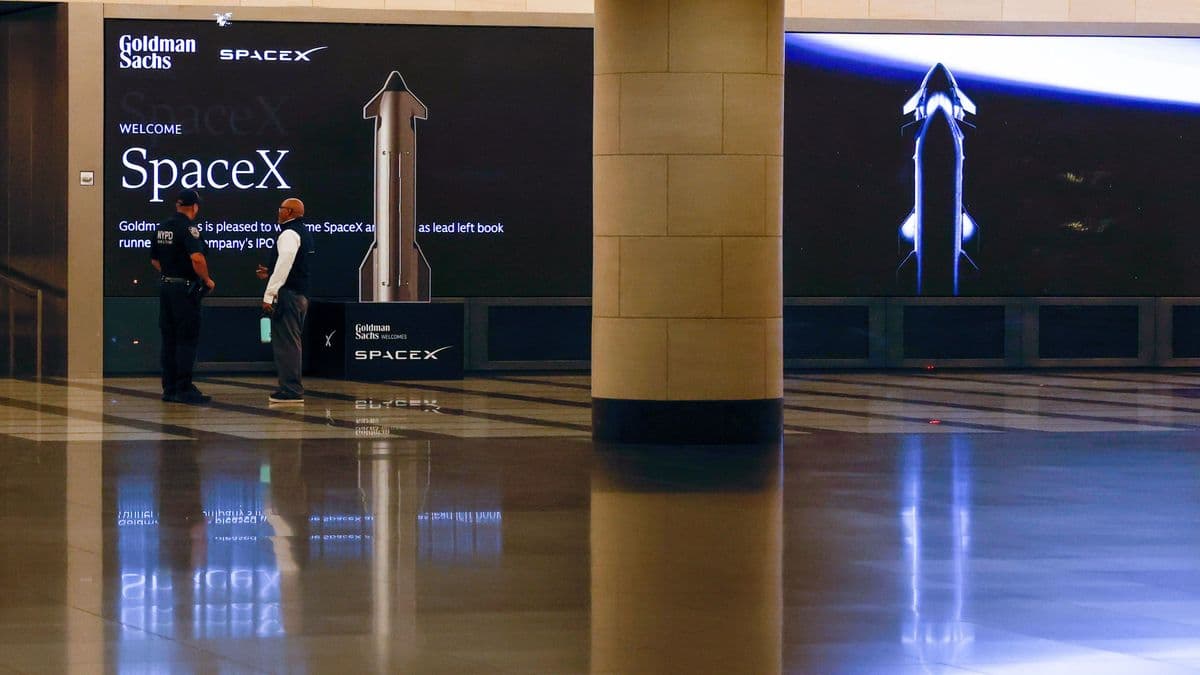
Goldman Sachs' calculations indicate that SpaceX's artificial intelligence division (xAI) could see revenues rise from about $3.2 billion in 2025 to roughly $322 billion by 2030 — nearly a hundredfold increase. These projections are a central input into the company’s planned initial public offering (IPO) valuation, which Goldman pegs at approximately $1.78 trillion.
Company-wide forecasts and key figures
According to the bank's model, SpaceX's total revenue could grow from $18.7 billion last year to $474 billion by 2030. Goldman breaks down the AI business trajectory as follows: revenue rising to $15.6 billion in 2026 (a 388% increase from 2025), reaching $34.5 billion in 2027, and ultimately hitting about $322 billion in 2030.
The bank also provides projections for other divisions: Starlink satellite internet revenue is forecast at $144 billion in 2030 — less than half of the anticipated AI revenue — while the launch business is expected to generate $8.3 billion in 2030 versus $4.1 billion last year.
Profitability and cash flow
Goldman Sachs expects SpaceX's adjusted EBITDA to increase from $6.6 billion in 2025 to $352 billion in 2030. Last year the company posted negative free cash flow of $13.8 billion, but Goldman’s model foresees positive free cash flow of $72 billion by 2031.
Underlying assumptions and competitive challenges
A large part of the valuation rests on the assumption that xAI can address a very large total addressable market: SpaceX’s IPO prospectus suggests xAI could serve a market worth $26.5 trillion, far exceeding the roughly $2 trillion market estimated for Starlink and other space activities.
To achieve these outcomes, SpaceX’s Grok model family would need to catch up to and then outperform leading AI labs in key areas such as programming, cybersecurity, AI agents, and chatbots — competing with firms like Anthropic, Google and OpenAI.
Risks and internal issues
The AI division recorded a $6.4 billion loss in 2025, and xAI has faced internal turmoil: Elon Musk removed all ten co‑founders within two years. Performance has so far fallen short of expectations, and xAI has captured only a fraction of the consumer and enterprise subscriber base that would be needed to support the projected revenues. Because Grok did not secure significant market share, the 300-megawatt Colossus 1 data center in Memphis, Tennessee remained underutilized and was leased to Anthropic by Musk.
The IPO process and bank fees
Goldman Sachs is leading SpaceX’s IPO roadshow and has been chosen ahead of rivals such as Morgan Stanley, JPMorgan, Citigroup, Bank of America and UBS. Bankers expect the offering could raise up to $86 billion and generate substantial fees for the Wall Street banks involved — on the order of multiple tens of millions of dollars.
Conclusion
Goldman Sachs presents a highly optimistic scenario for SpaceX’s AI business that underpins a very large IPO valuation. Realizing that scenario will require material advances from xAI/Grok and significant market share gains against strong incumbents, while the company must also address internal and market risks highlighted by its recent performance.