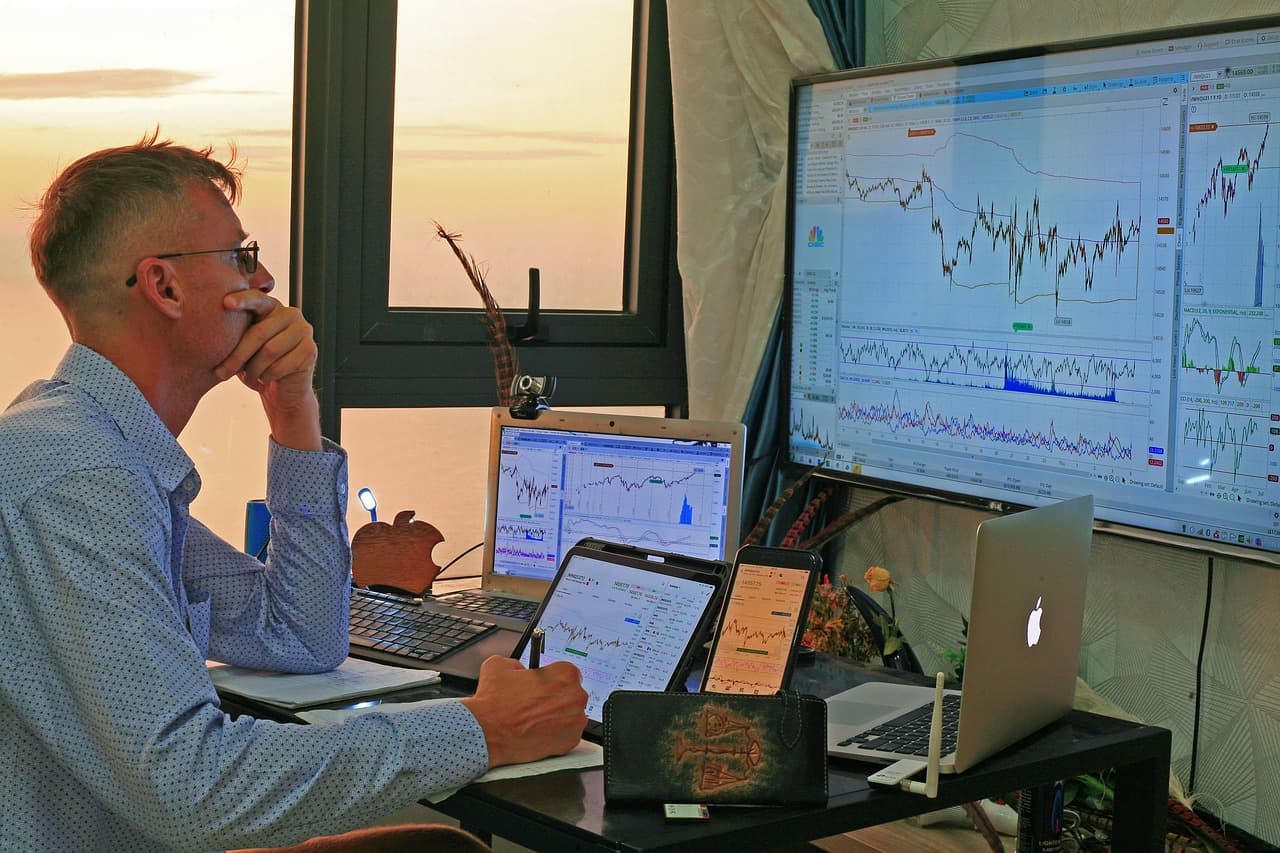
Israeli company 42AI has come out of stealth with $62.5 million in seed funding and a claimed product: a “behavioral world model” that estimates the probabilities of individuals making particular decisions, even in new or changing circumstances. The startup is initially deploying the system at several financial brokerages, where it says the model helps predict how individual traders will react in volatile market conditions.
How the model is designed to work
42AI says the model focuses on inferring internal motivations and tendencies rather than merely extrapolating from past actions. The company examines how people respond to seemingly unrelated events — for investors and traders this can include KYC completion and onboarding, support calls, money transfers and actual buy/sell transactions.
These observations are converted into mathematical trait representations and fed into a transformer-based world model that outputs probabilities for possible decisions under different conditions. A separate language model is used to generate explanations for the predictions. According to co‑founder and CTO Ehud Ezra, the training objective preserves an individual’s underlying tendencies in simulations: if a person is normally risk-averse, the model should maintain that tendency or the prediction target is considered off.
Development, datasets and claimed performance
The company says it spent three years developing the approach, combining psychological research with neuroscience and genetics and taking advice from experts in psychology, PTSD and from Dan Shechtman, the 2011 Nobel Prize in Chemistry laureate.
Initially the team ran psychometric assessments and behavioral scenarios on thousands of people, then added governmental and biobank datasets covering more than 2 million people. With customer data included, Amit Gal‑Or says the datasets now span nearly 30 million individuals.
For market trade prediction, 42AI claims the model reaches 98% accuracy in the sense that trading flows fall within a predicted range; this does not mean every single trade is predicted exactly. The model reportedly achieves an F1 score of 0.8–0.85 for predicting trading direction and volume, where F1 balances true positives against false positives and false negatives in classification tasks.
42AI’s live deployments analyze customers’ existing records — transactions, support interactions and similar signals. Gal‑Or states the system does not require personally identifiable information and that "the model never knows who the person is," although the company does construct individual behavioral profiles from linked customer activity.
Customers, revenue and funding
Gal‑Or said 42AI is working with ten large brokerages that use the model for liquidity management, margin requirements and hedging exposure. The company is onboarding additional customers and reports generating more than seven figures in revenue, without disclosing exact numbers. Customers pay either a flat fee or a share of the value the platform helps them capture; 42AI claims one brokerage generated roughly $30 million in additional value via dynamic hedging.
The $62.5 million seed round was assembled over three years from the founders and Infinity Group rather than exclusively from outside investors. Infinity Group was founded by Amir Gal‑Or, Amit Gal‑Or’s father; Amir Gal‑Or is 42AI’s chairman and a co‑founder. 42AI plans further fundraising.
Limits and ethical concerns
The founders acknowledge limitations: the system has a "natural ceiling" because it cannot access every aspect of a person’s experiences. Accuracy suffers when important situational context is missing — for example, if someone changes trading behavior after advice from a friend or colleague.
There are clear ethical concerns around firms using predictions about customers. If a brokerage can anticipate a client’s moves, that information could be used to the brokerage’s advantage. Ezra called this a "valid concern." The founders point to regulation, monitoring and an internal ethics committee as mitigations, but they did not detail mechanisms that would prevent customers from exploiting predictions against the people profiled.
Gal‑Or argued the technology itself could be part of the solution to some of these risks.
Broader ambitions
Beyond finance, 42AI is exploring applications in gaming, fraud prevention and cybersecurity, and ultimately wants the model to help robots and AI agents understand people. The company concedes that each new domain requires training the model on relevant rules and context, so wider applicability will take further work.
In summary, 42AI is pursuing an ambitious effort to translate psychological and behavioral characteristics into machine-readable representations and probabilistic decision forecasts. The firm reports promising metrics and early commercial traction, but its practical limits and the ethical and regulatory implications of profiling people’s likely decisions remain open questions.