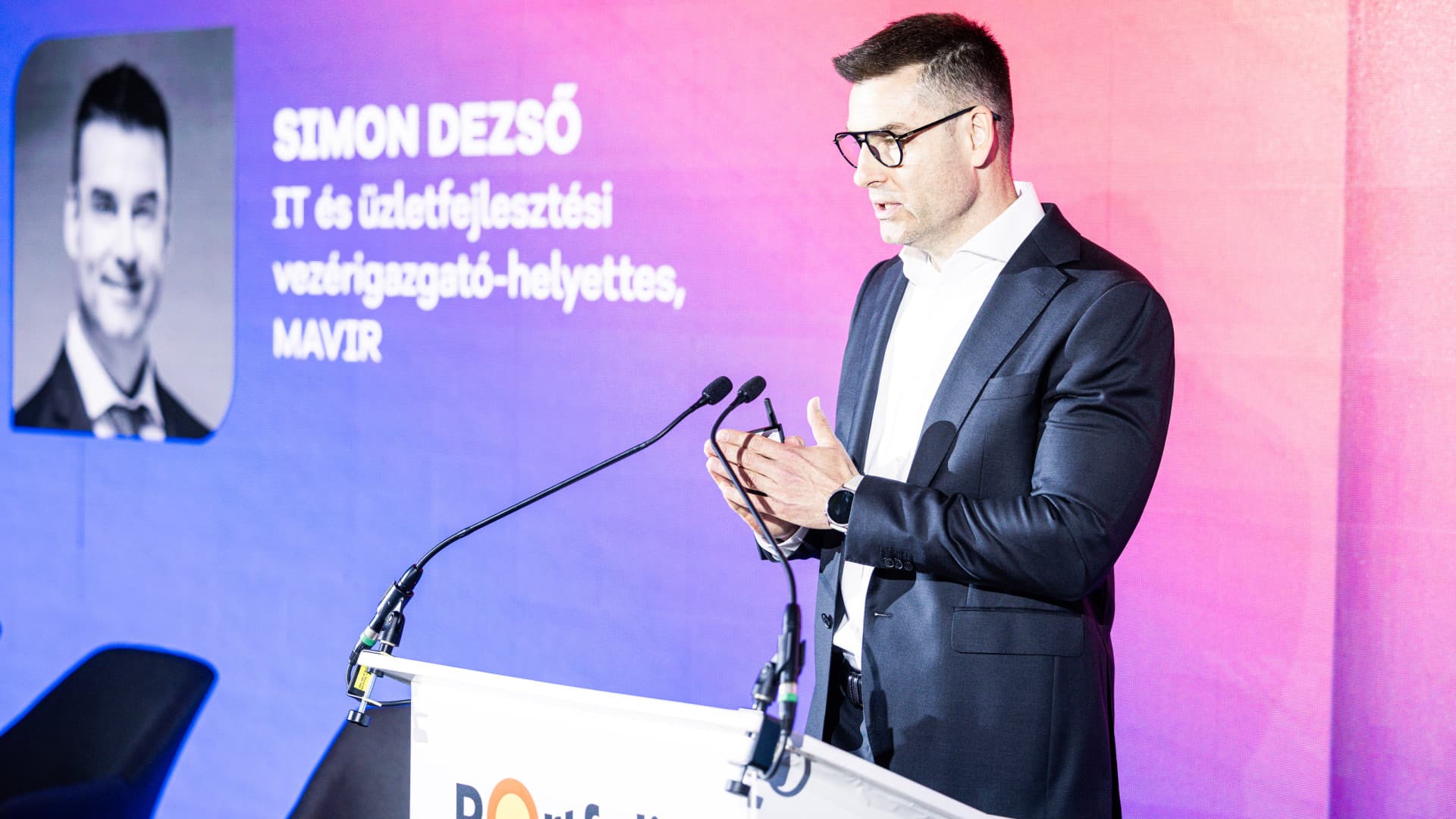
How can MAVIR, Hungary's transmission system operator, use artificial intelligence in an environment where operational reliability and national supply security are non-negotiable? Simon Dezső, Deputy CEO for IT and Business Development at MAVIR, addressed this question in his presentation at the Portfolio AI in Energy conference.
MAVIR's role and assets
MAVIR operates at the transmission level between generation, distribution and consumption, with three core activities: system operation, market operation and transmission network development and maintenance. The company manages about 5,000 kilometres of overhead lines, 37 substations, 107 transformers and 19 cross-border transmission lines. MAVIR is responsible for the safe functioning of the Hungarian electricity system and for keeping production and consumption balanced continuously, making 24/7 operations critical.
How the system has changed
According to Simon Dezső, the system used to be largely centralised, relying on a few large, well-controllable conventional power plants and predictable power flows. In recent years the system has become much more decentralised as renewable generation—especially solar—has rapidly expanded, introducing new uncertainties for system operation.
Key figures presented:
- Distributed and other solar capacity grew from 0.4 MW in 2012 to roughly 9,000 MW by 2025; the presentation projected renewable capacity could reach 13,240 MW by 2029.
- Conventional generation capacity fell from 9,550 MW in 2012 to 6,548 MW in 2025.
- Peak domestic demand rose from 6,443 MW to 7,663 MW.
These developments make AI-based tools increasingly relevant, while at the same time heightening the need to protect system security.
TSO expectations: security, cost-efficiency, sustainability
Simon framed expectations for transmission system operators around three pillars: supply security, cost-efficiency and sustainability. For MAVIR, supply security is the non-negotiable starting point for all decisions. As a commercial company, MAVIR also faces pressure to improve cost-efficiency, and sustainability appears both in the need to integrate fast-growing renewables and in the company’s own operations.
He highlighted additional sector trends:
- renewable integration and the resulting weather-dependent uncertainty;
- near-real-time network management as market gate-closure times move closer to operational timelines (even 30-minute horizons);
- growing interoperability needs among TSO-DSO and between European TSOs as Hungary integrates into cross-border markets;
- resilience strengthening against extreme weather, geopolitical risks and cyber threats;
- workforce challenges and knowledge transfer — at the European level roughly one million jobs related to TSO domains may need to be filled.
Where AI fits and what is different for TSO environments
AI has multiple relevant use cases, but deployment in TSO environments differs from typical enterprise settings because reliability is paramount. Main AI categories identified:
- forecasting and estimation: renewables, load, weather, network losses, cross-border flows;
- decision support and fault handling: operational assistance for system operators;
- optimisation: network calculations, congestion management, energy flow optimisation, digital twins, automated trading support;
- asset management: predictive maintenance, extending asset life, preventive fault detection;
- large language models: more suited to internal efficiency and organisational support rather than automating core system-operation decisions.
Simon stressed that an AI model’s occasional mistakes can have system-level consequences; a model that is ‘mostly right’ may still be unacceptable if rare errors affect supply security.
Data, cybersecurity, compute capacity and operational integration
MAVIR sits on large volumes of data distributed across many systems with varying quality and formats. Strict data-handling rules make it infeasible to simply upload operational data to external cloud providers for model training. The core question is how to extract value from that data while meeting data protection, cybersecurity and operational-security constraints.
Compute capacity is also a challenge: MAVIR has private data centres and computing resources but not the extensive server farms that some advanced AI solutions require. Cloud usage is constrained by security requirements, so architectural solutions must balance compute needs, secure data handling and operational controls. Often the greater difficulty is not algorithm development but safely and stably integrating AI solutions into day-to-day operations.
Concrete MAVIR AI pilots and results
Simon presented several specific projects:
- mFRR Tool: a machine-learning short-term imbalance forecasting tool for manual Frequency Restoration Reserve (mFRR) activation. Based on one year of use, MAVIR identified a potential saving of HUF 1.3 billion if the model had been used consistently — a theoretical potential rather than realised savings.
- Reserve sizing: an adaptive method to determine FRR procurement aligned to expected system states. The approach enabled more than a 6% reduction in required capacity at 99.88% reliability, a meaningful figure given reserve costs.
- Ultra short-term solar forecasts: these forecasts assist daily operations with 3–11% accuracy ranges.
- Drone-based inspections pilot: with an external partner MAVIR tested drone flights plus AI image processing to inspect overhead lines and towers, aiming to speed up and improve maintenance and fault detection.
International position and MAVIR's AI roadmap
From international benchmarking Simon drew two conclusions: TSOs adopt AI to solve specific national network, market and operational problems rather than for technology’s sake; and several Western European and some U.S. players have multi-year leads that MAVIR aims to narrow.
MAVIR’s AI vision rests on three aims:
- create measurable business value in core and support processes;
- reach an AI-ready organisational state, which requires further development;
- build an AI culture so staff use new tools with appropriate skills and security awareness.
The strategy covers nine areas: governance, use cases, measurement, organisation and community, training, communication, data, technology and architecture. On governance, MAVIR plans to set up a dedicated AI management body to define responsibilities, policies and compliance.
Closing: AI as a supporting tool, human responsibility retained
Simon concluded that AI can provide forecasting, decision support, faster analyses and automation, but that responsibility, context interpretation, priority setting and systemic thinking remain human tasks. MAVIR intends to use AI primarily as a supporting technology in the coming years, not as a system that autonomously takes over system operation.