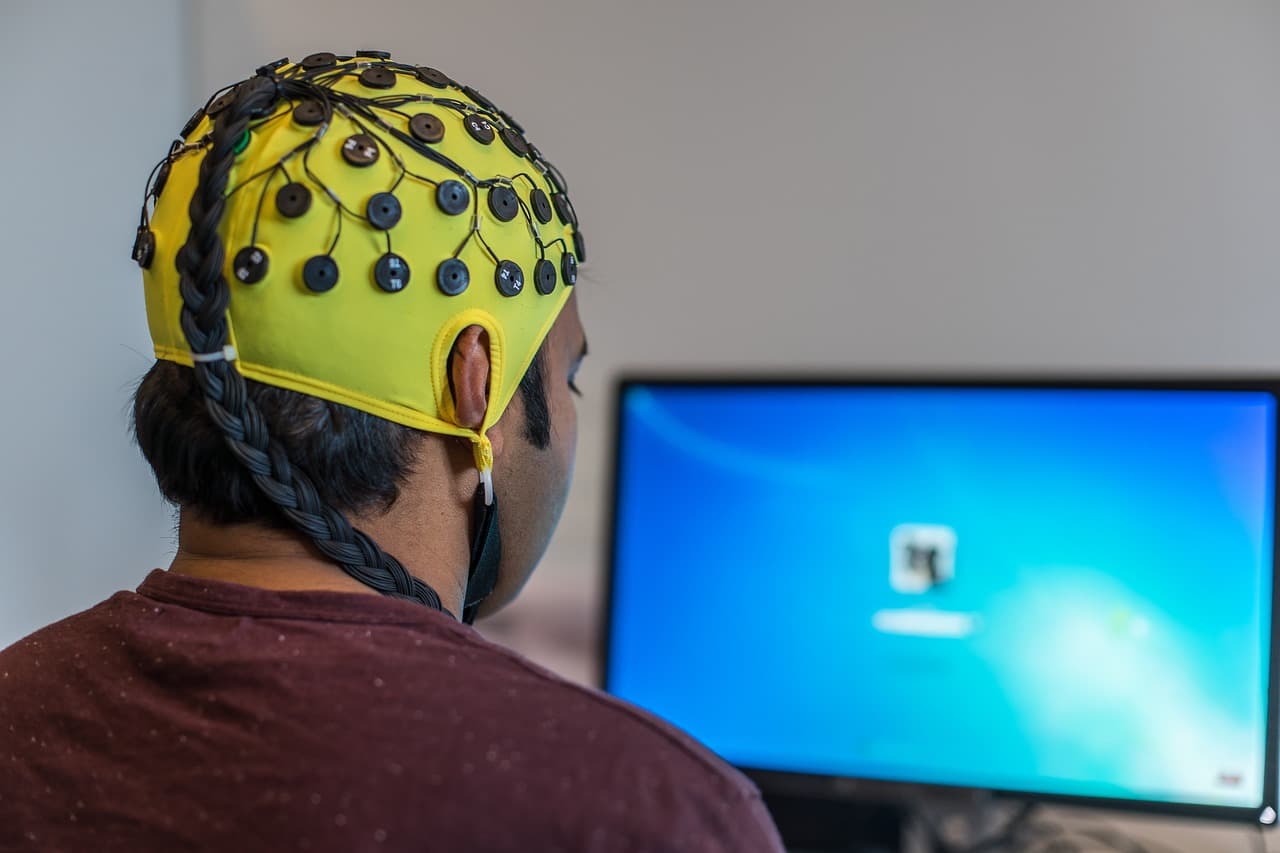
Meta has published Brain2Qwerty v2, an AI decoder that reconstructs typed sentences from non‑invasive recordings of brain activity. The company has open‑sourced the system's code.
Training data and performance
The model was trained on data from nine volunteers, each wearing a non‑invasive brain scanner for about ten hours. In total, 22,000 sentences were used for training. According to the reported results, Brain2Qwerty v2 achieves 61% word‑level accuracy across all subjects, while the best individual subject reached 78%—in that case most sentences were returned with either no incorrect words or just one wrong word.
The announcement contrasts these results with a previously reported non‑invasive ceiling of roughly 8% word accuracy, indicating a substantial improvement over earlier non‑invasive attempts.
Why this matters
Historically, high‑fidelity reading of brain signals typically required invasive implants: systems that place electrodes on or in the cortex provide cleaner signals but require craniotomy and an implanted device. Brain2Qwerty v2 operates from wearable, non‑invasive scanner data, and Meta reports that accuracy improves roughly log‑linearly with recording hours—meaning that increased data collection rather than surgical access can narrow the performance gap with invasive approaches.
Practical implications and limits
A key implication is that the effective "cost" of achieving high‑quality brain decoding has not solely been the biology but also the amount of available data: with enough non‑invasive recordings, performance can rise substantially. Nonetheless, the reported accuracies (61% average, 78% best) do not imply error‑free decoding for all users or sentences. While this represents a major advance in non‑invasive brain decoding, it does not eliminate technical, ethical, and practical concerns associated with translating such systems into broader use.
Summary
Meta's Brain2Qwerty v2 shows that non‑invasive methods can reach considerably higher decoding performance than previous benchmarks when trained on large, well‑collected datasets. By open‑sourcing the code, Meta enables further validation and research, but the technology's limitations and societal implications remain important subjects for continued scrutiny.