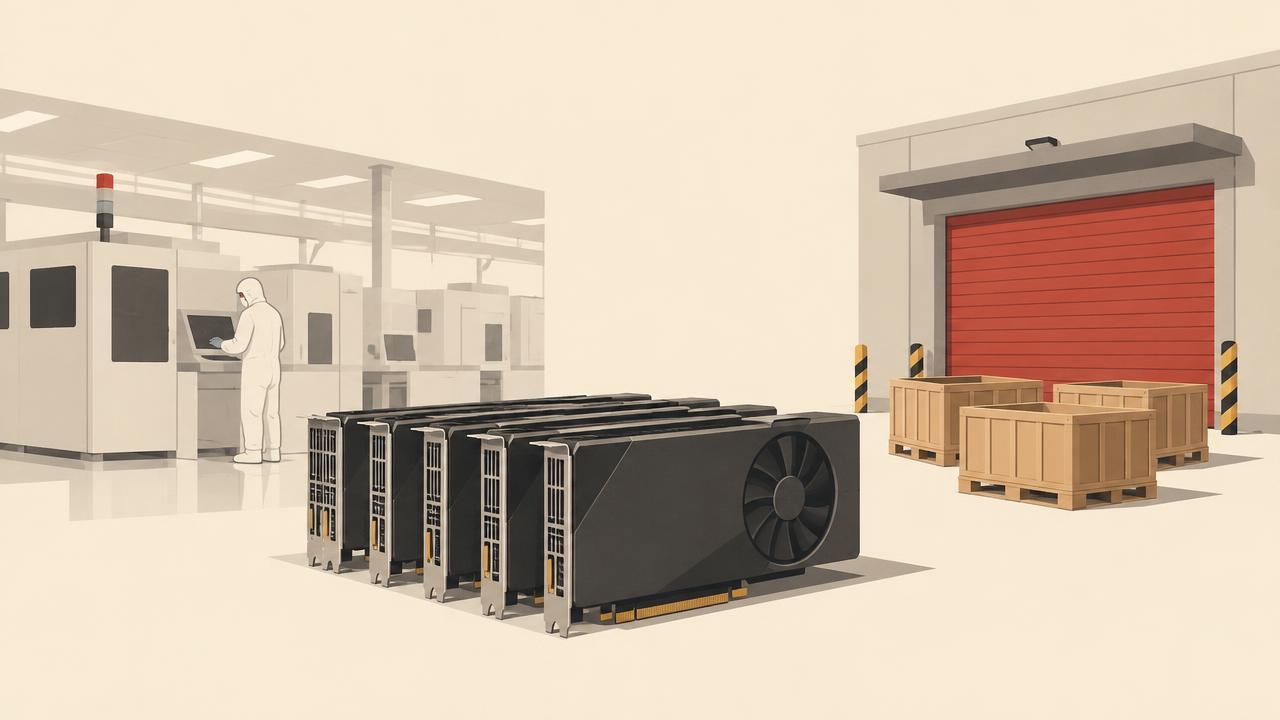
Nvidia will no longer sell its H200 chips in China, acting CEO Colette Kress said Tuesday. The decision ends the company’s use of a controversial sales arrangement that allowed it to navigate restrictions on the sale of advanced U.S. chips to China.
Chinese access to advanced artificial intelligence accelerators was a major subject on Nvidia’s first earnings call since co-founder and CEO Jensen Huang stepped down last week. On the same day as the disclosure, the company announced a board-level committee to oversee national security policies, export control compliance and global trade risks.
Disputed deal and new restrictions
Jensen Huang and U.S. President Donald Trump brokered the arrangement for H200 sales in China. It required the chips to be shipped through the United States, enabling the government to collect a 25% tariff.
The arrangement drew criticism from those seeking to deny Chinese laboratories computing power and preserve the United States’ lead in artificial intelligence. Huang had long argued instead that the American technology industry needed to remain competitive in the Chinese market. In April, he told podcaster Dwarkesh Patel that conceding the market would be a disservice to the United States.
Huang’s departure was partly connected to his relationship with the CEO of a company under investigation for smuggling chips into China. It coincided with new U.S. rules issued Monday that bar advanced American chips from foreign data centers serving Chinese customers remotely.
Investment bank Jefferies forecast that the measures could reduce Nvidia’s data center revenue next year by $44 billion to $62 billion. Kress said, however, that a backlog of demand for advanced chips such as Vera Rubin meant the new export controls would not affect the company’s overall revenue.
Chinese demand and overseas data centers
Over the longer term, Nvidia could lose potential customers in Singapore, Malaysia, Thailand and Indonesia. Critics of the company’s dependence on China say as much as 20% of its revenue may come from demand linked to the country. Annual revenue at its Singapore subsidiary reached $104 billion in 2025, before Nvidia stopped disclosing those figures.
China had already largely refused to accept H200 deliveries before Nvidia decided to stop shipping them. Jacob Feldgoise, a researcher at Georgetown University’s Center for Security and Emerging Technology, said the Chinese government would prefer to stimulate demand for its domestic chip industry, even though major users of AI computing power prefer Nvidia’s still-superior equipment.
Meanwhile, leading Chinese AI laboratories are finding ways to access Nvidia chips elsewhere. All of China’s leading AI models show evidence of having been trained on Nvidia Grace Blackwell chips, despite a ban on exporting them to China.
That training may have taken place in data centers outside China, but the new rules also restrict sales to such facilities. Export control attorney Dan Fisher-Owens told TechCrunch that large data centers suitable for training AI models must certify that they do not serve Chinese customers if they want to buy Nvidia chips. If they cannot provide that certification, they may turn to alternatives, further reducing Nvidia’s market share.