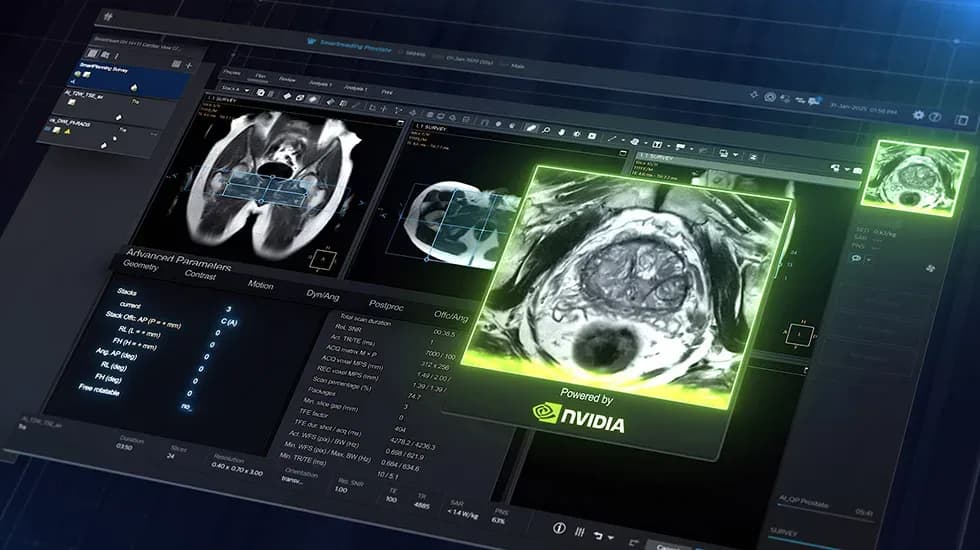
NVIDIA has published NV-Generate-MR-Brain, an open-source model that produces realistic 3D brain MRI scans. The stated aim is to allow medical AI teams — for example those building tumor detection and segmentation systems — to train and validate models without relying directly on real patient scans.
Training data and provenance
NV-Generate-MR-Brain was trained on MR-RATE, a de-identified dataset containing 100,000 studies. The dataset was prepared and released under a CC-BY-NC license by a consortium composed of the University of Zurich, Medipol University Hospital (Istanbul), Forithmus, and NVIDIA. The release makes the trained generator and its synthetic outputs available under the terms of that license.
Industry validation
According to the announcement, Philips has already begun validating workflows using the synthetic outputs from the model. This indicates interest beyond academic demonstration and suggests testing of the generated data in practical, industrial pipelines.
Why this matters
Access to clinical imaging data has long been constrained by patient consent processes and institutional approvals, which fragmented and slowed development: each startup or research group negotiated its own institutional review and data agreements. By contrast, the consortium behind MR-RATE and NV-Generate-MR-Brain effectively paid that one-time cost to cross the privacy barrier, trained a generator on real scans, and released it openly.
As a result, more teams can now train downstream models on synthetic data without paying royalties, particularly when using NVIDIA RTX hardware. The competitive advantage may shift from who can secure hospital contracts and raw patient data to who controls the high-quality synthesizer model that others use for training.
Limitations and open questions
De-identification does not automatically remove all privacy or validity concerns. Using synthetic data requires further evaluation for diagnostic accuracy, representation of rare cases, and potential biases. There are also legal and ethical questions about industrial use under the CC-BY-NC license and about long-term governance of widely used synthetic data generators.
Summary
The publication of NV-Generate-MR-Brain and the MR-RATE dataset is a notable development for medical imaging AI: a consortium consolidated access to real scans, trained a synthesizer, and made it openly available. The coming period will test how the research community and industry validate and integrate synthetic data into clinical-grade AI workflows.