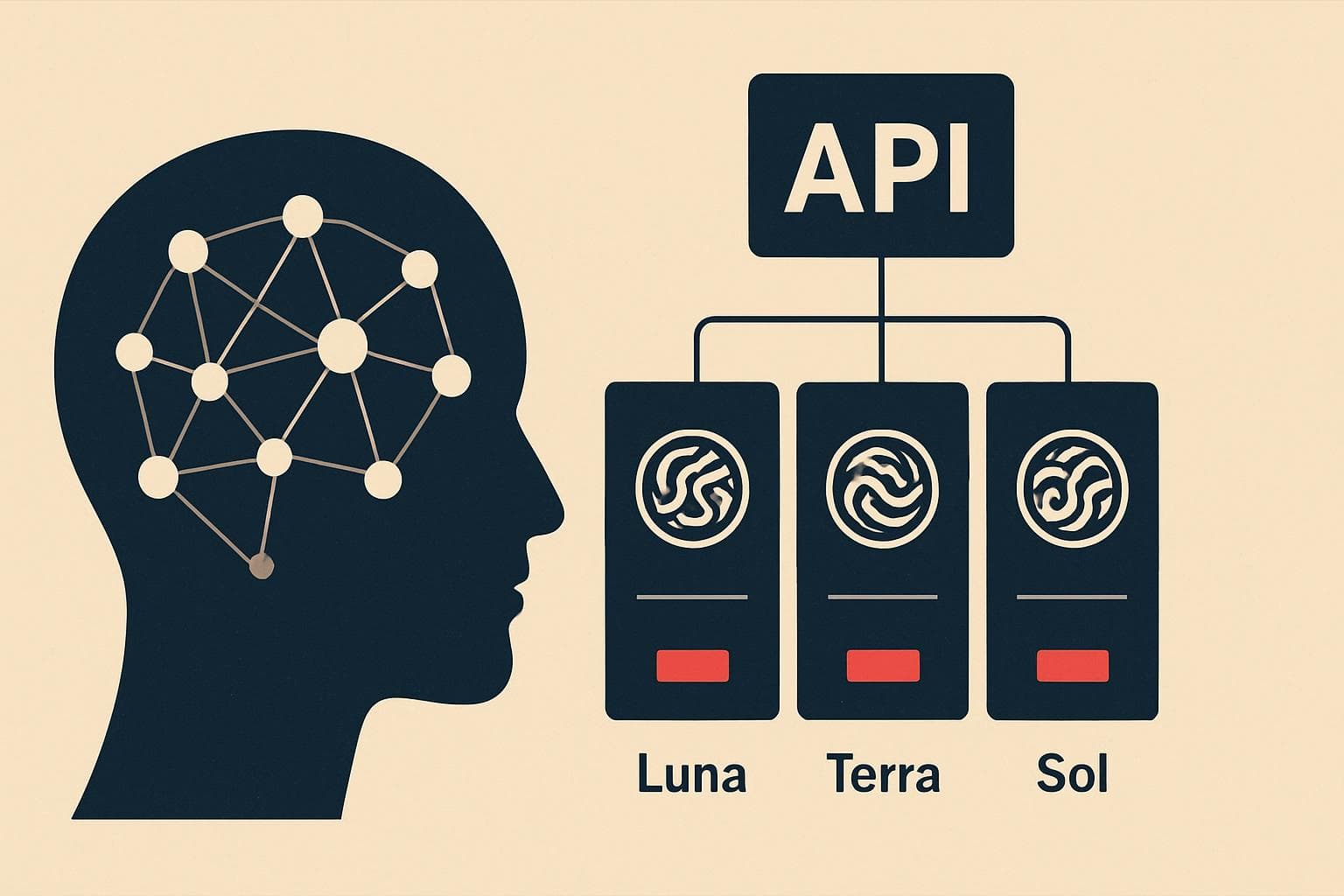
OpenAI made the GPT‑5.6 model family generally available this morning. The lineup includes three sizes: Luna (smallest), Terra, and Sol (largest). Pricing is given per 1 million input/output tokens: Luna $1/$6, Terra $2.50/$15, and Sol $5/$30.
For context, the article notes Anthropic’s Claude Opus series is priced at $5/$25 and Claude Fable 5 at $10/$50 per million input/output tokens. The piece cautions that per‑million‑token prices alone are not definitive, since different models may require very different numbers of reasoning tokens for the same task.
Benchmark claims and comparisons
OpenAI emphasizes improvements in long‑running, agentic performance. On Agents’ Last Exam, an evaluation of long professional workflows across 55 fields, GPT‑5.6 Sol reportedly achieved a new high score of 53.6, outperforming Claude Fable 5 (adaptive reasoning) by 13.1 points. At medium reasoning, OpenAI says Sol beats Fable 5 by 11.4 points at roughly one‑quarter the estimated cost. They also claim that smaller models show similar efficiency gains: GPT‑5.6 Terra and GPT‑5.6 Luna outperform Fable 5 at about one‑sixteenth the cost.
However, on SWE‑Bench Pro the situation was different: Claude Fable 5 scored 80%, while GPT‑5.6 Sol scored 64.6% on that benchmark. OpenAI reported finding problems while auditing SWE‑Bench Pro and estimated that roughly 30% of SWE‑Bench Pro tasks are broken, advising model developers to carefully inspect results from that benchmark.
The article’s author reports early access to GPT‑5.6 Sol and describes it as very competent, but so far not superior to Claude Fable 5 on the complex coding tasks they have used with Anthropic’s model.
New API features and guidance
OpenAI’s model guidance for GPT‑5.6 lists several new API features worth noting:
- Programmatic Tool Calling: models can "compose and run JavaScript that orchestrates tool calls," a capability that may help bridge the gap between model‑controlled toolchains and fuller terminal sessions that sequence CLI utilities.
- Multi‑agent: the API can "spin up subagents for parallel, focused work," making the sub‑agent pattern a core API feature.
- Prompt cache breakpoints: OpenAI adds an explicit way to mark prompt cache breakpoints (a pattern similar to prompt caching approaches elsewhere). Automatic detection remains supported, but explicit breakpoints could yield optimization savings for teams that implement them.
- Image requests can use detail: original to avoid any resizing before processing.
Pelican demos and cost illustrations
A demonstrative page contains 18 different pelican examples across the three models and the reasoning effort levels none, low, medium, high, xhigh, and max. It lists token counts and calculated costs; the cheapest example was gpt‑5.6‑luna at effort none costing $0.0071 (0.71 cents), and the most expensive was gpt‑5.6‑sol at max reasoning costing $0.4855 (48.55 cents).
In a lighter moment, OpenAI’s morning livestream includes a demo (around 17:50) showing 3D pelicans riding a tricycle, a bicycle, a pony, and another pelican.
Conclusion
The GPT‑5.6 release brings three model sizes with token‑based pricing and several new API capabilities aimed at richer tool orchestration, multi‑agent usage, and explicit prompt caching controls. OpenAI presents benchmark gains in long‑running agentic tasks versus Claude Fable 5, but also highlights issues in SWE‑Bench Pro that complicate direct comparisons; early hands‑on impressions suggest strong competence, with some tasks where Anthropic’s model remains competitive.