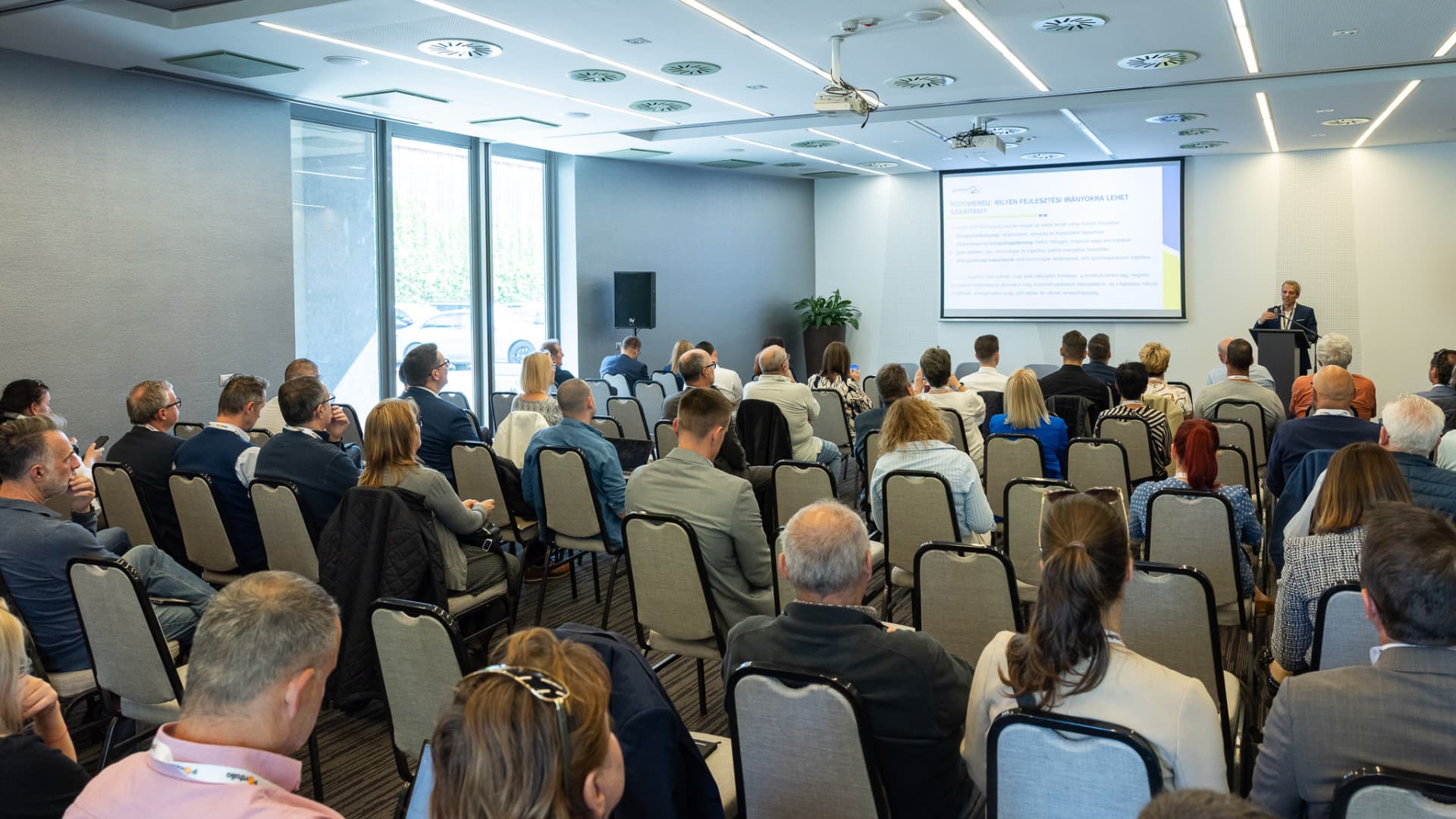
At Portfolio’s Székesfehérvár SME forum, speakers focused on practical areas affecting competitiveness: extracting measurable business results from artificial intelligence, avoiding compliance traps, preparing now for the expected wave of EU funding around 2026, and where energy efficiency and conscious procurement can deliver fast payback.
What role can AI play for SMEs?
During the AI panel participants noted that many Hungarian companies are still at an early stage of AI adoption. Illés Kata, co‑founder of Indivizo, said this is not necessarily a failure but part of the longer maturation process similar to earlier digitalization waves. The current heightened attention on AI acts as a catalyst, highlighting where resources can be freed, processes simplified and administrative burdens reduced.
A key takeaway was that strategic intent alone is insufficient: initiatives must be taken down to process owners and deliver quick, tangible wins. When teams see measurable speed‑ups in tasks such as documentation, customer responses or procurement admin, it becomes easier to scale. Illés also stressed that early hype has often been replaced by a pragmatic question: what human expertise and controls are needed to make AI reliably work?
Rapid deployment versus compliance risks
Kiss Barna, CEO of PILOUS Hungary, brought manufacturing perspective and warned that the simultaneous push for automation, digitalization and AI forced them to scale back from an initial “AI everywhere” momentum. Focus and prioritization are essential.
Kiss emphasized risks: without training and internal rules, AI use can lead to GDPR issues or leakage of commercially sensitive information. Accordingly, small, targeted applications — automating repetitive customer service or procurement tasks with in‑house development or external partners — often perform best.
Sárási Kata, IT Compliance and Resilience Manager at Norsk Hydro, reinforced that brakes are needed alongside AI: controls and a secure environment. She argued AI should not be treated as a classic project but as an infrastructure‑like layer that starts in narrow use and becomes a daily foundation, making auditability, governance and traceability central design goals.
The panel repeatedly raised the risk of Shadow AI: ad‑hoc, uncontrolled experiments that create data‑handling and reputational exposure.
Preparing for 2026 EU funding
Madarász András, development consultant at Goodwill Consulting, warned firms not to wait for the 2026 funding wave but to prepare application materials now. He noted that planning and energy calculations for energy projects alone can take months, while application windows are expected to be short and highly competitive.
Madarász also pointed out that not only large Brussels‑level calls exist; smaller, even several‑ten‑thousand‑euro opportunities are available if projects respond to real market demand.
Energy efficiency and procurement as quick wins
Szalai Sándor, KKV sales lead at E.ON Energiamegoldások, stressed that energy efficiency and conscious procurement are key for competitiveness given Hungary’s relatively high energy costs within the EU.
He said fixed‑price contracts are understandable for predictability but can be expensive at current price levels; exchange‑indexed (spot) solutions remain cost‑efficient albeit with higher price risk. As a middle path he presented a “spot‑to‑fix” approach: enter an index‑linked contract and switch to a fixed price when market conditions are favourable.
He also discussed time‑of‑use tariffs: high daytime solar production often creates lower or even negative daytime prices. Examples cited included daytime, weekend and the new “ritmus” tariff, which was reported to offer roughly a 35% difference between discounted and peak time bands.
Closing panel: controls, cost scrutiny and diversification
The final panel offered actionable profit‑improving advice. Szalai Attila, COO of Magyarmet Finomöntöde, urged companies to revisit numbers with detailed controlling and to scrutinize line items: unjustified benefits, unnecessary travel, avoidable energy use or compressed‑air losses in production can cause monthly waste at the scale of hundreds of thousands of forints.
For supplier risk he recommended diversification: aim for at least three suppliers for each critical input; where that is not feasible, consider alternative production or process redesign.
Ferencz Kornél, a principal owner of VERTIKAL Group, emphasized mindset: ongoing crises make it worthwhile to treat uncertainty as opportunity and use data‑driven decisions to pursue directions — such as opening new markets — that would otherwise seem risky. Both panelists closed by underscoring the value of industry knowledge sharing: partnerships and joint risk management can become competitive advantages.
Conclusions
The Székesfehérvár forum’s practical message was that incremental, well‑governed AI and energy measures can yield rapid, measurable benefits, while compliance and controls cannot be overlooked. Advance preparation of project plans and conscious energy procurement could be differentiators for SMEs around 2026.