Researchers at Australian National University published a study in Proceedings of the National Academy of Sciences describing a recognition method that substantially improves people’s ability to tell whether a face image was generated by artificial intelligence. The authors say the approach does not require specialized software and is simple and fast enough to be delivered online.
Background
As generative artificial intelligence has advanced, so has the realism of fabricated images and videos, making it increasingly difficult for lay observers to distinguish real from AI‑produced content. Previous studies found humans often perform little better than chance when asked to detect AI‑generated material, especially for faces. Earlier detection strategies typically relied on spotting visual errors — distorted backgrounds or anatomical anomalies — but the researchers argue that relying on such defects is becoming less effective.
Research approach
The study builds on the observation that generative models produce faces by averaging across large datasets of human faces used for training. According to the paper, this mathematical averaging makes AI images appear more prototypical: algorithmically generated faces tend to be judged as more symmetric, more proportionate, and more attractive, while being less expressive, less distinctive and less memorable than real human faces.
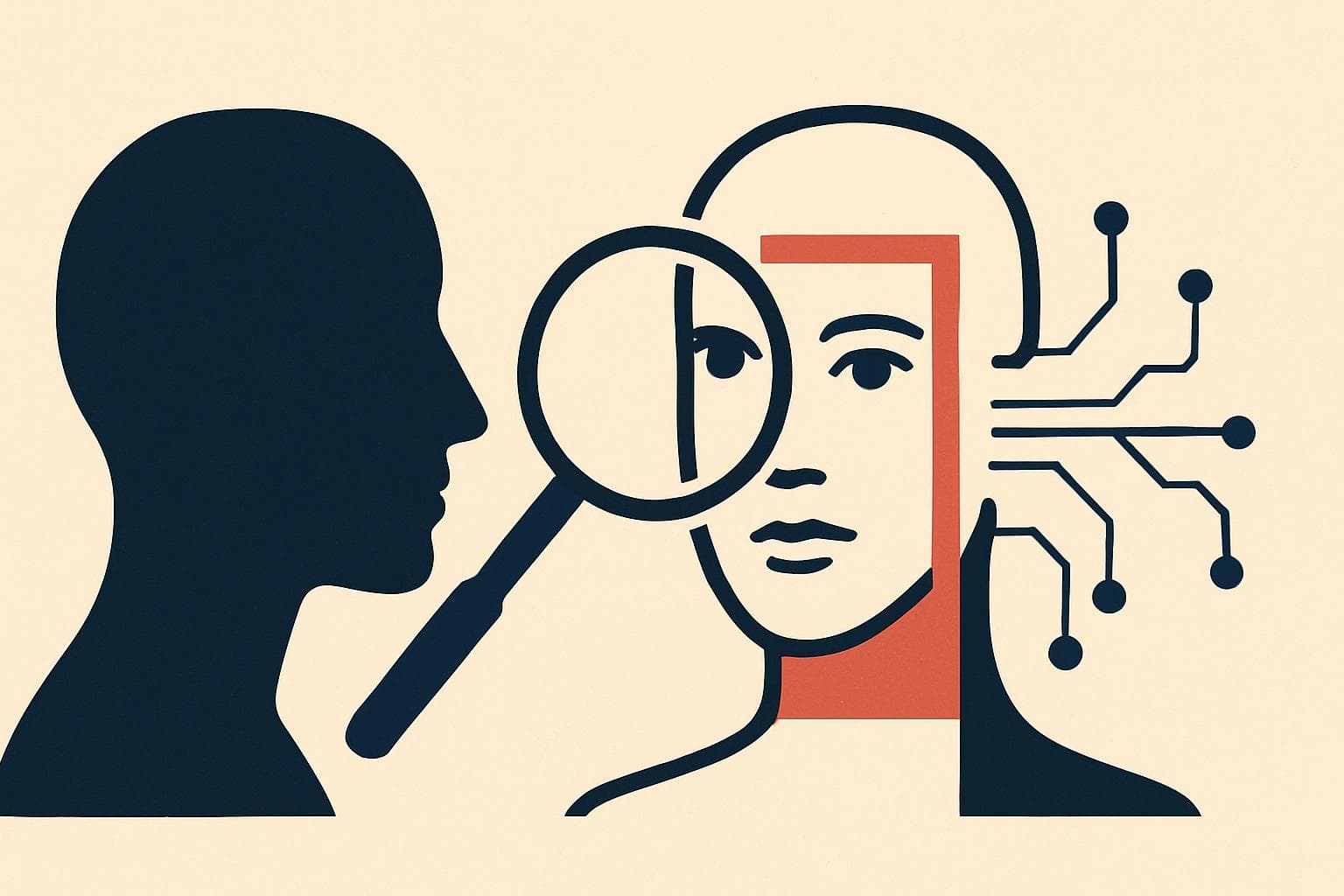
Rather than hunting for visual artifacts, the researchers shift attention from local details to the broader, so‑called global impression of a face. They identified six key attributes for participants to evaluate: symmetry, proportion, attractiveness, expressiveness, distinctiveness and memorability.
Experiment design and results
In the first phase of the study, 45 volunteers were shown a series of faces, some real and some produced by AI, and asked to decide which images were AI‑generated. Instead of simply telling participants which features to look for, the researchers trained them through a structured six‑step protocol; each training stage consisted of 96 tasks.
During training, participants rated faces on the listed general visual attributes (for example, how attractive or symmetric an image appeared). Participants typically gave higher scores to AI‑generated faces for symmetry, proportion and attractiveness, and rated real faces as more expressive, distinctive and memorable.
After training, detection accuracy — the rate at which participants correctly identified AI images — nearly doubled. The highest‑performing participants achieved near‑perfect scores on the test tasks.
Limitations and open questions
The authors note that these findings currently apply to still images of faces; it remains unclear whether the same approach would work for AI‑generated videos or synthetic voices. They also point out that, given the method’s simplicity and speed, it could be scaled online, but practical deployment and broader validation require further study.
Summary
The Australian National University team demonstrates that differences between human and AI faces are not limited to obvious visual defects. A brief, structured training that encourages evaluation of global facial characteristics can teach people to detect AI‑generated faces far more effectively, offering a potentially useful tool in the fight against deepfake imagery.