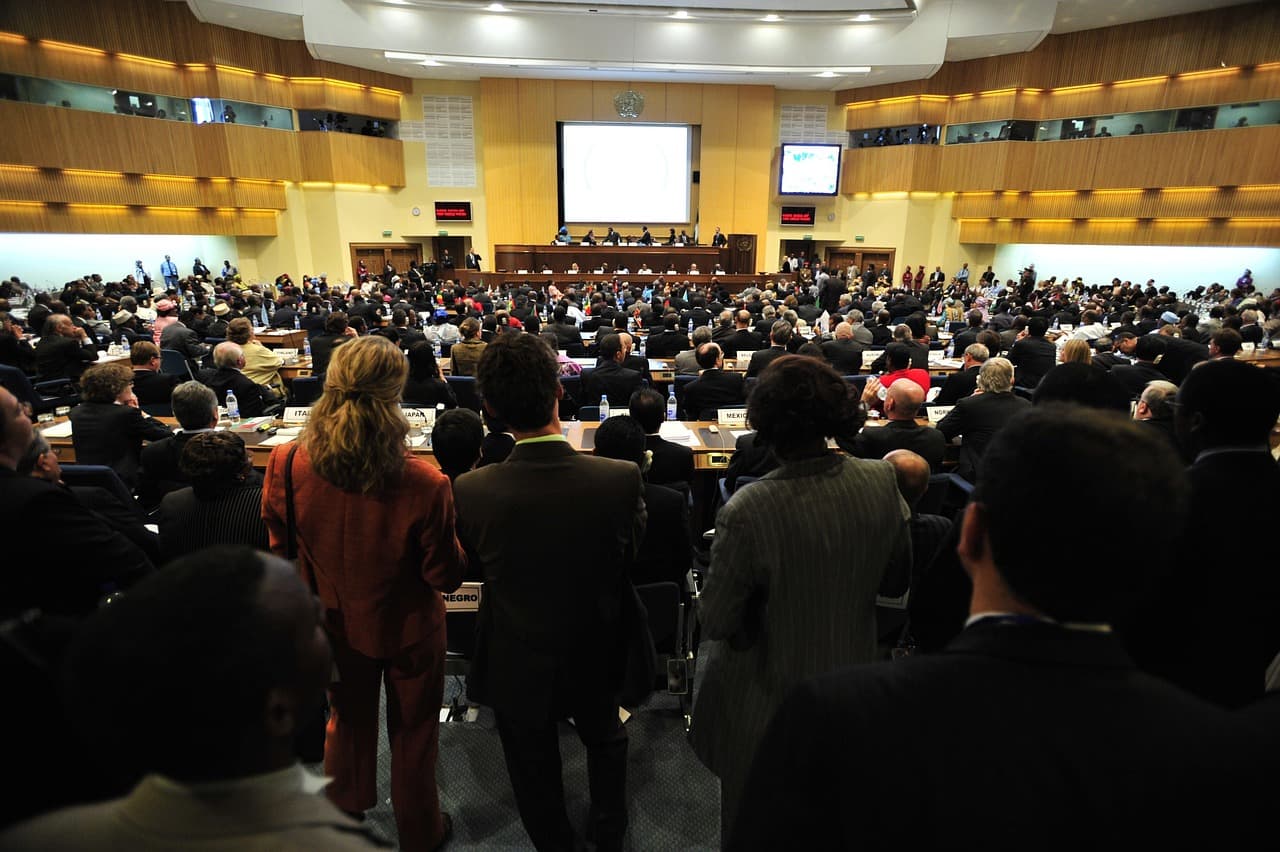
Today Sam Altman, Chief Executive Officer of OpenAI, addressed the United Nations Security Council on the role, risks and governance needs of artificial intelligence (AI). He argued that while AI can expand opportunities in science, healthcare, education and the economy, it is crucial to keep powerful systems under human control and to develop international safety standards.
Accelerating progress and a consequential choice
Altman said recent weeks and months have felt different because rapid model progress has compressed timelines: the upside is more tangible but the risks are more immediate. He framed the present as a choice between two unfavorable outcomes to be avoided: losing control of the future to AI, or concentrating too much power in too few hands.
He warned that the industry must not accept excessive technological risk simply because potential benefits are large or competitive pressure is strong. Altman noted that companies have unilaterally slowed development in the past and can do so again; building systems that cannot be aligned, monitored, and guaranteed safe is unacceptable.
Human-centered AI and alignment
Altman set out three core principles for a preferable path forward:
- People must remain central to AI decision-making. Alignment is practical work to ensure systems stay under human control, reflect human values, and follow human guidance—not an abstract research problem.
- Scientific progress and economic gains should benefit people: AI should assist researchers, doctors, teachers, entrepreneurs and communities to solve problems and improve lives.
- The technology must empower individuals. The goal is to enable people to realize their potential and build value for themselves and their communities, not to make technology’s builders the heroes of the story.
Examples of rapidly increasing capability
Altman cited specific advances in the company’s models to illustrate capability growth: three summers ago the models handled elementary math, two summers ago they performed at high-school competition level, last summer they reached a gold-medal level at a major international math competition, and “this summer a few weeks ago” one model solved a Millennium Prize problem—the Navier–Stokes equations. He framed these achievements as ways to enable new discoveries with practical relevance (aircraft design, weather forecasting, blood flow studies), not as ends in themselves.
International cooperation and common standards
Altman emphasized that the most consequential decisions must not be made solely by a handful of labs. He called for international cooperation and complementary national and international frontier-AI standards that would cover:
- Methods to measure capabilities and assess risks;
- Criteria to judge whether safeguards are sufficient and human oversight is preserved as systems become more autonomous;
- Shared standards enabling countries to compare evidence and verify compliance;
- Rapid incident reporting, classification and reporting protocols so the world can learn from failures before they escalate;
- Secure channels for governments, critical infrastructure operators and technical experts to share emerging vulnerabilities and threats.
He stressed these standards should not entrench incumbents or favor one business model; they must accommodate open and closed model developers, new entrants and established labs. Each government should decide how to incorporate standards into its legal framework, but global agreement on what constitutes good evidence, safeguards and oversight would benefit everyone.
Closing: two paths and a pragmatic middle way
Altman described the crossroads facing the world: one path leads to concentrated power, opaque decisions, and people feeling technology is being done to them; the other leads to AI governed through democratic institutions, scientific advances that improve lives, and broader participation in shaping the future. He said OpenAI does not have all the answers, is open to better ideas, and is willing to work with governments and others to find a responsible path forward. He concluded that this future—where AI expands human potential—is worth building.