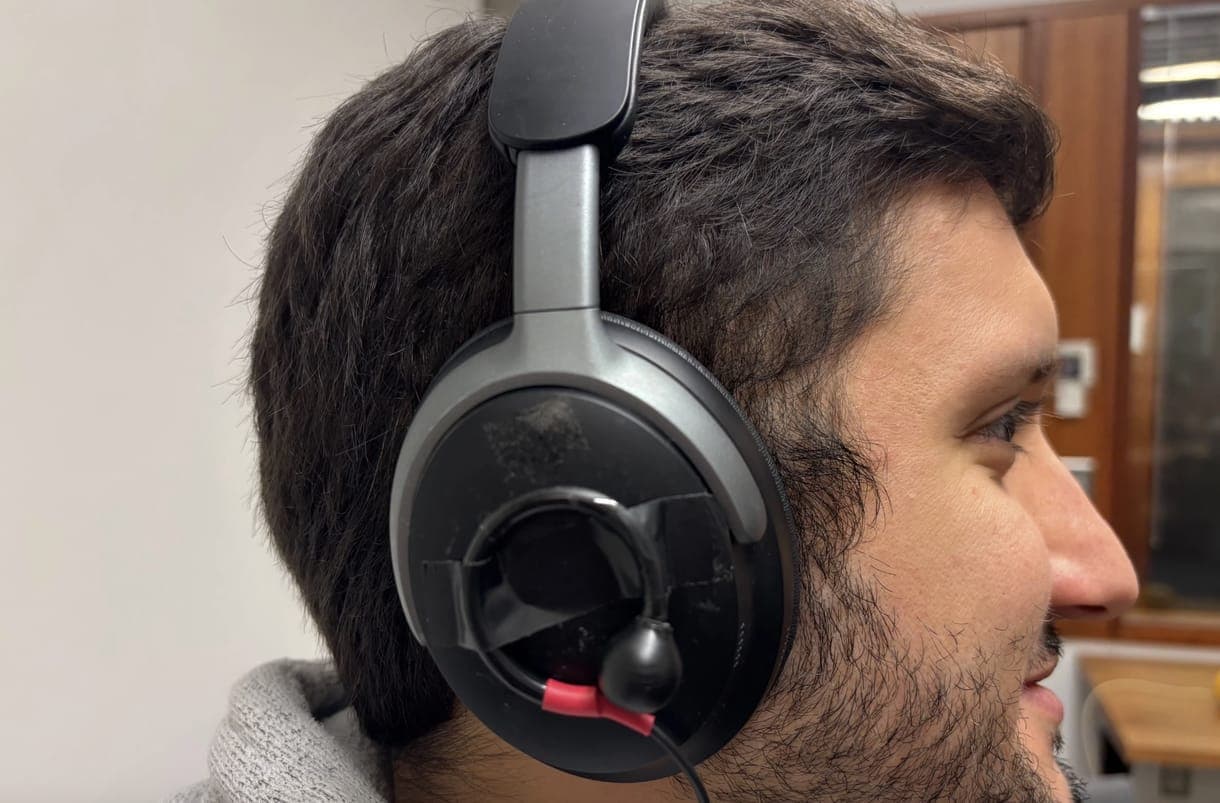
Researchers at the University of Washington have developed a prototype headphone described as a "proactive hearing aid" that automatically identifies and isolates the voice of the person the wearer is addressing. The device aims to address the so-called cocktail party problem: the difficulty hearing aids and noise-cancelling systems have in amplifying one person's voice without also amplifying other voices and background noise.
How the system works
The prototype uses a binaural microphone that simulates human spatial hearing and relies on two separate artificial intelligence models.
- The system activates when the headphone wearer starts to speak. The first AI model then tracks the participants in the conversation with a "who speaks when" analysis and looks for low overlap between conversational turns.
- The output from the first model is passed to the second AI model, which separates the participants and plays a cleaned, isolated audio stream to the wearer.
According to the researchers, the pipeline is fast enough to avoid perceptible latency that would disturb the user.
Performance and limitations
The current prototype can handle one to four conversational partners simultaneously alongside the wearer's own voice. The team notes that highly dynamic conversations — for example, multiple people speaking at once or extended monologues — make separation harder, and participants entering or leaving a conversation present additional challenges.
The researchers said they were nevertheless surprised by how well the prototype performed in these more complex scenarios. The models have so far been tested on English, Mandarin and Japanese dialogues; the team cautions that the rhythmic properties of other languages may require further tuning.
Why this matters
Previous approaches have generally required users to manually select a speaker or a listening distance, degrading the user experience. Guilin Hu, the study's lead author, described the new system as a "proactive technology" that infers human intent automatically and less invasively, removing the need for users to constantly adjust the system.
The researchers hope the approach can be integrated not only into ear-mounted headsets but eventually into smaller devices such as hearing aids, earbuds and smart glasses. That would allow users to avoid manual control of the AI's attention and instead receive a filtered audio scene tailored automatically to their conversational focus.
Demonstration
The research was presented at an EMNLP (Empirical Methods in Natural Language Processing) conference held in China. The demonstration used an ear-mounted headset prototype; the team is continuing to refine the models and improve the user experience.
(Note: the article reports on a research prototype and demonstration; broader practical deployment will require additional development.)