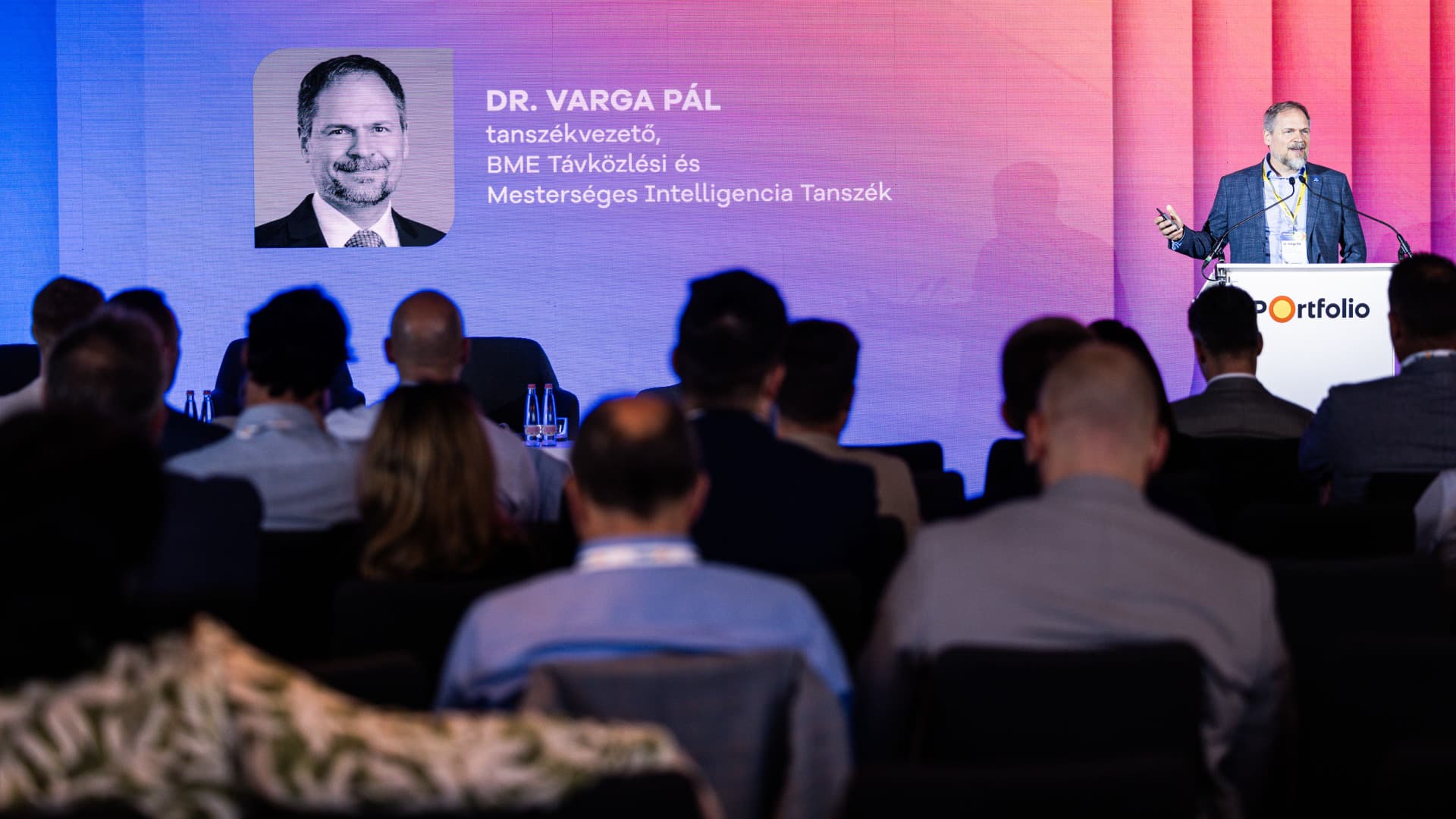
At the Portfolio AI in Energy 2026 conference, Varga Pál, head of the Department of Telecommunications and Artificial Intelligence at the Budapest University of Technology and Economics (BME), argued that the success of AI projects in the energy sector depends not on the technology itself but on whether it delivers measurable improvement in a specific system. He proposed a four-level measurement architecture that spans technical accuracy to strategic scalability.
When to use LLMs and generative methods
Varga distinguished by task type: large language models (LLMs) are not the default solution for every problem. Generative approaches are especially useful where reasoning, summarization, human interaction, natural-language search or document processing are required. If a task can be solved with rule-based systems, classical machine learning or workflow automation, deploying an LLM is not automatically justified. He warned that many poor AI projects start by applying language models to problems that do not require linguistic intelligence.
Critical infrastructure: deterministic solutions prioritized
The department head stressed that reliability is decisive: in critical infrastructure, where failure creates direct operational or supply-security risk, deterministic, physically or mathematically verified solutions and verifiable algorithms running on target hardware should take priority. Large language models and self-learning deep neural nets have more scope where the task is inherently approximate, human oversight remains, and errors do not create system-level risk.
Four-level measurement architecture
Varga Pál warned that without baselines and clear KPIs, AI remains a buzzword. His four-level measurement framework includes:
- Technical level: algorithm performance itself (e.g., forecasting error, precision/recall, latency, model drift).
- Process level: improvements in day-to-day operations (e.g., time to detect faults, time to prepare decisions, maintenance cycles, reduction in manual analysis time).
- Operational/business level: gains for the company or operator (e.g., OPEX reduction, lower outage costs, balancing costs, energy intensity).
- Strategic level: whether the investment is future-proof (scalability across sites, reusability in other processes, auditability, regulatory compliance, durable competitive advantage).
He noted there is no single universal AI KPI: an early experiment, an operational integration and an enterprise-scale AI platform must be judged by different metrics. Technical indicators alone — such as model accuracy or number of pilots — are misleading unless tied to business or operational outcomes.
Areas where AI already brings tangible benefits in energy
The talk broke down AI use in energy into practical "building kits":
- Forecasting and network operations: load, renewable generation, price and demand forecasts, and flexibility planning. The aim is to make operations cheaper and more stable and potentially defer costly network investments. In network operations AI can improve fault detection, outage prediction and fault localization — not by standalone model scores, but by earlier detection, better localization and reduced restoration time.
- Asset management and energy efficiency: predictive maintenance for transformers, turbines, inverters and other grid assets. Relevant KPIs include unplanned downtime, MTBF, MTTR, the ratio of reactive vs planned maintenance, and hit rate of failure predictions. Industry examples suggest predictive maintenance can significantly reduce outages and reactive maintenance needs. Energy-efficiency applications target consumption optimization, peak shaving and tariff-based optimization; real benefit is persistent reductions in kWh consumption, peak load, cost per MWh or carbon intensity.
- Customer-facing applications: chatbots, consumption advice, churn prediction — these require different metrics (e.g., CSAT, first-contact resolution rate, average handling time, share of cases closed on digital channels, complaint resolution time, customer retention).
- Flexibility and DER integration: battery control, EV charging, local capacity planning and DER integration — aiming to help modern distribution networks handle higher renewable and DER penetration more stably.
Varga emphasized that the greatest value often comes not from a single AI tool but from identifying the highest-value process and building AI-driven transformation around it.
Innovation vs. routine: the success paradox
He described a paradox: well-functioning routines make it harder for organisations to question whether the same approach will remain optimal as technology, markets and regulation evolve rapidly. Change can be reactive (forced by untenable legacy operations) or proactive (anticipatory innovation). The latter is cheaper and more controllable. Innovation, he said, is structured curiosity: propose ideas, filter them against reality, test, then implement and scale working solutions — always clarifying early how outcomes will be measured.
Closing thought
Varga concluded that AI must not be an end in itself: first define what the system should improve, then choose technology and metrics. "Without real target definitions, AI remains a buzzword, hype and ornament, because it only has real value if it measurably makes the energy system more reliable, cheaper, stable or flexible."
(Date: presentation at Portfolio AI in Energy 2026 conference.)