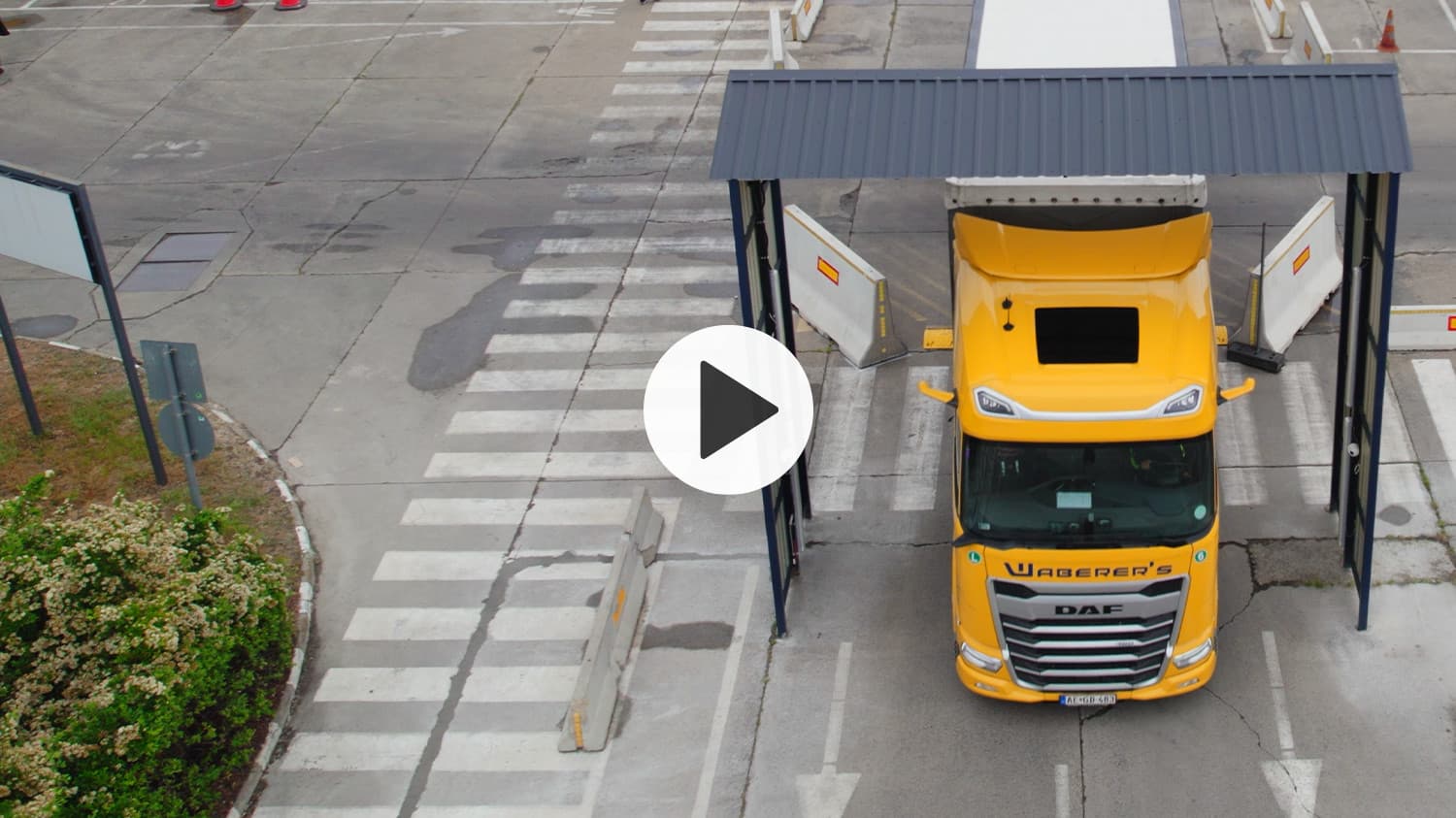
Waberer's has put into service an AI-driven scanner gate at its Nagykőrösi úti facility in Budapest to speed up and partially automate the technical inspection of heavy vehicles arriving on site.
The investment was driven by Dudola Tibor, Waberer's Technical Operations Manager, who said the company wanted an objective measurement point to record a vehicle's technical condition on arrival, supplemented with other vehicle parameters. The project was motivated in part by rising labor costs and increased accessibility of the enabling technology.
Technical setup and efficiency gains
The physical gate measures 4.8 metres wide and 4.5 metres high. It is equipped with nine IP cameras providing continuous data streams, flicker-free lighting and non-reflective side walls. Image processing runs on local servers and uses three separate local AI models:
- the first model identifies whether the arriving vehicle belongs to the company's fleet or an external fleet;
- the second finds the least-distorted centre point in the captured image;
- the third performs the damage detection.
After several rounds of tuning, the system today recognises the most common damage types with roughly 90 percent confidence. At the end of the automated process typically only a single staff member's manual approval is required.
Before deployment, garage staff recorded incoming vehicle data on paper and in Excel spreadsheets, a process that took about 30 minutes. Thanks to the semi-automated, database-level system — integrated with APIs and Power BI reporting — the turnaround time for inspecting the several hundred vehicles processed daily fell by 40–50 percent to 10–15 minutes. It should be noted that document checks and the recording of load-securing devices are still done manually, which partly explains the remaining time requirement.
What the system detects and how issues are handled
The scanner most often detects scrapes on lower sections of tractor units, damage to heat shields on exhaust silencers, fuel tanks, steps, door skirts and lamp housings. For trailers, common findings include torn tarpaulins and scratches on underride protection bumpers.
Detected defects are immediately routed to Waberer's in-house service network for repair. The group provides full workshop services from painting to tyre work: repairs are carried out at 42 service bays in Budapest and 10 in Mosonmagyaróvár. The company maintains dealer status, its own spare-part stocks and testing centres for every vehicle brand it operates.
Planned extensions
To further optimise costs, the system will be expanded with more functions. As part of an in-house tyre management programme launched earlier this year, the scanner will start recording tyre sidewall damage and overall tyre condition. Additional planned features include automatic queries for vehicle marketing elements, logos and superstructures, and checks for the presence and potential replacement needs of blind-spot warning stickers required in international transport.
The article's publication was supported by Waberer's.