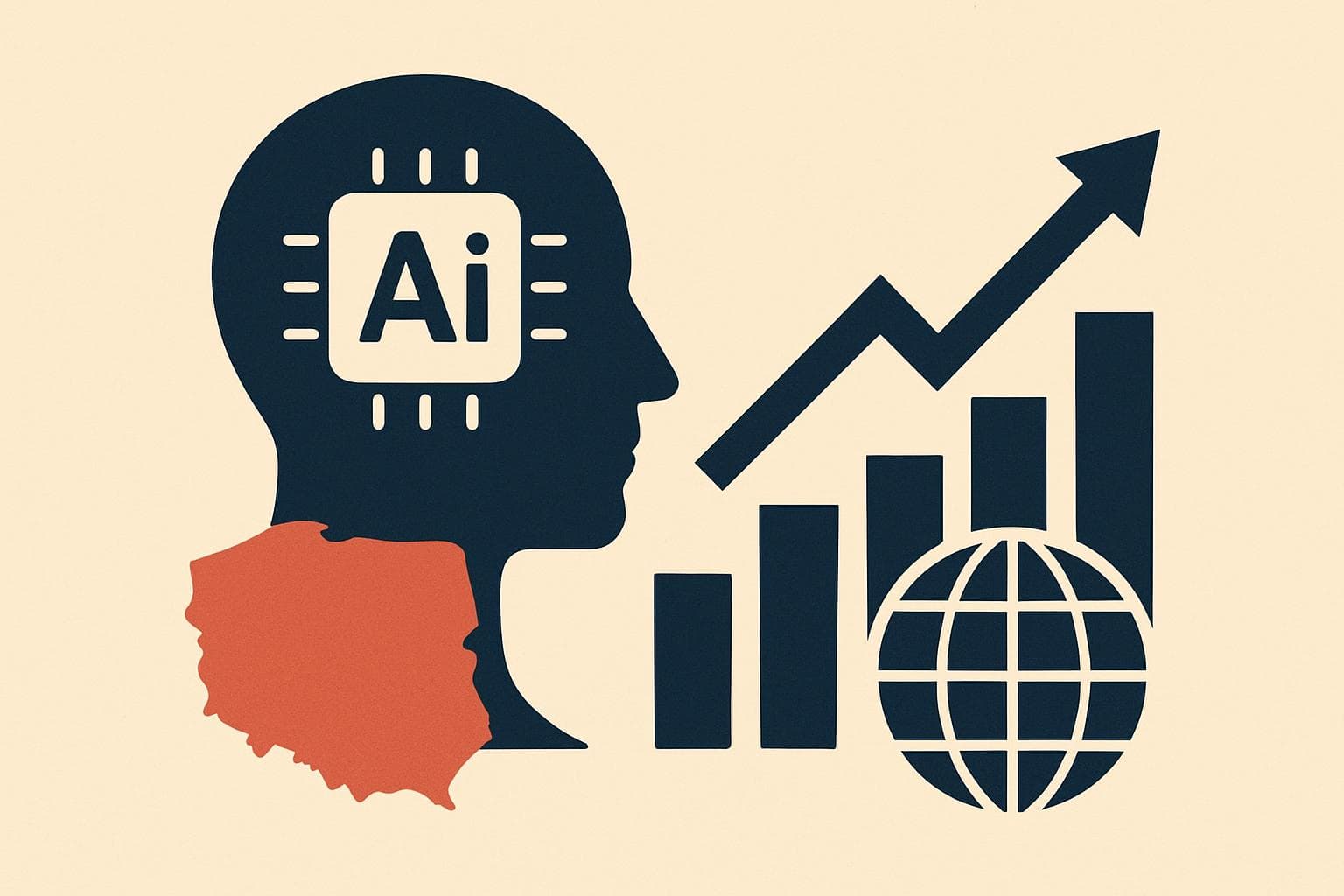
A World Bank analysis published on Monday and reported by Bloomberg concludes that artificial intelligence (AI) could increase Poland’s economic output by up to 12 percent by 2035. The report says AI can help Poland close the gap with the world’s wealthiest nations, but realizing that potential depends on meeting significant preconditions.
The World Bank points out that the next phase of Poland’s convergence will be more challenging than previous ones. The cost-based advantages that have underpinned competitiveness are gradually eroding, while demographic pressures are intensifying. As a result, future growth will need to rely far more on innovation and productivity gains than on low-cost advantages.
Two factors are highlighted as especially important by the report:
- attracting foreign direct investment (FDI) linked to AI, and
- effectively capturing the productivity gains that the technology enables.
The report positions Poland not as a frontier innovator but as a "capable adopter" on the global AI map: the economic impact will largely depend on how flexibly workers can switch sectors and occupations, and how much companies are willing to invest in new solutions.
The World Bank also warns that Poland’s coal-dependent energy infrastructure—responsible for electricity prices that are higher than the EU average—could become a significant impediment to AI-related goals, since wide adoption of digital technologies requires reliable and competitively priced power.
Ary Naïm, World Bank Director for Poland, emphasized that the primary challenge is not access to technology itself but its effective practical application. Achieving that will require investments in infrastructure, digital networks, the energy sector and education.
The report places Poland’s prospects in a regional context by noting a McKinsey study published last week on Hungary’s AI opportunities. McKinsey found that Hungary’s previous growth model, which relied on employment expansion, has reached its limits; automation could represent roughly a €15 billion potential by 2030, equivalent to 6–7 percent of GDP. Across the region, success will hinge on how quickly domestic firms—especially lagging small and medium-sized enterprises—and public systems integrate new technologies into everyday operations.
In short, the World Bank sees significant upside from AI for Poland, but converting that upside into real economic gains will demand targeted investments and structural adaptation, particularly in energy, infrastructure, digital networks and education.
Tags: world bank, competitiveness, artificial intelligence, productivity, innovation, demography, poland, infrastructure, energy sector, foreign direct investment