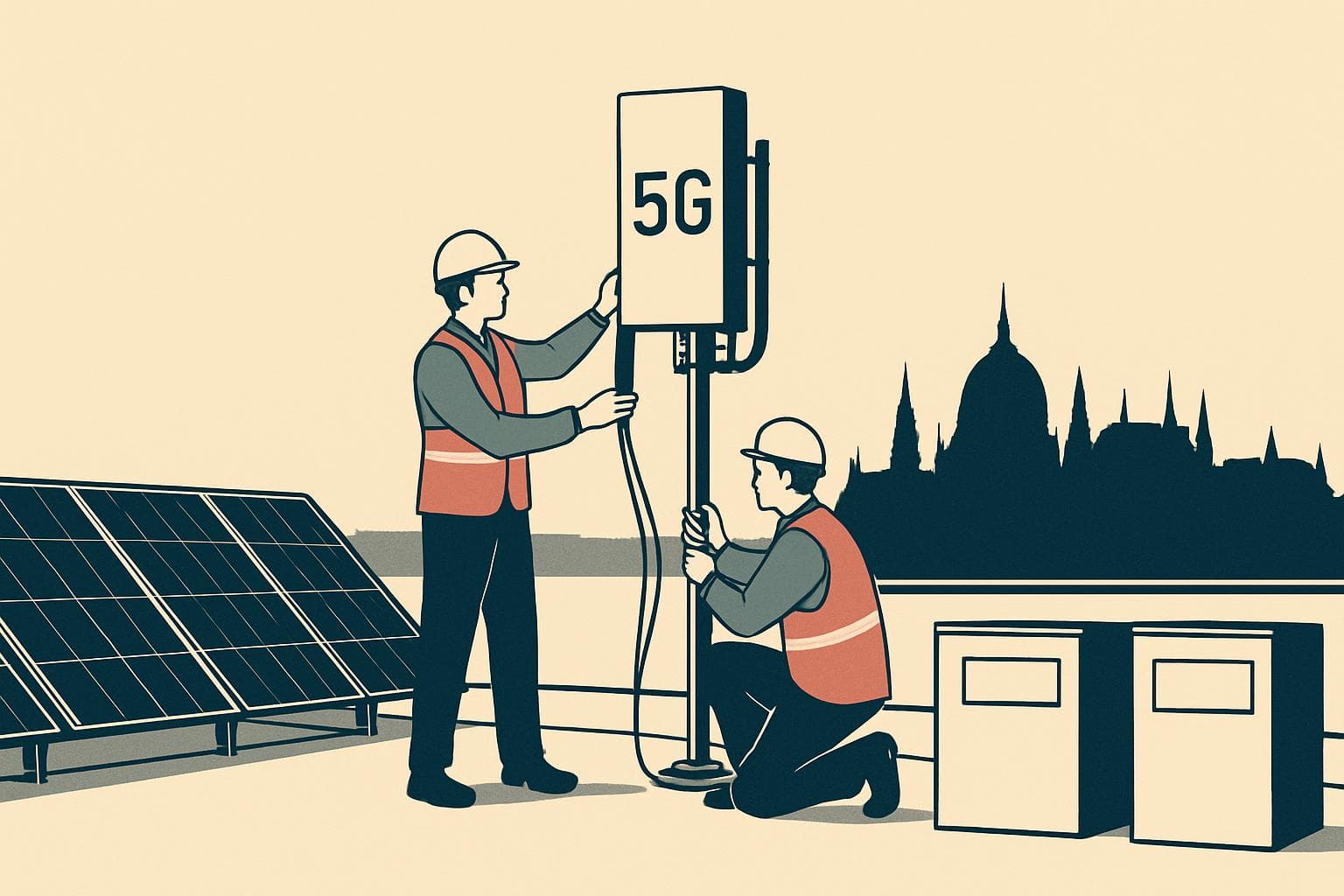
Artificial intelligence (AI) is being applied across almost every area of telecommunications, from network planning and operations to improving energy efficiency. CETIN Hungary recently modernized its network infrastructure with an investment exceeding HUF 120 billion, covering more than 4,080 base stations. The company is actively exploring AI-based applications to make its operations more efficient, sustainable and user-focused.
AI in network planning
CETIN Hungary is developing solutions that analyze aggregated telemetry and customer feedback to pinpoint geographic demand and capacity needs more accurately. AI-driven, cell-level planning can indicate where to build new base stations or where to expand capacity at existing sites. The aim is to improve coverage and continuously enhance user experience, while also assessing how AI affects planning speed and complexity.
Continuous optimization and self-healing capabilities
The company monitors its network using several thousand key performance indicators (KPIs). AI correlates these metrics with traffic forecasts to identify underperforming base stations and propose optimized radio configurations that can then be integrated into the network. Predictive analytics enable the detection of certain faults and anomalies before they occur, and in some cases automatic remediation is possible, enabling self-healing network behavior.
Intelligent operation also appears in administrative and technical workflows: CETIN uses generative AI to review engineering work orders, identify gaps and provide professional feedback. This approach helps ensure that interventions are properly prepared and documented, improving operational quality and efficiency.
Edge AI and low-latency services
Koltai Balázs, university lecturer and digital transformation lead, notes that base stations could evolve into distributed AI compute nodes—so-called Edge AI points. This would allow the network to serve ultra-low latency applications locally. The result would be a more autonomous and proactive infrastructure whose benefits end users would experience directly.
Energy efficiency and savings
AI also opens opportunities in energy management by continuously analyzing consumption patterns. Early detection of anomalies helps uncover hidden faults, while traffic forecasting allows dynamic control of individual network elements. During low-traffic periods, surplus capacity can be switched off or placed into energy-saving modes—often referred to as smart sleep—without compromising service quality.
According to CETIN Hungary’s experience, intelligent network control and power-saving features can save around 3 million kWh of electricity annually, roughly equivalent to the yearly electricity consumption of about 1,295 average Hungarian households. Targeted AI support could further increase the saved electrical energy by approximately 20 percent.
Why this matters
Deploying AI in telecommunications not only increases network intelligence but also supports more cost-effective and environmentally friendly operation. CETIN Hungary’s investment and AI-led developments improve service quality, reduce operational burdens and generate measurable energy savings, helping prepare mobile networks for future application demands.
Ongoing evaluations
CETIN is continuing to test and roll out various AI applications: measuring their impact on planning cycles, the potential for automation in network operations, and further optimization of energy consumption. The company aims for these developments to deliver tangible benefits in both operational metrics and subscriber experience.