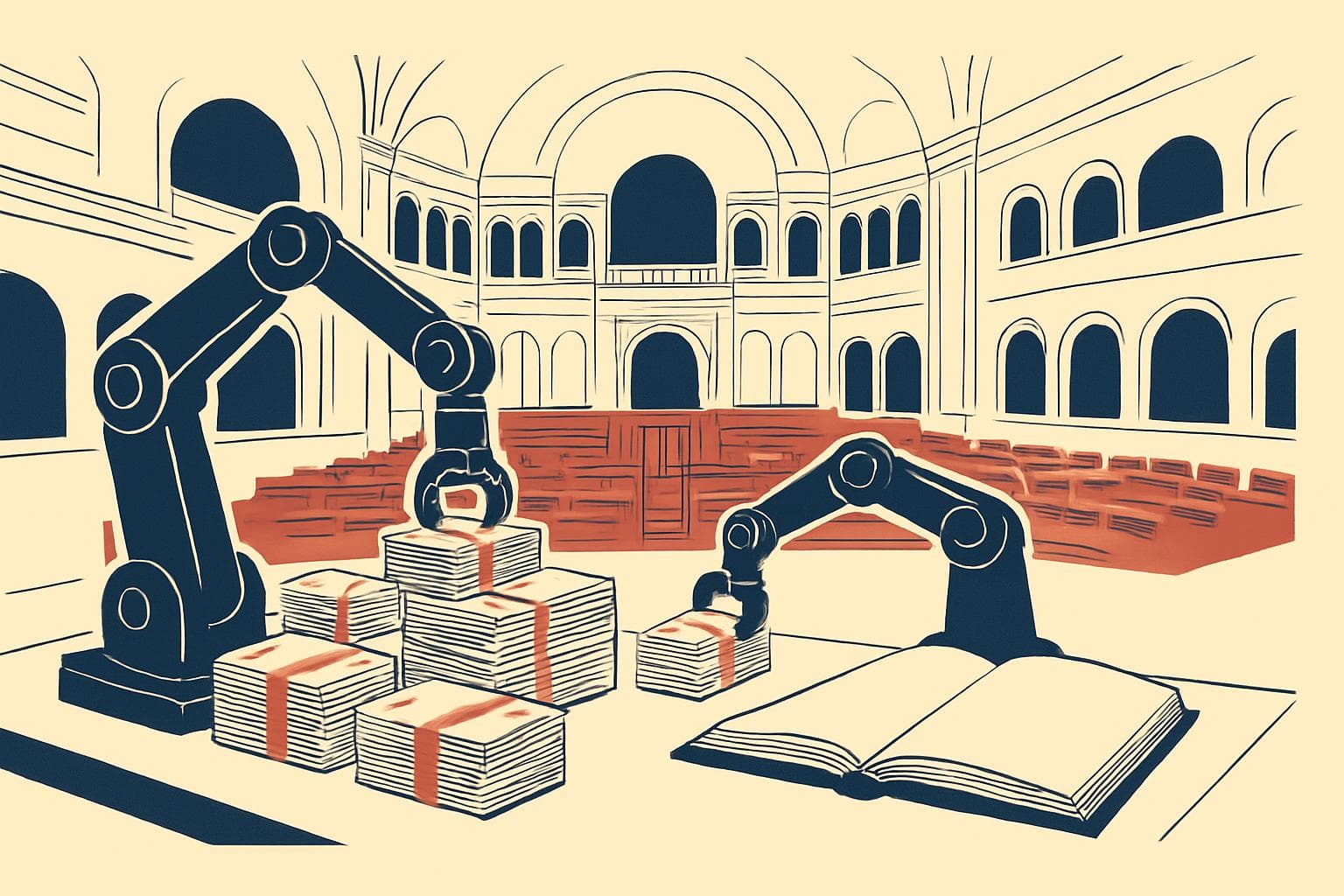
According to analyses published in the Harvard Business Review in June 2026, companies that rapidly and widely deployed generative artificial intelligence are increasingly confronting what researchers call “knowledge decay.” Matthias Holweg, Professor of Operations Management at the University of Oxford, and Thomas Davenport, Professor at Babson College, describe how accumulated low‑quality AI output undermines the information base organizations rely on for decisions.
What is “workslop”?
The term “workslop” was coined by researchers at BetterUp Labs and the Stanford Social Media Lab in a September 2025 Harvard Business Review article. It denotes AI‑generated work that looks acceptable on the surface but lacks substantive value. A survey of 1,150 full‑time U.S. employees found that 41 percent received at least one piece of “workslop” in the prior month, and each incident required on average 1 hour 56 minutes of extra work to identify and fix defects.
Financial and organizational impacts
Using reported wages and time costs, the BetterUp–Stanford researchers estimated that “workslop” imposes an average monthly loss of $186 per employee. Scaled to a 10,000‑employee company, this implies more than $9 million per year of wasted work time. Those figures do not include additional harms to morale, trust and collaboration, which could raise the broader social and organizational costs.
The survey also reported measurable social effects: among recipients of workslop, 53 percent felt annoyed; 42 percent trusted the sender less; nearly half judged the sender as less creative, competent or reliable; and one in three would be less willing to collaborate with that colleague again.
Productivity promises vs. reality
Empirical evidence for broad productivity gains from generative AI remains limited. A July 2025 report from the MIT Media Lab found that 95 percent of organizations could not demonstrate measurable returns from their generative AI investments. A March 2026 analysis by Goldman Sachs similarly concluded that, at the macro level, there is no clear link between AI adoption and productivity improvements, even as more than 70 percent of S&P 500 executives mentioned AI in quarterly earnings calls.
Knowledge decay is different from hallucination
Holweg and Davenport distinguish “knowledge decay” from the familiar problem of AI hallucinations. Whereas a hallucination is a discrete factual error in an AI output, knowledge decay describes what happens when such errors and low‑effort AI artifacts accumulate over months, eroding collective confidence in internal documents. Processes built on unreliable information produce unreliable outcomes, and employees may rely more on AI outputs than on developing their own expertise.
Hiring is particularly affected
The authors identify recruitment as an especially vulnerable area: AI‑generated résumés flood recruiters, AI‑composed job ads can mislead applicants, and automated screening tools may filter out suitable candidates. HBR characterizes trust in the hiring pipeline as having reached a “historic low” for both applicants and recruiters.
Growing employee resistance
A 2026 survey of 2,400 workers in the U.S., U.K. and Europe found that 29 percent admitted to actively resisting their employer’s AI strategy—by ignoring policies, refusing training, or even skewing performance metrics. Resistance was higher among Gen Z employees (44 percent), driven mainly by fear of job loss.
Layoffs and a mismatch with AI capabilities
In the technology sector in 2026, more than 95,000 jobs were eliminated across 247 distinct layoff events, and roughly half of those cited AI as the rationale. Analysts have questioned whether many of those firms actually had mature AI systems capable of performing the displaced roles.
The irony: fixing workslop demands more human work
Addressing the workslop problem typically requires new human oversight, quality standards and review processes around AI outputs—measures that consume the same staff time organizations hoped AI would free. HBR’s prescription effectively creates an additional human verification layer, which undercuts some of the efficiency arguments originally used to justify rapid AI rollout.
Not all AI use is equal
Both HBR articles stress the distinction between indiscriminate AI use and targeted applications. Models trained on company‑specific data can deliver real value, while public large language models (LLMs) often produce generic, error‑prone copy. Firms that froze hiring based on anticipated AI productivity gains may find those gains illusory if work quality deteriorates faster than headcount is reduced.
Framing the productivity debate anew
The knowledge decay concept shifts the AI productivity debate: it’s no longer only about whether AI speeds task completion, but whether widespread AI use improves or degrades an organization’s overall decision‑making capability. The Harvard Business Review’s verdict is clear: at firms that introduced AI without adequate quality control, the net effect is more likely negative. The authors’ expertise lends credibility to the argument, but they and other contributors caution that the knowledge decay idea is not yet backed by controlled long‑term empirical studies; current conclusions synthesize multiple independent reports and self‑reported survey data. Nonetheless, Goldman Sachs, the MIT, BCG and two separate HBR research teams converge on a similar message: many organizations are not getting the benefits they expected from generative AI, and those that adopted it fastest may be incurring the largest hidden costs.