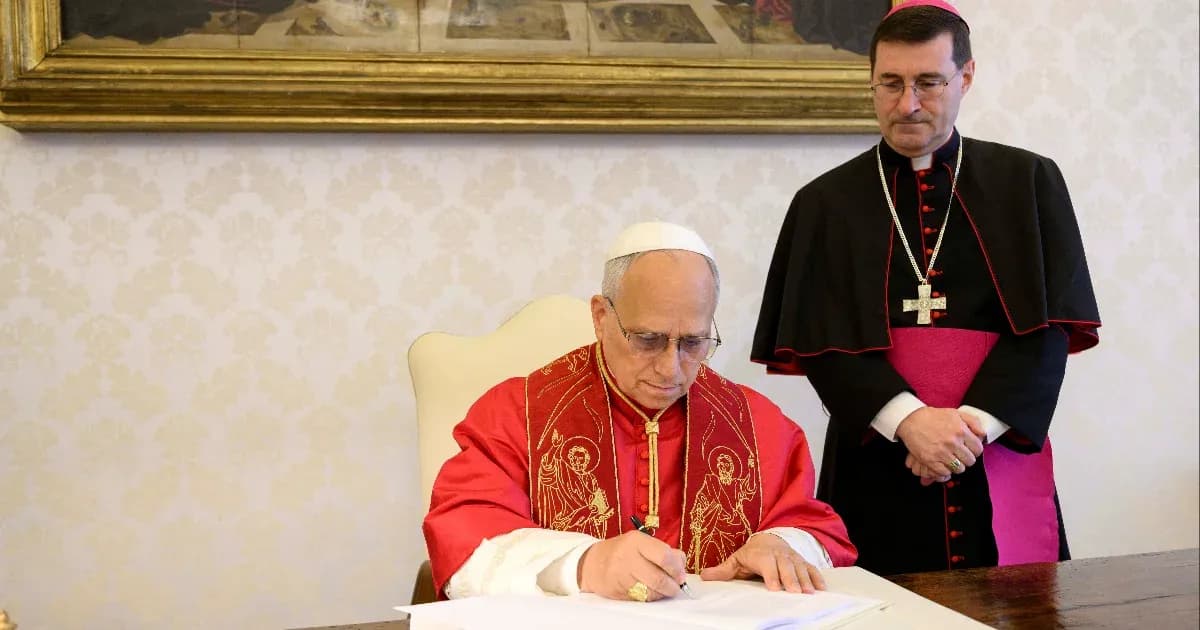
Pope Francis published his first encyclical, Magnifica Humanitas (wonderful humanity): On the protection of the human person in the age of artificial intelligence, on Pentecost Monday. The document was signed by the pope on May 15, coinciding with the 135th anniversary of Pope Leo XIII’s encyclical Rerum novarum on the condition of workers.
Scope and main message
The encyclical examines how artificial intelligence (AI) affects current crises and the identity of humanity. Francis warns that control over AI cannot remain concentrated in the hands of a narrow elite; if mismanaged, the technology risks building an "new Tower of Babel." He contrasts that outcome with the alternative of constructing a shared civic order "where God and humanity dwell together."
Specific proposals and ethical principles
The long document sets out several concrete recommendations:
- The use of AI in warfare should be subject to strict ethical limits and tight regulation. The pope insists that armed force may be used only for defensive purposes.
- Technological development must protect people’s jobs; Francis is not opposed to progress per se but urges slowing the deployment of AI.
- It is insufficient to appeal to abstract ethics alone: the encyclical calls for solid legal frameworks, independent oversight, informed users, and political systems that do not evade responsibility.
As Francis writes: "It is not enough to refer to ethics in an abstract way. We need robust legal frameworks, independent oversight, informed users and a political system that does not exempt itself from responsibility. Otherwise change will be directed solely by technocratic thinking."
War, disinformation and communicative risks
The pope addresses contemporary wars and argues that traditional Christian formulations such as the just war doctrine may no longer be fully applicable in the present context. He recalls Pope Paul VI’s words spoken before the United Nations in 1965: "No more war, no more war!" and reiterates that armed force should be used only in defense.
Francis also condemns disinformation, manipulation and divisive communication as extremely harmful. He warns that "communication networks, a fragmented information environment and algorithms that favour conflict can amplify polarization and enmity, increase propaganda, and make collective decision-making more difficult." He adds that simplistic narratives, enemy-making and fear-mongering culturally prepare the ground for war, because when ethical protections and historical memory weaken, violence becomes easier to present as necessary or morally "clean."
Presentation at the Vatican
The document was presented on Monday morning at the Vatican, with Pope Francis in attendance. Alongside Catholic church representatives and theologians, Christopher Olah, co-founder of the American AI company Anthropic (developer of the Claude AI models), also spoke at the event.
Why this matters
As the Catholic Church’s first substantial encyclical focused explicitly on AI, Magnifica Humanitas signals a call for global dialogue on shared regulation, legal safeguards and social responsibility. Pope Francis’s message stresses that technology will serve humanity only if it is governed by ethical commitments and not left solely to technocratic logic.